WordPress.com Free Hosting: A Documented Warning for New Site Creators

Cet article en français

WordPress.com free hosting is widely used by new site creators as an accessible way to publish content without upfront cost. Presented as a stable and reliable solution, it is often chosen for projects intended to grow over time. What is less clearly visible is that the effective publishing conditions of free WordPress.com sites, particularly regarding advertising, can evolve after long-term dependence has been established.

This article documents a concrete, measured case illustrating this structural risk.


Critical Tip – Protect Your WordPress Content

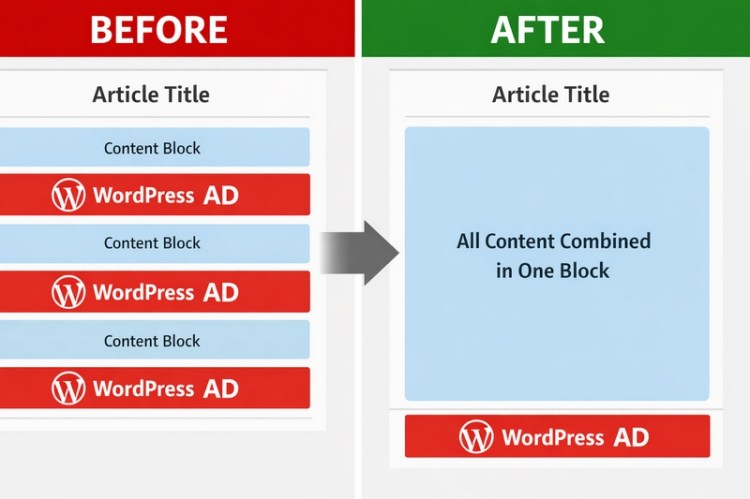
Group all content blocks in every article before publishing your first post.

  • This ensures the only embedded advertisement appears at the end, leaving your text intact.
  • Do it immediately, before you accumulate dozens or hundreds of articles — once content is scattered, a massive ad insertion can permanently fragment your site.
  • Early structure = long-term protection. Don’t wait, act from the very first post.

1. Purpose and scope of this article

WordPress.com free hosting is commonly promoted as an entry point offering simplicity, minimal configuration, and access to a well-established publishing platform. For many new site creators, it appears to provide a stable environment suitable for long-term content publishing.

What is far less apparent is that the effective operating conditions of free WordPress.com sites — especially the way advertising is inserted within editorial content — can change over time, without any modification of the hosting plan and without any breach of platform rules. Such changes may occur after years of accumulated content, internal linking, and readership, when migration to another platform becomes technically and economically difficult.

This article documents a concrete case involving a long-running WordPress.com free site whose editorial environment was progressively and severely altered by in-article advertising, despite full compliance with platform policies. The observations presented are not speculative: they are measurable, reproducible, and directly compared with other free WordPress.com sites.

The purpose is not to dispute the presence of advertising on free hosting, but to examine how advertising is applied in practice, how significant disparities can appear between comparable free sites, and what these disparities imply for creators evaluating WordPress.com free hosting as a long-term publishing solution.

All findings are based on a documented comparative advertising audit, supported by written alerts and detailed reports formally submitted to WordPress.com. The facts are verifiable, reproducible, and remain, at the time of publication, substantively unaddressed.

2. Early warnings and formal submissions to WordPress.com

A first alert was sent to WordPress.com on January 28, 2026, in both French and English, reporting a sudden increase in advertising density within editorial content.

In view of the consistency and generic nature of the initial responses, a detailed, evidence-based report was subsequently submitted:

  • in French on January 30, 2026,
  • in English on January 31, 2026.

Both the initial alert letter and the detailed report are available as attachments, together with the full set of factual materials produced by the advertising audit described below.

3. A long-established WordPress.com free site, suddenly destabilized

The website bernardgrua.net has been hosted on WordPress.com for over eleven years.
It contains more than 530 interlinked articles, published in multiple languages, forming a structured and cumulative editorial corpus.

For most of its existence, advertising on the site remained limited and did not interfere with reading continuity or editorial intent. The presence of ads was consistent with what WordPress.com typically presents as the trade-off for free hosting.

This equilibrium was disrupted abruptly.
 Without any change of plan, settings, or content policy, the site became subject to dense, intrusive in-article advertising, fragmenting articles and repeatedly interrupting reading flow.

Given the scale and suddenness of the change, a comparative audit was conducted and formally transmitted to WordPress.com support.

4. Methodology of the comparative advertising audit on WordPress.com free sites

On January 29, 2026, three strictly identical articles — published in English, French, and Russian — were examined in parallel:

To ensure neutrality and reproducibility, all observations were conducted under identical conditions:

  • incognito browser mode,
  • no logged-in WordPress sessions,
  • synchronized scroll positions,
  • systematic documentation via screenshots (PNG) and PDF exports.

5. Advertising audit findings on WordPress.com free hosting

5.1 Advertising presence on comparable WordPress.com free sites

The results were unambiguous:

  • On the test site: no visible or intrusive advertising within articles.
  • On bernardgrua.net: systematic advertising saturation inside editorial content.

The difference was not occasional or marginal; it was structural and consistent across languages.

5.2 Quantified impact of advertising on editorial content

For the same Russian-language article:

  • the version without advertising produced a PDF of 18 pages,
  • the version with advertising produced a PDF of 33 pages.

This represents an 88 % increase in length, attributable solely to advertising insertion.

These results are stable, reproducible, and fully documented.

6. WordPress.com’s official response to the advertising audit

On February 1, 2026, WordPress.com support responded with a standard explanation stating that:

  • advertising applies to all free sites,
  • ad display is dynamic and varies normally,
  • no site receives targeted treatment,
  • upgrading to a paid plan is the only available solution.

While the response was courteous, it did not address the documented discrepancies.

7. Where WordPress.com’s explanation fails to address the documented facts

7.1 “Advertising applies to all free sites”: a factual inconsistency

This assertion does not explain why two free sites on the same platform, observed under identical conditions, exhibit radically different advertising behavior.

In practice:

  • advertising is effectively absent on the newly created test site,
  • and structurally intrusive on the long-established site.

The discrepancy is factual and remains unexplained.

7.2 “Advertising is dynamic and variable”: limits of this explanation

Normal variation cannot account for persistent, systematic differences observed across all tested articles and languages.

What is documented is not fluctuation, but structural divergence.

7.3 “There is no targeted treatment”: observable differential outcomes

No intent is alleged.
However, differential treatment is objectively observable, and it correlates with site seniority and accumulated editorial value.

This correlation alone raises a legitimate question that remains unanswered.

7.4 “There is no mechanism to adjust advertising”: what observation shows

This claim conflicts with observable behavior:

  • advertising density varies according to article structure,
  • ad placement shifts when content blocks are reorganized,
  • outcomes differ significantly between sites.

Uniformity is asserted; variability is documented.

7.5 “The only solution is to pay”: reframing rather than explanation

This reframes the issue as a pricing choice, while leaving a central question untouched:

Why were the effective operating conditions of a long-established site altered unilaterally after years of stability?

8. What remains unaddressed by WordPress.com

The response from WordPress.com does not address:

  • the number of ads per article,
  • the proportion of screen space occupied by advertising,
  • the documented comparison with a free test site,
  • the chronology of degradation,
  • the practical and economic constraints created by long-term platform lock-in.

9. Why this case matters to new site creators using free hosting

This situation illustrates a broader, structural risk inherent to free hosting models:

editorial conditions can evolve significantly over time, according to criteria that are neither transparent nor negotiable, once a publisher has become dependent on the platform.

For short-lived or experimental projects, this risk may appear acceptable.
For long-term publishing — journalism, research archives, advocacy work, multilingual documentation — it represents a serious vulnerability.

Creators considering WordPress.com free hosting for durable content would be well advised to evaluate alternative platforms and hosting models early, before dependence becomes irreversible.

Key takeaways for new site creators

  • Free hosting conditions are not static.
    On WordPress.com, advertising practices on free sites can evolve over time, even without any change of plan or violation of platform rules.
  • Comparable free sites may not be treated identically.
    Documented evidence shows significant differences in advertising density between free WordPress.com sites under identical observation conditions.
  • Long-term dependence increases exposure.
    After years of content accumulation, internal linking, and readership growth, migrating away from a platform can become technically and economically difficult.
  • Advertising impact is measurable.
    In this case, in-article advertising increased content length by nearly 90 %, fragmenting editorial structure and degrading readability.
  • Upgrading is not an explanation.
    Being offered a paid plan does not answer why effective publishing conditions changed unilaterally after long-term stability.
  • Early evaluation matters.
    Creators planning long-term publishing projects should assess alternative hosting models early, before platform dependence becomes irreversible.

10. Conclusion: a documented risk for long-term WordPress.com free hosting

The issue documented here is neither ideological nor speculative.
It is factual, measured, and unresolved.

As of today, a long-established WordPress.com free site is subject to advertising conditions that are objectively different, substantially more intrusive, and editorially destructive than those applied to other free sites on the same platform.

This article is published in the interest of transparency and to inform current and future site creators of a risk that is rarely made explicit.


Online available attachments:

WordPress response as of February 1, 2026

Lexi (Automattic)
Feb 1, 2026, 19:33 UTC

Hi Bernard,

Thank you for your continued feedback and for sharing your detailed observations.

I understand this isn’t the answer you’re hoping for, but I want to be clear and direct with you: the only way to remove advertising from a free WordPress.com site is to upgrade to a paid plan.

WordPress.com offers free hosting, and this is made possible through the display of advertisements. This applies to all free sites on our platform. We don’t have a mechanism to reduce or customize the level of advertising on individual free sites, regardless of how long the site has been active or how much content it contains.

Ad serving is dynamic and can vary based on many factors — including visitor location, traffic patterns, advertiser demand, and more. These variations are normal and not indicative of any targeted approach toward specific users or sites.

If you’d like to remove ads entirely, our Personal plan (or higher) includes ad-free hosting. You can view the available options here: https://wordpress.com/pricing/

I truly appreciate your 11 years with WordPress.com and the effort you’ve put into your site. However, I’m not able to offer an alternative solution beyond what I’ve outlined above.

If you have any other questions about our plans or features, I’m happy to help.

Best,
Lexi

Happiness Engineer at WordPress.com
Need a website fast? Let us build it for you in four business days or less.

WordPress response as of February 2, 2026

Lexi (Automattic)

Feb 2, 2026, 16:18 UTC,

Hi Bernard,

Thank you for your detailed documentation and for taking the time to share your concerns. I understand this is frustrating, and I want to be as clear as possible.

After careful review, I must confirm that the responses you’ve received from our team are accurate and final. There is no option to reduce or customize advertising on free WordPress.com sites, regardless of the site’s age or history.

Regarding your comparison between your established site and a newly created test site: advertisements are served dynamically based on factors like visitor location, traffic volume, and advertiser demand. A well-established site with consistent traffic will naturally attract more ad placements than a brand-new site with minimal visitors. This isn’t targeting—it’s simply how programmatic advertising works.

The advertising on free sites is what allows us to provide free hosting, themes, and support to millions of users. If an ad-free experience is important to you, the Personal plan at $4/month (or regional equivalent) removes all WordPress.com advertising from your site.

I recognize this isn’t the answer you were hoping for, but I want to be honest with you: continuing to escalate this request will not result in a different outcome. Our team has provided you with accurate information, and we’re unable to make exceptions to this policy.

If you have questions about other topics, we’re happy to help.

Best,
Lexi

Happiness Engineer at WordPress.com
Need a website fast? Let us build it for you in four business days or less.

Addendum – February 2026: clarification following WordPress.com’s latest response

Following the response, on February 2, stating that the matter was considered closed, WordPress.com subsequently provided an additional clarification after being informed of the public publication of this report.

In this later response, WordPress.com confirmed that advertising intensity on free sites varies according to traffic volume, audience engagement, and site maturity.

This clarification directly corroborates the core observation documented in this report: long-established, content-rich free sites are subject to substantially higher advertising density than newer or low-traffic sites.

While presented as a normal feature of programmatic advertising, this mechanism produces a clear structural effect: as a free site becomes editorially successful, advertising pressure increases to a point that significantly degrades readability and user experience.

At that stage, the only solution offered by WordPress.com remains an upgrade to a paid plan.

Lexi (Automattic)
Feb 3, 2026, 20:33 UTC
Hi Bernard,
Thank you for taking the time to share your observations and feedback with us — we genuinely appreciate it.
After reviewing this with our team, I can confirm that the advertising system is working as expected. The variation you’re seeing between your established site and a newer test site is a normal part of how programmatic advertising works — advertisers bid more actively on sites with consistent traffic and engaged readership, which your 12-year-old site has built up over time.
That said, we’re always looking for ways to improve the experience for our users. If you have any suggestions on how we could make ads more meaningful or less intrusive from your perspective, we’d love to hear them. Your feedback as a long-time user is valuable, and we’re happy to pass along any ideas to the relevant teams for consideration.
Please let us know if there’s anything else we can help with.
Best,
Lexi
Happiness Engineer at WordPress.com
Need a website fast? Let us build it for you in four business days or less.


Signalement documenté d’une dégradation substantielle des conditions d’affichage publicitaire affectant le site bernardgrua.net

Depuis douze ans, mon site bernardgrua.net est hébergé sur WordPress. Récemment, la politique publicitaire appliquée sur ce site a considérablement changé, entraînant une saturation massive des articles et une dégradation significative de l’expérience de lecture. Ce document présente un signalement détaillé et documenté de l’impact des publicités sur bernardgrua.net, en comparant la situation actuelle avec un site test récent, afin d’illustrer l’effet concret de la politique publicitaire de WordPress sur la lisibilité, la valeur éditoriale et l’intégrité économique du contenu.

English version of the letter


Ce courrier est disponible en PDF

De :
Bernard Grua
bernardgrua.net
bernardg***@ya***fr
bernardgru***@***il.com
+33 753 *** 344

À l’attention de  :
WordPress Customer Service
support@wordpress.com
help@wordpress.com
hello@wordpress.com

Objet : Signalement documenté d’une dégradation substantielle des conditions d’affichage publicitaire affectant le site bernardgrua.net

Le 30 janvier 2026,

Chère Madame, Cher Monsieur,

Je vous contacte au sujet de la politique publicitaire actuellement appliquée à mon site bernardgrua.net, hébergé sur WordPress depuis douze ans. Lorsque j’ai choisi de développer ce site, le niveau de publicité était limité et n’affectait pas la lisibilité des contenus. Je n’ai jamais été averti qu’une telle situation de publicité massive et ciblée pourrait survenir après plusieurs années de publication et d’investissement éditorial.

À la suite de mon courrier du 28 janvier 2026, et au cours des échanges avec votre helpdesk, notamment via le ticket #10786145, je vous ai adressé des questions précises concernant le nombre et le type d’insertions publicitaires ainsi que leur impact sur mes articles. Ces questions sont restées sans réponse claire, ce qui rend la situation d’autant plus problématique.


1. Contexte important

Lorsque j’ai décidé de créer mon blog sur WordPress, d’y rédiger des articles et de travailler le référencement, rien, dans votre communication ni dans l’expérience de publication, ne permettait de prévoir qu’une telle situation de pression publicitaire ciblée pourrait survenir. Je n’avais aucune information sur le fait que, dans le futur, mon investissement éditorial et SEO massif pourrait me rendre vulnérable à une situation similaire à un chantage économique déguisé, contraignant l’auteur à souscrire à un abonnement payant pour retrouver des conditions normales de lecture.

Aujourd’hui, la migration vers un autre site ou une autre plateforme est pratiquement impossible sans perdre des années de travail, de référencement et d’interconnexions entre articles.

2. Méthodologie de l’audit

Nous avons procédé à un audit technique de la dégradation des conditions d’affichage publicitaire appliquées au site bernardgrua.net et évalué la transparence, la méthode et les motifs potentiels de la politique publicitaire de WordPress

Les articles ont été consultés en mode incognito, avec date, heure et URL visibles, afin de reproduire l’expérience d’un utilisateur normal, non connecté et sans historique. Trois articles identiques ont été sélectionnés pour comparaison : un en français, un en anglais, un en russe. Les mêmes articles ont été publiés sur un site test WordPress gratuit récent (wp-ad-test, 14 articles publiés) et sur bernardgrua.net, hébergé depuis douze ans sur WordPress.com et comptant 538 articles interconnectés :

Chaque article a été capturé quatre fois par scroll, puis des versions PDF et PNG ont été générées pour archivage. Cette méthode permet de comparer de manière objective l’impact de la publicité sur la lisibilité et l’expérience de lecture.

2.1. Galeries des impressions écrans

2.2. Impressions PDF des articles

2.3. Galeries des impressions PNG d’articles

3. Constats principaux

3.1. Audit comparatif de l’impact publicitaire pour les trois articles 

Les résultats des comparaisons, documentées par les captures d’écran, sont disponibles dans les annexes PDF : 

3.2. Absence de publicité sur le site test

  • Les trois articles sur le site test WordPress récent apparaissent sans aucune publicité visible ni intrusive, sur l’ensemble de la longueur de l’article. Il en est de même pour tous les onze autres articles du nouveau site.
  • Aucun bandeau ni insertion graphique ne vient masquer le texte.

3.3. Saturation publicitaire sur bernardgrua.net

  • Une partie significative des articles est occupée par les publicités. A titre d’exemple, sur le même article russe, la publication sur bernardgrua.net occupe 18 pages PDF sans publicité et 33 pages avec publicité, soit +88 % d’espace parasité par les annonces.
  • Certaines publicités sont au format vertical A4 et s’étendent sur plusieurs écrans, rendant l’article totalement déstructuré.
  • Les bandeaux recouvrent jusqu’à la moitié de l’écran et doivent être fermés pour accéder à l’article, mais cela ne supprime pas les publicités incrustées dans le corps du texte.

3.4. Impact sur l’expérience utilisateur

  • La lecture est rompue, difficile, voire impossible sans action répétée pour fermer les bandeaux.
  • Le contenu éditorial est dévasté par la publicité, ce qui crée un rejet immédiat des lecteurs et entraîne une perte de fréquentation.
  • La saturation publicitaire compromet la continuité de lecture et altère la valeur éditoriale et économique du site.
  • Cet envahissement publicitaire provoque un effondrement de l’audience du site bernardgrua.net. Il est donc difficile de comprendre comment un tel niveau de saturation publicitaire pourrait contribuer à maximiser les revenus publicitaires de WordPress. Il semble donc que l’explication doit être recherchée ailleurs 

3.5. Comparaison objective

  • Même plan gratuit, même plateforme, mêmes articles → traitement radicalement différent.
  • La publicité n’est donc pas inhérente au plan gratuit, mais appliquée de manière ciblée selon la valeur et l’ancienneté du site.

Cette modulation unilatérale crée une situation où l’éditeur est contraint de souscrire un abonnement payant pour retrouver un accès normal à son contenu, alors que le même contenu sur un site nouveau ou peu développé n’est pas soumis à cette pression.

4. Bilan factuel

Ces observations montrent que la politique publicitaire appliquée à bernardgrua.net n’est ni neutre ni uniforme. Elle modifie substantiellement l’expérience de lecture et le rendu des articles, tout en créant une dépendance économique contrainte, puisque le site ne peut plus diffuser ses contenus normalement sans souscrire à un abonnement payant.

La décision initiale de s’engager sur WordPress a été prise sur la base d’un niveau de publicité donné, stable pendant des années, puis modifié unilatéralement une fois que le coût de sortie est devenu prohibitif.

La publicité massive et intrusive actuellement appliquée à mon site n’a, semble-t-il, pas pour objectif d’améliorer les revenus publicitaires de WordPress, mais de contraindre le créateur de contenu à souscrire un abonnement payant. Cette évolution est intervenue après plusieurs années de publications normales et d’exploitations éditoriales, ce qui constitue un changement unilatéral des conditions, un mécanisme conduisant de fait à une captation unilatérale de la valeur produite.

En résumé, on constate donc :

  • une rupture d’égalité de traitement
  • une incitation économique ciblée
  • une modification non explicite des conditions réelles d’exploitation

5. Appel à l’action précis

Ma demande reste factuelle : réduction effective de la pression publicitaire, afin de préserver l’intégrité du contenu et l’expérience des lecteurs, sans passer par un paiement obligatoire. Je vous demande de fournir une réponse claire et circonstanciée, incluant :

5.1. Le nombre exact d’insertions publicitaires prévu par article, leur type et leur emplacement,

5.2. Les mesures concrètes envisagées pour réduire la pression publicitaire et rétablir une expérience de lecture normale,

5.3. Les délais précis pour la mise en œuvre de ces mesures.

Cette demande vise à établir un cadre transparent et mesurable pour la diffusion de mes contenus et la préservation de leur intégrité éditoriale et économique.

Conclusion

À défaut de réponse détaillée et de mesures correctrices effectives dans un délai raisonnable, je me verrai contraint de prendre toutes mesures nécessaires pour protéger mes contenus, leur référencement et la relation de confiance avec mes lecteurs. Je cesserai donc de recommander WordPress comme je l’ai fait jusqu’à présent. Le cas échéant, j’expliquerai de manière factuelle la situation dans laquelle se trouve aujourd’hui mon site.

Conformément à une démarche de transparence, ce courrier est publié sur mon site WordPress ainsi que sur d’autres plateformes, accompagné des preuves documentées (PDF et PNG) figurant dans les pièces jointes.

Veuillez agréer, Chère Madame, Cher Monsieur, l’expression de mes salutations distinguées.

Bernard Grua
bernardg***@***oo.fr
bernardgru***@***il.com
+33 753 *** 344


English version of the letter

For twelve years, my website bernardgrua.net has been hosted on WordPress. Recently, the advertising policy applied to this site has changed considerably, leading to massive saturation of articles and a significant deterioration in the reading experience. This document presents a detailed and documented report on the impact of advertising on bernardgrua.net, comparing the current situation with a recent test site, in order to illustrate the concrete effect of WordPress’s advertising policy on the readability, editorial value, and economic integrity of the content.

From:
Bernard Grua
bernardgrua.net
bernardg***@***oo.fr
bernardgru***@***il.com
+33 7 53 ** *3 44

To the attention of:
WordPress Customer Service
support@wordpress.com
help@wordpress.com
hello@wordpress.com

Case: #10786145, [YR6DPX-92NXK] 

Subject : Documented report of a substantial degradation in advertising display conditions affecting the site bernardgrua.net

January 31, 2026

Dear Madam, Dear Sir,

I am writing to you regarding the advertising policy currently applied to my website bernardgrua.net, hosted on WordPress for the past twelve years. When I chose to develop this site, the level of advertising was limited and did not affect the readability of the content. I was never informed that such a situation of massive and targeted advertising pressure could occur after several years of publication and editorial investment.

Following my letter of January 28, 2026, and during exchanges with your helpdesk, notably via ticket #10786145, I submitted specific questions concerning the number and type of advertising insertions as well as their impact on my articles. These questions have remained without a clear answer, which makes the situation all the more problematic.

1. Key context
2. Audit methodology
  2.1. Screenshot galleries
  2.2. PDF exports of the articles
  2.3. PNG article export galleries
3. Main findings
  3.1. Comparative audit of advertising impact on three articles
  3.2. Absence of advertising on the test site
  3.3. Advertising saturation on bernardgrua.net
  3.4. Impact on user experience
  3.5. Objective comparison
4. Factual assessment
5. Specific call to action
Conclusion

1. Key context

When I decided to create my blog on WordPress, to write articles and to work on search engine optimisation, nothing in your communication nor in the publishing experience made it possible to anticipate such a situation of targeted advertising pressure. I had no information indicating that, in the future, my extensive editorial and SEO investment could make me vulnerable to a situation akin to disguised economic coercion, forcing the author to subscribe to a paid plan in order to restore normal reading conditions.

Today, migrating to another site or platform is practically impossible without losing years of work, search engine positioning, and internal interlinking between articles.

2. Audit methodology

We conducted a technical audit of the degradation of advertising display conditions applied to the site bernardgrua.net and assessed the transparency, methods, and potential motives of WordPress’s advertising policy.

The articles were viewed in incognito mode, with date, time, and URL visible, in order to reproduce the experience of a normal user, not logged in and without browsing history. Three identical articles were selected for comparison: one in French, one in English, and one in Russian. The same articles were published on a recently created free WordPress test site (wp-ad-test, 14 published articles) and on bernardgrua.net, hosted on WordPress.com for twelve years and containing 538 interlinked articles:

Each article was captured four times at different scroll positions, and PDF and PNG versions were generated for archiving purposes. This methodology allows for an objective comparison of the impact of advertising on readability and reading experience.

2.1. Screenshot galleries

2.2. PDF exports of the articles

2.3. PNG article export galleries

3. Main findings

3.1. Comparative audit of advertising impact on three articles

The results of the comparisons, documented by screenshots, are available in the PDF appendices:

  • Appendix 1 – English article – Documented comparison of advertising display and its editorial and economic impact on bernardgrua.net
  • Appendix 2 – French article – Documented comparison of advertising display and its editorial and economic impact on bernardgrua.net
  • Appendix 3 – Russian article – Documented comparison of advertising display and its editorial and economic impact on bernardgrua.net

3.2. Absence of advertising on the test site

  • The three articles on the recently created free WordPress test site display no visible or intrusive advertising throughout the entire length of the articles. The same applies to the eleven other articles published on the test site.
  • No banner or graphic insertion obscures the text.

3.3. Advertising saturation on bernardgrua.net

  • A significant portion of the articles is occupied by advertising. By way of example, for the same Russian-language article, the publication on bernardgrua.net occupies 18 PDF pages without advertising and 33 pages with advertising, representing +88% of space polluted by ads.
  • Some advertisements are in vertical A4 format and extend over several screens, rendering the article completely fragmented.
  • Banners cover up to half of the screen and must be closed to access the article, without removing the advertisements embedded within the body of the text.

3.4. Impact on user experience

  • Reading is interrupted, difficult and impossible without repeated actions to close advertising banners.
  • Editorial content is severely degraded by advertising, leading to immediate reader rejection and a loss of traffic.
  • Advertising saturation compromises reading continuity and alters the editorial and economic value of the site.
  • This advertising overload has led to a collapse in audience for bernardgrua.net. It is therefore difficult to understand how such a level of saturation could contribute to maximising WordPress’s advertising revenue. The explanation therefore appears to lie elsewhere.

3.5. Objective comparison

  • Same free plan, same platform, same articles → radically different treatment.
  • Advertising is therefore not inherent to the free plan, but applied in a targeted manner according to the value and seniority of the site.

This unilateral modulation creates a situation in which the publisher is compelled to subscribe to a paid plan in order to regain normal access to their content, while the same content on a new or lightly developed site is not subject to this pressure.

4. Factual assessment

These observations demonstrate that the advertising policy applied to bernardgrua.net is neither neutral nor uniform. It substantially alters the reading experience and article rendering, while creating a form of constrained economic dependency, as the site can no longer disseminate its content under normal conditions without subscribing to a paid plan.

The initial decision to commit to WordPress was made on the basis of a given level of advertising, stable for many years, then unilaterally modified once the cost of exit became prohibitive.

The massive and intrusive advertising currently applied to my site does not appear to aim at increasing WordPress’s advertising revenue, but rather at compelling the content creator to subscribe to a paid plan. This evolution occurred after several years of normal publication and editorial exploitation, constituting a unilateral change in conditions and a mechanism effectively leading to unilateral capture of the value produced.

In summary, this situation reveals:

  • a breach of equal treatment
  • targeted economic pressure
  • a non-explicit modification of the actual operating conditions

5. Specific call to action

My request remains factual: an effective reduction of advertising pressure, in order to preserve content integrity and reader experience, without mandatory payment.

I request a clear and detailed response, including:

  1. The exact number of advertising insertions planned per article, their type, and placement;
  2. The concrete measures envisaged to reduce advertising pressure and restore a normal reading experience;
  3. The precise timeline for the implementation of these measures.

This request aims to establish a transparent and measurable framework for the dissemination of my content and the preservation of its editorial and economic integrity.

Conclusion

In the absence of a detailed response and effective corrective measures within a reasonable timeframe, I will be compelled to take all necessary steps to protect my content, its search engine positioning, and the trust relationship with my readers. I will also cease recommending WordPress as I have done until now and, where appropriate, will explain in a factual manner the situation in which my web site currently finds itself.

In accordance with a transparency-based approach, this letter is published on my WordPress site as well as on other platforms, accompanied by the documented evidence (PDF and PNG) included in the attachments.

Yours faithfully,

Bernard Grua
bernardg***@***oo.fr
bernardgru****@***il.com
+33 7 53 ** *3 44


WordPress — Editorial and Economic Harm Resulting from the Advertising Policy Applied to bernardgrua.net

This letter was addressed to WordPress to report the editorial and economic harm resulting from the advertising saturation imposed on my site bernardgrua.net. It is published so that readers have access to the factual elements of this action.

Courrier en français

From:
Bernard Grua
bernardgrua.net

To:
WordPress Customer Service
support@wordpress.com
help@wordpress.com
hello@wordpress.com

Subject: WordPress — Editorial and Economic Harm Resulting from the Advertising Policy Applied to bernardgrua.net

January 28, 2026,

Dear Sir or Madam,

I am formally bringing to your attention the advertising policy currently applied by WordPress to my site bernardgrua.net, which has been hosted on your platform for more than twelve years.

The progressive but now massive increase in advertising insertions — particularly intrusive and repetitive visual formats — directly obscures editorial content, disrupts reading continuity, and severely impairs the user experience. This situation has resulted in a noticeable decline in traffic and explicit rejection by loyal readers.

Editorial and Economic Harm

Since 2014, I have published 536 articles and invested continuous work in editorial production, content structuring, and search engine optimization. This work has created stable and qualified traffic, now exploited by WordPress’ advertising system in conditions that undermine the purpose and readability of the content.

This results in a clear editorial and economic harm:

  • degradation of access to texts,
  • loss of readership,
  • weakening of search engine rankings in the medium term,
  • a manifest imbalance between the value created by the author and the conditions under which this value is now exploited.

This evolution, implemented without real consultation or effective control by the author, amounts to a unilateral capture of the value produced, to the detriment of the integrity of the content and its normal dissemination.

Request for Concrete Measures

I therefore request that WordPress indicate:

  • what concrete measures it intends to implement to reduce the advertising pressure applied to my site,
  • the timeline for these measures to be implemented,
  • and the methods WordPress intends to use to maintain a balance between advertising exploitation and respect for the editorial work hosted on its platform.

This action aims to stop ongoing harm and restore conditions compatible with normal reading and the maintenance of the search engine optimization built over the long term.

In the absence of a detailed response and effective corrective measures within a reasonable timeframe, I will be compelled to consider any appropriate action to protect the integrity of my content, its search engine ranking, and the trust relationship established with my readers.

Publication and Transparency

In accordance with a policy of editorial transparency, this letter is intended to be published on my WordPress site as well as on other publishing platforms (Medium, Blogger).
For reference:

I look forward to your detailed response.

Yours sincerely,

Bernard Grua

WordPress — Préjudice éditorial et économique lié à la politique publicitaire appliquée à bernardgrua.net

Ce courrier a été adressé à WordPress afin de signaler le préjudice éditorial et économique résultant de la saturation publicitaire imposée à mon site bernardgrua.net. Il est publié afin que les lecteurs disposent des éléments factuels de cette démarche.

Text in English

De:
Bernard Grua
bernardgrua.net

À l’attention de:
Service client WordPress
support@wordpress.com
help@wordpress.com
hello@wordpress.com

Objet : Préjudice éditorial et économique lié à la politique publicitaire appliquée à bernardgrua.net

Le 28 janvier 2026,

Chère Madame, Cher Monsieur,

Je vous saisis formellement au sujet de la politique publicitaire actuellement appliquée par WordPress à mon site bernardgrua.net, hébergé sur votre plateforme depuis douze ans.

L’augmentation progressive mais désormais massive des insertions publicitaires — en particulier les formats visuels intrusifs et répétitifs — a pour effet direct de masquer les contenus éditoriaux, de rompre la continuité de lecture et d’altérer gravement l’expérience des visiteurs. Cette situation entraîne une baisse constatée de fréquentation et un rejet explicite de la part de lecteurs fidèles.

Préjudice éditorial et économique

Depuis 2014, j’ai publié 536 articles et investi un travail constant de production éditoriale, de structuration des contenus et de référencement naturel. Ce travail a permis la constitution d’un trafic stable et qualifié, aujourd’hui exploité par le dispositif publicitaire de WordPress dans des conditions qui portent atteinte à la finalité même des contenus et à leur lisibilité.

Il en résulte un préjudice éditorial et économique caractérisé :

  • dégradation de l’accès aux textes,
  • perte de lectorat,
  • affaiblissement du référencement à moyen terme,
  • déséquilibre manifeste entre la valeur créée par l’éditeur et les conditions dans lesquelles cette valeur est désormais exploitée.

Cette évolution, intervenue sans réelle concertation ni possibilité effective de maîtrise pour l’auteur, s’apparente à une captation unilatérale de la valeur produite, au détriment de l’intégrité des contenus et de leur diffusion normale.

Demande de mesures concrètes

Je vous demande en conséquence de bien vouloir m’indiquer :

  • quelles mesures concrètes WordPress entend mettre en œuvre afin de réduire la pression publicitaire appliquée à mon site,
  • dans quels délais ces mesures pourraient être effectives,
  • et selon quelles modalités WordPress entend préserver l’équilibre entre exploitation publicitaire et respect du travail éditorial hébergé sur sa plateforme.

Cette démarche vise à faire cesser un préjudice en cours et à rétablir des conditions de diffusion compatibles avec une lecture normale et avec le maintien du référencement construit sur le long terme.

À défaut de réponse circonstanciée et de mesures correctrices effectives dans un délai raisonnable, je serai conduit à envisager toute démarche appropriée afin de préserver l’intégrité de mes contenus, leur référencement et la relation de confiance établie avec mes lecteurs.

Publication et transparence

Conformément à une démarche de transparence éditoriale, ce courrier est destiné à être publié sur mon site WordPress, ainsi que sur d’autres plateformes de publication (Medium, Blogger).

Pour information :

Dans l’attente de votre réponse circonstanciée,
Veuillez agréer l’expression de mes salutations distinguées,

Bernard Grua


Autopsy: an emblematic militant narrative of the Russian ship « Shtandart »

For more than three and a half years, the Russian ship Shtandart has been the subject of a French peculiarity that persists, while other European countries have resolved it in a matter of weeks. The case of ‘Caeso Fabius Gallus’ (sic), alias ‘Fabio Caeso Gallus’, is an example of discourse that has been repeated for several years, based on emotional narratives or biased interpretations, perpetuating a distorted view of this affair.

This article in French

Note: in addition to ‘Caeso Fabius Gallus’ alias ‘Fabio Caeso Gallus’, some readers have made repetitive comments repeating emotional language already widely used in the debate. The response below addresses these circulating assertions and is intended solely to clarify the facts, place the ‘Shtandart’ case in its institutional and documented context, and enlighten all readers.

Comment Received (January 22, 2026)

“Have you considered that this ‘relentlessness’ in trying to have the law recognized as unfair in this case might come from wanting to protect the ship and its crew, to safeguard this priceless heritage?
What other way does the ship have to exist and allow all lovers of tall ships to enjoy it?
It’s all well and good to make analytical fences and other ex-nihilo thought exercises, but a bit of empathy and practical sense would be welcome, rather than a torrent of bile. Or is blind hatred too much?”
— Caeso

Original comment available here.


M. “Caeso Fabius Gallus”,

1. Reminder of Previous Exchanges

I have responded to your three previous emails courteously, with argumentation and references:

Nothing in that correspondence explains the tone or accusations you express here. Nonetheless, I will once again attempt to clarify.

2. Absence of Factual Contradiction

If you carefully reread your January 22, 2026 comment, you will reach the same conclusion as any other reader. Your remarks contain no factual basis, no verification, and no precise references. You simply recycle an emotional narrative, part of recurring language elements, regularly used by Shtandart supporters as a diversion and victimization tactic.

3. Origin and Use of a Diversionary Narrative

Personal conflict, alleged hatred, lack of empathy — this rhetoric was launched on March 21, 2022, by Michel Balique4. Its circulation preceded by two and a half months the Shtandart’s installation in La Rochelle. It has been repeated for several years. It has been repeated indiscriminately here5, there6 and even there7, as a diversion. It is not possible to cite all instances of this. It has been reused indiscriminately, as a diversionary tactic. This dogma permeates the Shtandart team to such an extent that it led to false testimony8. by sailor Arthur Gazzarin in the newspaper Libération. It has also been the source for attempted strategic “SLAPP”-type lawsuits9.

This included judicial harassment by Thierry Clerc10, lawyer for Vladimir Martus. The professional ethics of the legal profession were thereby compromised. This inappropriate action led us to file a complaint with the Rouen Bar Association11 regarding the instrumentalization of justice.

In any case, this rhetoric now only deceives those who refuse to examine its factual basis. These factual elements were presented to you courteously, in detail, and with references in my three previous responses. I invite you to review them while trying to set aside any cognitive bias.

4. An Institutional Affair, Not Personal

Later than many others, you followed the same path with a copy-paste. Yet you do not address or refer to any substantive point developed in the article. These phrases are interchangeable and respond to nothing specific in the text. Moreover, they do not reflect the approach12 of the whistleblowing collective No Shtandart in Europe, as anyone can verify.

Our previous exchanges have evidently not allowed you to move beyond this narrative framework. You are personalizing an affair that is not personal, by repeating without caution what others have prepared and worn out.

5. A Documented French Singularity

If this were only about Vladimir Martus, there would be no “Shtandart affair.” In all other European countries, the law was applied quickly13. This summer, seven countries denied access to the Shtandartfourteen planned port calls were canceled. Elsewhere, the Russian ship’s case was resolved in less than fifteen days.

In France, the situation has lasted more than three and a half years. Such singularity cannot be explained by heritage, emotion, or culture, but by administrative dysfunctions, networks of influence, and documented exceptional treatments14.

6. Responsibilities and the Real Scope of the Shtandart Affair

Thus, unlike in other European countries, there is indeed a “Shtandart affair” in France. Neither Vladimir Martus nor our collective is the originator. It was constructed and maintained by actors operating at the heart of the state apparatus.

Patrice Bernier, director of the La Rochelle marina, recently confirmed in the newspaper Sud-Ouest15 that the Secretariat-General for the Sea remains involved in mechanisms allowing the circumvention of European sanctions by the Shtandart.

Vladimir Martus is just one Russian among millions. Like them, he acts according to his own interests and those of his country, in a framework of practices that do not comply with European rule-of-law standards. There is no reason to elevate him to bogeyman or martyr. Making him a focal point only prevents any analysis of the institutional responsibilities that made this situation possible.

Conclusion

Accusing without argument, without documentation, and without discussing the presented facts is not a contradiction; it is a posture. It contributes nothing to the debate.

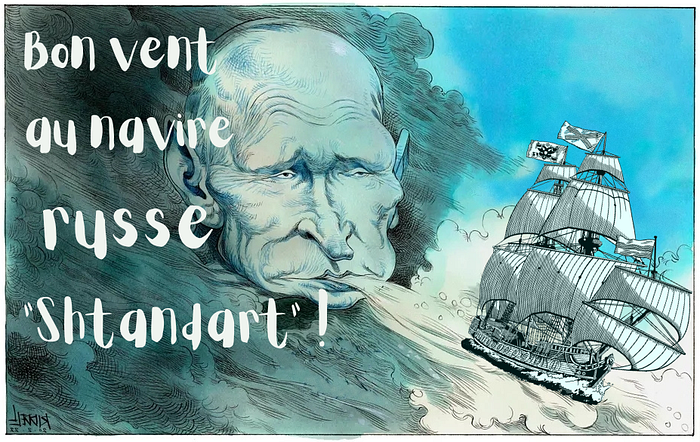
I wish fair winds to the Russian ship Shtandart.

Caeso Fabius Gallus alias Fabio Caeso Gallus, some readers have made repetitive comments repeating emotional language already widely used in the Shtandart debate.
Fair winds to the Russian ship Shtandart.

Appendix: links to documents referenced in order of appearance

  1. Response to a request for documentation and evidence concerning the link between Shtandart and Russia, 14/12/2025 (fr) ↩︎
  2. Firm stance, zero controversy: the No Shtandart in Europe collective responds a second time to the anonymous petitioner, 15/12/2025 (fr) ↩︎
  3. When the narrative cracks: response to a methodological critique, third letter from the collective to the anonymous petitioner, 21/12/2025 (fr) ↩︎
  4. Welcoming the Shtandart — Michel Balique — 21/03/2022 (fr) ↩︎
  5. Libération: In France, the Russian sailing ship that is homesick — 16/01/2023 (fr) ↩︎
  6. Benoît Marin-Curtoud, right of reply to his slander, refused by the tabloid Paris-Normandie (fr) ↩︎
  7. Fécamp Grand’Escale 2024, the hoax of Vladimir Martus and the Russian ship Shtandart on 76Actu (fr) ↩︎
  8. Camaret: false testimony in Libération by Arthur Gazzarin, sailor on the Shtandart, 18/01/2023 (fr) ↩︎
  9. Formal notice received from Clerc Avocats regarding the Russian ship Shtandart circumventing European sanctions — 31/10/2024 (en) ↩︎
  10. Shtandart: the strategy of judicial harassment orchestrated by Thierry Clerc and Russian Vladimir Martus against Bernard Grua, 5 August 2025 (en) ↩︎
  11. President of the Rouen Bar Association: Repeated and strategic judicial harassment by Thierry Clerc — No Shtandart in Europe case, 1 September 2025 (fr) ↩︎
  12. FAQ No Shtandart In Europe — The Shtandart and European Union sanctions (en) ↩︎
  13. Report — Russian ship ‘Shtandart’: exclusions and restrictions on port calls in Europe in 2025 (en) ↩︎
  14. The French authorities and the special privileges granted to the Russian ship ‘Shtandart’, 15/05/2025 (fr) ↩︎
  15. Sud-Ouest — ‘He threatened to give my address to mercenaries’: a former volunteer on the ‘Shtandart’ summoned to court, 07/01/2026 (fr) ↩︎


Note on the Russian vessel Shtandart – Application of EU sanctions and access to European ports (2022–2026)


Download this note in a PDF format

Purpose
This note provides a factual and legal overview of the situation of the Russian vessel Shtandart, MMSI 518999255, with regard to its access to French and European ports since the entry into force of EU port sanctions on 16 April 2022. It is intended as background information for internal or diplomatic use.

Scope
The document covers:

  • the vessel’s movements and port calls in European waters since 2022;
  • the conditions of its establishment in France and subsequent changes of flag;
  • the bans and restrictions imposed by several European states;
  • the vessel’s management, ownership structure and documented links to Russian state actors;
  • the specific French administrative context and possible diplomatic follow-up.

Legal basis
The analysis is based on EU restrictive measures, notably Regulation (EU) No 833/2014 and subsequent amendments, as well as relevant national administrative decisions and judicial rulings. Of particular importance is the decision of the Court of Justice of the European Union (CJEU) on 22 August 2025, which definitively rejected the Shtandart’s attempts to challenge the application of EU port sanctions or to advance a selective interpretation of the regulation. All references are listed in the annexes.

Status of the document
This note is a factual and non-exhaustive background document. All statements are supported by primary sources cited in the text and annexes.

Author
Collective No Shtandart in Europe

Date
23 January 2026


Executive Summary

This note provides a concise factual and legal overview of the Russian vessel Shtandart and its access to French territorial waters.

Access and ports: After EU port sanctions came into force on 16 April 2022, the Shtandart re-entered French waters in June 2022 and established La Rochelle as its base, despite its Russian registry. In June 2024, it changed to a Cook Islands flag of convenience.

Itineraries and restrictions (2022–2026): The vessel made numerous port calls, including unannounced stopovers, participated in paid maritime events, and repeatedly attempted to bypass restrictions. It has been formally banned from ports and territorial waters in Spain, Portugal, and other EU countries. A 2026 return to France raises enforcement concerns.

Management and Russian links: Vladimir Martus remains the de facto owner and captain, using corporate intermediaries and a flag of convenience. He has documented ties to Russian state authorities and media.

French administrative context: Port sanctions fall under the departmental prefect, and enforcement in France has been limited. Experience shows that explicit governmental or EU-level requests are decisive.

This summary is supported by detailed sources, regulations, and judicial decisions cited in the attached note.

Table of contents 


1. Russian vessel Shtandart‘s access to French territorial waters

The Shtandart, MMSI 518999255, was in Port-de-Bouc, France, when port sanctions came into force (Article 3ea of EU Regulation No 833/2014) on 16 April 2022. It remained there for about a month. From the Mediterranean Sea to the Atlantic Ocean, it stopped in Portugal and in Spain. It re-entered French territorial waters, in the Gulf of Biscay, on 6 June 2022. It was at this point that Ukrainian and pro-Ukrainian activists took up the case.

2. Port of entry and stay in France for the Shtandart

The Shtandart docked in La Rochelle on 8 June 2022, with the agreement of the prefecture, the municipality and the port authorities. It made La Rochelle its base port. It should be noted that its port of registry was Saint Petersburg until it was transferred to the Cook Islands flag of convenience on 6 June 2024. Its port of registry is now Avarua, which it never visited.

3. Ports of call, routes and bans (2022–2026) for the Shtandart 

3.1. Years 2022 and 2023

Since June 2022, the Shtandart has visited a significant number of French ports and participated in numerous maritime events where it was paid for its services. Its Automatic Identification System (AIS) was switched off between June 2022 and June 2024. It is therefore difficult to account for all of its voyages.

The Shtandart attempted to return to Spain in July 2022. Thanks to the Ukrainian association in Vigo, it was banned from participating in the Ruta Iacobus Maris festival in Vigo in July 2022 and from calling at La Coruña. It then returned to La Rochelle. In 2023, the Shtandart remained in French ports.

3.2. Year 2024

The Shtandart stayed in France, in the English Channel and Atlantic Ocean, until February 2024, before heading to Sète on the Mediterranean Sea. 

On its outward journey, it made an unannounced stopover in Almerimar (Andalusia, Spain). On its return, it was banned from participating in the Escala a Castelló festival (Spain) and from stopping in Denia (Spain) thanks to the local Ukrainian associations. Nevertheless, it made an unannounced stopover in Valencia and possibly a second stopover in Almerimar.

The Shtandart then returned to La Rochelle and continued to participate or attempt to participate in maritime events in France. 

In July 2024, the Shtandart travelled to the Iacobus Maris Experience in Vigo. However, it was formally banned from entering all Spanish ports (en) thanks to the action of the association of Ukrainians in Galicia. Furthermore, as a result of its infringements, the Shtandart was banned from Spanish territorial waters (es) from 27 July 2024. It then returned to La Rochelle.

3.3. Year 2025

In 2025, the Shtandart made numerous calls in La Rochelle. It made a stop in Les-Sables d’Olonne. It participated in the Gulf of Morbihan Week

In July 2025, the Shtandart set sail for a major European tour and to participate in the Tall Ships Races. It was banned from the seven countries where it wished to dock. It was not allowed to participate in the Tall Ships Races. It had to cancel its fourteen planned stopovers(en). It therefore cut short its cruise and returned to La Rochelle. 

In mid-September 2025, the Shtandart set sail for the Mediterranean Sea. It was banned from docking in Spain and Portugal, thanks to the Ukrainian World Congress and the union of Ukrainians in Portugal. It therefore docked in Tangier, Morocco, then Bizerte, Tunisia, before heading for Turkey. It took part in a film shoot there, and then picked up customers for cruises along the Anatolian coast.

All the details relating to the year 2025 are set out in the attached report: “Shtandart Vessel – Exclusions and Port Call Restrictions in Europe, 2025 (en)1 

3.4. Year 2026 

At the end of June 2026, the Shtandart plans to sail from La Rochelle to Saint-Malo with various stops in Brittany. This trip is being marketed by the Smolensk-based travel agency Kombat-Tours: “Kombat-Tours: 21–30 June 2026, aboard the frigate Shtandart, family cruise along the French coast” (ru)2

However, the Shtandart may return earlier to France. It will be in Bizerte on 28 April 2026.

This is why it is important to formally and effectively oppose its return to European and particularly French territorial waters.

4.1. Shtandart management 

Vladimir Martus is the captain of the Shtandart and a Russian citizen. He is also its de facto owner. 

In spring 2024, ownership of the ship was officially transferred from the Saint Petersburg-based company Shtandart Project to Mariia Martus. She is Mr Martus’s daughter. She holds a Finnish passport and may still hold a Russian one.

Martus TV GmbH is the managing owner (en) of the Shtandart. This commercial company is domiciled in a Hamburg mailbox. Vladimir Martus owns 80% of it and his wife, Irina Ermakova, owns the remaining 20%. In practice, this is a Russian company, and Vladimir Martus is the owner of the Shtandart.

The Shtandart‘s choice of the Cook Islands flag of convenienc was, as previously stated, a strategic move to conceal its Russian nationality.

These facts, along with the frequent disabling of the AIS, suggest patterns comparable to those observed within the Russian shadow fleet, as detailed in this article: “Why is the sanctioned ship ‘Shtandart’ part of the Russian shadow fleet?” (en)3

4.2. Vladimir Martus’s connections with the Russian regime.

This is an important and extensive topic. Here, it will be summarised in a few points.

Until 2009, the Shtandart was the emblematic ship of Saint Petersburg (fr) (ru). From that period onwards, Vladimir Martus established connections with key Russian authorities, the municipality, Valentina Matviyenko (governor) and possibly others. 

In 2009, the Shtandart sailed off the Russian coast due to violations of Russian security regulations. It probably remained abroad for business purposes, or possibly for additional reasons. Vladimir Martus claims he left Russia because he opposes the Russian regime. However, Russian evidence does not support this claim. See: “Shtandart”, 2009, Vladimir Martus’ refusal to comply with safety regulations falsely presented as political opposition to Putin’s regime.” (en)4 

The following offers an alternative point of view to that promoted by Vladimir Martus:

5. French administrative context and possible follow-up

According to European regulations and French legislation, the departmental prefect is responsible for port sanctions (fr).

The prefect for the Charente-Maritime department (including La Rochelle) is Brice Blondel, former head of staff to Emmanuel Macron. He shows some “understanding” for Vladimir Martus. Part of the French state apparatus thinks the same way, as evidenced by the internal documents collected here: “The French authorities and the special privileges granted to the Russian ship Shtandart (fr).

Brice Blondel will not change his policy unless he is compelled to do so by the French head of state in response to formal and explicit requests from the Ukrainian government and the European Commission. Even in this case, however, the Shtandart will continue to force access to ports by making unannounced port calls, using media pressure and humanitarian narratives. These are common practices for the Russian frigate according to numerous examples observed since 2022. The only solution for this Russian ship would be a ban on French territorial waters, as in Spain and Portugal. 

The Ukrainian representation in Paris has been fully aware of the situation since 2022, as presented in this information note: “The case of the Russian ship Shtandart and the role of the Ukrainian Embassy in France” (fr)7

This document also contains a complete list of EU regulations and judicial decisions. It clearly explains why and how the Shtandart is banned from European ports. This crucial information is additionally presented below in an exhibit in English and in Ukrainian.

Conclusion

The Shtandart case is an international issue that is being closely followed by Ukrainian citizens and Ukrainian public figures. It is also a topic covered by the Ukrainian media. It is a concern for the Ukrainian diaspora in Western European countries.

Until now, all of Shtandart‘s setbacks and the implementation of EU regulations or national laws have been the result of the determined actions of Ukrainian embassies and diaspora communities in numerous European countries. This is explained in detail in this memorandum: “Participation of Ukrainian actors and the Ukrainian diaspora in the case of the Russian ship ‘Shtandart’ (2022–2025)” (fr)8

The French exception raises serious questions. 
Experience since 2022 suggests that exchanges at local administrative or port level have not produced results. The embassy of Ukraine would find interest working with the Ukrainian MFA in order to prepare an official request demanding that the French government ban the Shtandart from its territorial waters.. 


DateAuthority Act / Decision Subject / Content Language
8 Apr 2022 European CouncilFifth Package of Restrictive MeasuresRestrictive measures, including port sanctions, introduced in response to the Bucha massacre EN
16 Apr 2022European CouncilArticle 3ea of Regulation (EU) No 833/2014Entry into force of EU port sanctions concerning vessels flying the Russian flagEN
24 Jun 2024European CouncilDecision (CFSP) No 2024/1744, Art. 4haExplicit confirmation that EU port sanctions also apply to replicas of historical vessels    EN
7 Jul 2024Prefect of FinistèreOrderProhibition of the Shtandart from accessing all ports of the departmentFR
11 Jul 2024Administrative Court of RennesRuling No 2403878Rejection of the Shtandart’s appeal against the Finistère Prefect’s orderFR
12 Jul 2024European CommissionLetter to No Shtandart in EuropeConfirmation of the application of EU port sanctions to the ShtandartEN
27 Jul 2024Maritime Administration (Spain)Administrative and police measures Evacuation and prohibition of the Shtandart in Spanish territorial watersES
18 Nov 2024 Conseil d’État (France)Ruling No 496439Rejection of the appeal against the Administrative Court decisionEN
7 Aug 2025European CommissionLetter to No Shtandart in EuropeConfirmation of the application of sanctions to the ShtandartFR
22 Aug 2025Court of Justice of the European Union (CJEU)Case T-446/24, ruling Confirmation of the application of port sanctions to the Shtandart as of 16 Apr 2022EN
24 Sep 2025Autoridade Marítima Nacional (Portugal)Administrative and police measuresDetention of five crew members and prohibition of the vessel in territorial watersPT

Додаток 2
Юридичні та адміністративні посилання («Штандарт»)

ДатаОрганАкт / РішенняПредмет / ЗмістМова
8 квітня 2022Європейська радаП’ятий пакет обмежувальних заходівОбмежувальні заходи, зокрема портові, що запроваджують санкції у відповідь на різанину в Бучі(англ.)
16 квітня 2022Європейська радаСтаття 3ea Регламенту (ЄС)  No 833/2014 Набуття чинності портовими санкціями ЄС щодо суден, що ходять під російським прапором(англ.)
24 червня 2024Європейська радаРішення (СПБО) № 2024/1744, стаття 4haЧітке підтвердження того, що портові санкції ЄС також застосовуються до реплік історичних суден(англ.)
7 липня 2024Префект ФіністеруРозпорядженняЗаборона доступу «Штандарта» до всіх портів департаменту(фр.)
11 липня 2024Адміністративний суд РеннаУхвала № 2403878Відхилення скарги «Штандарта» проти розпорядження Фіністеру(фр.)
12 липня 2024Європейська комісіяЛист до No Shtandart in EuropeПідтвердження застосування портових санкцій ЄС до судна(англ.)
27 липня 2024Управління торгового флотуАдміністративні та поліцейські заходиЕвакуація та заборона «Штандарта» у територіальних водах Іспанії(ісп.)
18 листопада 2024Державна радаПостанова
№ 496439
Відхилення апеляції на рішення адміністративного суду(укр.)
7 серпня 2025Європейська комісіяЛист до No Shtandart in EuropeПідтвердження застосування санкцій до «Штандарта»(фр.)
22 серпня 2025Суд Європейського СоюзуСправа T-446/24, ухвалаПідтвердження застосування портових санкцій до «Штандарта» з 16 квітня 2022 року(англ.)
24 вересня 2025Autoridade Marítima Nacional (Порт.)Адміністративні та поліцейські заходиЗатримання п’яти членів екіпажу та заборона судна у територіальних водах(порт.)
  1.  2025 report in Ukrainian and in French:
    Пан’європейський колектив викривачів Російське судно «Штандарт»: заборони та обмеження заходів у порти Європи у 2025 році
    Navire « Shtandart » : exclusions et restrictions d’escales en Europe en 2025 ↩︎
  2.  Kombat‑Tours cruise in French:
    Kombat‑Tours : 21–30 juin 2026, à bord de la frégate “Shtandart”, croisière familiale le long des côtes françaises ↩︎
  3. Shtandart and the Russian shadow fleet in French:
    Pourquoi le navire sous sanctions “Shtandart » fait-il partie de la flotte fantôme russe ? ↩︎
  4. Is Vladimir Martus an opponent (in French)?
    « Shtandart » 2009, le refus de respecter les règles de sécurité fallacieusement présenté, par Vladimir Martus, comme une opposition politique au régime de Poutine ↩︎
  5. The Greek diplomatic mission in Russian:
    Русское географическое общество – Эффект бабочки: почему появление российского парусного фрегата взбудоражило Грецию ↩︎
  6. Communique from the Consulate General of Russia in Russian:
    Консульство РФ назвало абсурдом запрет кораблю « Штандарт » зайти в порт Шотландии ↩︎
  7. Embassy information note in Ukrainian:
    Справа російського судна «Штандарт» та роль Посольства України у Франції ↩︎
  8. Memorandum about Ukraine and “Shtandart” in Ukrainian
    Меморандум про участь українських акторів та української діаспори у справі російського судна «Штандарта» (2022–2025) ↩︎

Autopsie: un narratif militant emblématique du navire russe «Shtandart»

Depuis plus de trois ans et demi, le navire russe Shtandart fait l’objet d’une singularité française qui perdure alors que d’autres pays européens l’ont résolue en quelques semaines. Le cas de « Caeso Fabius Gallus » (sic), alias « Fabio Caeso Gallus », est un exemple de discours répétés depuis plusieurs années, reposant sur des narratifs émotionnels ou des interprétations biaisées, entretenant une vision déformée de cette affaire.

This article in English

Note : outre « Caeso Fabius Gallus » alias « Fabio Caeso Gallus », certains lecteurs ont exprimé des remarques répétitives reprenant des éléments de langage émotifs déjà largement diffusés dans le débat. La réponse ci-dessous s’adresse à ces assertions circulantes et vise uniquement à clarifier les faits, replacer l’affaire « Shtandart » dans son contexte institutionnel et documenté, et éclairer tous les lecteurs.


Commentaire reçu (22 janvier 2026)

« Avez vous pensé que cet “acharnement” de faire reconnaître la loi comme injuste pour son cas, pourrait venir pour le navire et son équipage, de vouloir protéger ce patrimoine inestimable ?
Quel autre moyen a le navire d’exister et de faire profiter tous les amoureux des vieux gréements ?
C’est bien beau de faire des clôtures analytiques et autres exercices de pensée ex-nihilo mais un peu d’empathie et de sens pratique serait les bienvenues, plutôt qu’un torrent de fiel. Ou alors la haine aveugle elle trop »
— 
Caeso 

Commentaire original consultable ici.


M. “Caeso Fabius Gallus”

1. Rappel des échanges précédents

J’ai répondu à vos trois courriels précédents de manière courtoise, argumentée et sourcée :

Rien, dans cette correspondance, ne permet de comprendre le ton ni les accusations formulées ici. Néanmoins, je vais, une nouvelle fois, tenter de vous éclairer.

2. Absence de contradiction factuelle

Si vous relisez posément votre commentaire, vous ferez la même constatation que tout autre lecteur. Vos remarques ne reposent sur aucun élément factuel, aucune vérification, aucune référence précise. Vous vous contentez de reprendre un narratif émotionnel faisant partie des éléments de langage récurrents, régulièrement mobilisés par les soutiens du Shtandart à des fins de diversion et de victimisation.

3. Origine et usage d’un narratif de diversion

“Conflit personnel, haine supposée, absence d’empathie » — cette rhétorique a été lancée dès le 21 mars 2022 par Michel Balique4. Sa diffusion a précédé de deux mois et demi l’installation du Shtandart à La Rochelle. Elle a tourné en boucle pendant plusieurs années. Elle a été reprise indistinctement ici5, 6 ou encore là7, à titre de diversion. Il n’est pas possible d’en citer toutes les occurences. Cette doxa imprègne tellement l’équipe du Shtandart qu’elle a donné lieu au faux témoignage du matelot Arthur Gazzarin8 sur le journal Libération. Elle a, de plus, été à l’origine de tentatives de procédures bâillons9.

Cela s’est traduit par un harcèlement judiciaire mené par Thierry Clerc10, conseil de Vladimir Martus. Ce faisant, la déontologie de la profession d’avocat a été malmenée. Cette démarche inopportune a conduit à un recours, par nos soins, auprès du bâtonnier de Rouen mettant en cause une instrumentalisation de la justice11.

Quoi qu’il en soit, une telle rhétorique ne trompe plus que ceux qui refusent d’en examiner les ressorts factuels. Pourtant, ils vous ont été exposés de manière détaillée, sourcée et courtoise lors de mes trois précédentes réponses. Je vous invite à les réexaminer en tentant d’écarter tout biais cognitif.

4. Une affaire institutionnelle, non personnelle

Plus tardivement que bien d’autres, « Caeso Fabius Gallus » alias « Fabio Caeso Gallus », vous faites de même en procédant à un copier-coller. Mais vous ne répondez ni ne faites référence à aucun point de fond développé dans l’article. Ces phrases sont interchangeables et ne concernent aucun élément précis du texte. De plus, elles ne correspondent pas à la démarche12 du collectif lanceur d’alerte No Shtandart in Europe, comme chacun peut le vérifier.

Nos longs échanges précédents ne vous ont manifestement pas permis de dépasser ce cadre narratif. Vous personnalisez à tort une affaire qui ne l’est pas, en reprenant sans prudence ce qui a été préparé et usé par d’autres.

5. Une singularité française documentée

Car, s’il ne s’agissait que de Vladimir Martus, il n’y aurait pas d’« affaire Shtandart ». Dans tous les autres pays européens, l’application du droit a été rapide13. Cet été, sept pays ont refusé l’accès au Shtandart ; quatorze escales prévues ont été annulées. Partout ailleurs, le cas du navire russe a été traité en moins de quinze jours.

En France, la situation dure depuis plus de trois ans et demi. Une telle singularité ne s’explique ni par le patrimoine, ni par l’affect, ni par la culture, mais par des dysfonctionnements administratifs, l’existence de réseaux d’influence et des traitements dérogatoires documentés14.

6. Responsabilités et cadre réel de l’affaire Shtandart

Ainsi, à la différence des autres pays européens, il existe bien, en France, une « affaire Shtandart ». Ni Vladimir Martus, ni notre collectif n’en sont à l’origine. Elle a été construite et entretenue par des acteurs opérant au cœur de l’appareil d’État.

Patrice Bernier, directeur du port de plaisance de La Rochelle, a récemment confirmé dans le journal Sud-Ouest15 que le Secrétariat général de la mer demeure partie prenante de dispositifs permettant le contournement des sanctions européennes par le Shtandart.

Vladimir Martus n’est qu’un ressortissant russe parmi des millions d’autres. Comme eux, il agit en fonction de ses intérêts propres et de ceux de son pays, dans un cadre de pratiques qui ne relèvent pas des principes de l’État de droit européen. Il n’y a donc pas lieu de l’ériger en épouvantail ou un martyr. En faire un point de fixation permet surtout d’éviter toute analyse des responsabilités institutionnelles qui ont rendu cette situation possible.

Conclusion

Accuser sans argumenter, sans documenter et sans discuter les faits exposés n’est pas une contradiction : c’est une posture. Elle n’apporte rien au débat.

Bon vent au navire russe Shtandart !

Caeso Fabius Gallus, alias Fabio Caeso Gallus : bon vent au navire russe Shtandart !

Lien des documents mis en référence par ordre d’apparition

  1. Réponse à une demande de documentation et de preuves concernant le lien « Shtandart »-Russie, 14/12/2025 ↩︎
  2. Position ferme, zéro polémique : le collectif No Shtandart in Europe répond une deuxième fois au solliciteur anonyme, 15/12/2025 ↩︎
  3. Quand le narratif se fissure : réponse à une critique méthodologique, troisième courrier du collectif au solliciteur anonyme, 21/12/2025 ↩︎
  4. Accueillir le Shtandart — Michel Balique — 21/03/2022 ↩︎
  5. Libération : En France, le voilier russe qui a le mal d’amarres — 16/01/2023 ↩︎
  6. Benoît Marin-Curtoud, le droit de réponse à ses calomnies, refusé par le tabloïd « Paris-Normandie » ↩︎
  7. Fécamp Grand’Escale 2024, la mystification de Vladimir Martus et du navire russe Shtandart sur 76Actu ↩︎
  8. Camaret: le faux témoignage, sur « Libération », d’Arthur Gazzarin, matelot du « Shtandart », 18/01/2023 ↩︎
  9. Mise en demeure reçue de “Clerc Avocats” au sujet du navire russe Shtandart contournant les sanctions européennes — 31/10/2024 ↩︎
  10. « Shtandart » : la stratégie de harcèlement judiciaire orchestrée par Me Thierry Clerc et le Russe Vladimir Martus contre Bernard Grua, 05/08/2025 ↩︎
  11. Bâtonnier Rouen : Harcèlement judiciaire répété et stratégique par Maître Thierry Clerc — dossier « No Shtandart in Europe », 01/09/2025 ↩︎
  12. FAQ No Shtandart In Europe — Le Shtandart et les sanctions de l’Union européenne ↩︎
  13. Rapport — Navire russe « Shtandart » : exclusions et restrictions d’escales en Europe en 2025 ↩︎
  14. Les autorités françaises et les passe-droits du navire russe « Shtandart », 15/05/2025 ↩︎
  15. Sud-Ouest — « Il a menacé de donner mon adresse à des mercenaires » : un ancien bénévole du « Shtandart » convoqué devant la justice, 07/01/2026 ↩︎


Note d’information : Affaire du navire russe « Shtandart » et rôle de l’ambassade d’Ukraine en France

  Завантажити інформаційну записку у форматі PDF українською мовою
 France flag Télécharger la note d’information au format PDF en français

Nantes, le 19 janvier 2026

La présente note vise à exposer de manière circonstanciée l’évolution de l’affaire du navire russe Shtandart. 

Elle présente les démarches entreprises depuis 2022 par le collectif pan-européen No Shtandart in Europe, ainsi que l’absence persistante d’implication des services diplomatiques de l’Ukraine en France, en contraste avec l’action déterminée d’autres ambassades ukrainiennes en Europe. Elle intervient dans un contexte juridique désormais clarifié par les juridictions nationales françaises et par la Cour de justice de l’Union européenne.

Elle se fonde sur des éléments juridiques et administratifs, ainsi que sur des documents publics et vérifiables.

1. Interdictions du navire Shtandart en Europe (année 2025)

Au cours de l’année 2025, le collectif pan-européen No Shtandart in Europe a obtenu que le navire propagandiste russe Shtandart soit interdit, en application des sanctions de l’Union européenne ou de sanctions nationales, par sept États européens, qu’ils soient ou non membres de l’Union. Cette interdiction concerne l’Irlande, le Royaume-Uni, la Norvège, le Danemark, la Belgique, l’Espagne et le Portugal, soit l’ensemble des pays où le navire a tenté d’accoster l’an dernier, à l’exception de la France.

Le détail de ces décisions figure dans le rapport intitulé « Navire « Shtandart » : exclusions et restrictions d’escales en Europe en 2025 ». Dans tous les États précités, les procédures ont été closes en moins de quinze jours. En France, en revanche, cette affaire se prolonge depuis plus de trois ans et demi.

2. Soutiens ukrainiens et implication des ambassades en Europe

Depuis le début de cette fraude russe, le collectif a reçu le soutien de personnalités résidant en Ukraine ainsi que d’associations ukrainiennes issues de différentes diasporas. Le « Mémorandum sur la participation des acteurs ukrainiens et de la diaspora ukrainienne dans l’affaire du navire russe « Shtandart » (2022–2025) » en atteste.

Par ailleurs, un appui déterminé a été apporté par les ambassades d’Ukraine en Espagne, en Irlande et au Royaume-Uni. À cet égard, la lettre adressée par l’ambassade d’Ukraine en Irlande aux autorités portuaires de Dublin constitue un exemple particulièrement significatif d’intervention diplomatique effective.

3. Information et sollicitations adressées à l’ambassade d’Ukraine en France

Depuis juin 2022, l’ambassade d’Ukraine en France est régulièrement informée par le collectif No Shtandart in Europe des actes irréguliers liés au Shtandart. Elle a également été sollicitée de manière directe à plusieurs reprises. La liste des courriers transmis est explicite.

Aucune réponse n’a été reçue, à une seule exception près. En une occasion, un retour indirect a été obtenu : le conseiller politique de l’ambassade, par l’intermédiaire de M. Oleh Koval, a recommandé de ne pas s’opposer à la participation illégale du Shtandart au festival maritime Fécamp Grand’Escale, en mai 2024.

4. Échange public du 5 mars 2025 à Nantes

Le jeudi 5 mars 2025, dans une salle de l’hôtel de ville de Nantes, Monsieur l’Ambassadeur d’Ukraine en France a tenu une réunion devant une assistance d’environ 150 personnes. Celle-ci comprenait des élus ainsi que des représentants d’associations de Bretagne et des Pays de la Loire. Le fondateur et porte-parole du collectif No Shtandart in Europe a été interrogé publiquement sur le Shtandart.

À cette occasion, il a rappelé à Monsieur l’Ambassadeur que des démarches avaient été entreprises afin de mettre un terme au contournement des sanctions. Il a notamment exposé que des réponses avaient été obtenues de la Commission européenne, qu’une confirmation avait été apportée par le Conseil européen — c’est-à-dire par les 27 États membres de l’Union —, ainsi qu’une ordonnance du tribunal administratif de Rennes et un arrêt du Conseil d’État. L’ensemble de ces institutions a confirmé la légitimité de l’action engagée (Voir annexe 1).

Le porte-parole a souligné que, dans le contexte français, cette mobilisation ne pouvait pas aller plus loin sans un relais institutionnel approprié. 

5. Absence d’intervention et éléments contextuels

Pour expliquer l’absence d’intervention de ses services, le responsable de l’ambassade d’Ukraine a évoqué l’existence d’un « problème bureaucratique ». Le porte-parole du collectif a répondu que cette situation devait plutôt être analysée comme résultant de l’existence de réseaux d’influence russes opérant au sein de l’appareil d’État français. Des documents internes, dont le collectif a obtenu copie, attestent de l’existence de passe-droits confidentiels allant en ce sens.

Dans ce contexte, une implication des services diplomatiques de l’Ukraine en France apparaît nécessaire. Cette demande a été renouvelée par écrit le 13 mars 2025. Aucune réponse n’a, là encore, été reçue. À ce jour, mi-janvier 2026, aucune action n’a été engagée.

6. Contexte général et alerte antérieure

La France demeure un pays historiquement russophile et relativement peu sensibilisé aux mécanismes d’ingérence de Moscou. Cette réalité avait déjà été portée à l’attention de l’agence nationale d’information ukrainienne, Ukrinform, il y a plus de cinq ans.

« L’expert a également souligné les défis qui attendent le successeur d’Oleh Shamshur, Vadym Omelchenko. “Le poste d’ambassadeur à Paris n’a rien à voir avec le glamour, le prestige, les avantages ou l’insouciance que pourrait offrir la Ville Lumière. L’Ukraine a besoin d’un diplomate francophone de haut niveau, car les réseaux d’influence de Moscou restent anciens, puissants, complexes et opaques”, a fait remarquer M. Grua.»

Ukrinform, 16 juin 2020

7. Coopération antérieure du collectif avec l’ambassade d’Ukraine en France

La situation actuelle contraste avec celle observée en octobre et novembre 2023. À cette période, Monsieur l’Ambassadeur et ses collaborateurs avaient sollicité le concours du collectif No Shtandart in Europe. Ils lui demandaient de contribuer à la préparation d’un déplacement officiel à Nantes, notamment en ce qui concerne les contacts avec les associations, les autorités locales et la presse. Cette mission, assurée à titre bénévole, a été menée avec diligence et a donné lieu à des retours d’information transmis dans les meilleurs délais.

8. Clarification juridique par la CJUE et risques à venir

Le 22 août 2025, la Cour de justice de l’Union européenne (CJUE)s’est prononcée et a confirmé, une nouvelle fois, que les sanctions européennes s’appliquent bien au Shtandart depuis le 16 avril 2022. Après la décision de la CJUE, l’absence d’action ne peut plus être imputée à l’incertitude juridique, mais relève désormais d’une responsabilité politique.

Le navire, actuellement en Turquie, prévoit de revenir faire escale dans des ports français en juin 2026, comme l’indique une croisière commercialisée par la société Kombat-Tour de Smolensk. Il n’est toutefois pas exclu qu’il se présente plus tôt sur les côtes françaises, puisqu’il est annoncé à Bizerte, en Tunisie, le 28 avril 2026. Dans ces conditions, il apparaît urgent que l’ambassade d’Ukraine en France se saisisse de ce dossier afin d’y mettre un terme, à l’instar des ambassades d’Ukraine en Espagne, en Irlande et au Royaume-Uni. 

9. Conclusion

La « saga » du Shtandart constitue à la fois une faute de l’appareil d’État français, un élément préjudiciable à l’image des services diplomatiques de l’Ukraine en France et une remise en cause du régime des sanctions ainsi que des institutions européennes. Il apparaît désormais nécessaire d’y apporter une conclusion définitive.

Une intervention de l’ambassade d’Ukraine en France, en vue d’obtenir l’interdiction du navire russe dans les eaux territoriales françaises, y contribuerait de manière déterminante, à l’image de ce qui est déjà mis en application en Espagne et au Portugal.

Pour le collectif pan-européen
No Shtandart in Europe
Autres références et documents : voir annexes

Cette note peut être librement copiée ou partagée. Des demandes de précisions ou de rectification et des propositions d’ajout d’informations complémentaires peuvent être adressées par les contacts figurant ci-dessus.

Ce document est mis à disposition selon les termes de la licence Creative Commons Attribution 4.0 International (CC BY 4.0).


Annexe 1
Références juridiques et administratives (Shtandart)

DateAutoritéActe / DécisionObjet / ContenuLangue
8 avril 2022Conseil européenCinquième volet des mesures restrictivesMesures restrictives, y compris portuaires, sanctionnant le massacre de Boutchafr
16 avril 2022Conseil européenArticle 3 sexies bis du règlement (UE)
n° 833/2014
Entrée en vigueur des sanctions portuaires de l’UE concernant les navires battant pavillon russefr
24 juin 2024Conseil européenDécision (PESC)
n° 2024/1744, article 4 nonies bis
Confirmation explicite que les sanctions portuaires de l’UE s’appliquent également aux répliques de navires historiquesfr
7 juillet 2024Préfet du FinistèreArrêtéInterdiction de l’accès du Shtandart à tous les ports du départementfr
11 juillet 2024Tribunal administratif de RennesOrdonnance
n° 2403878
Rejet du recours du Shtandart contre l’arrêté du préfet du Finistèrefr
12 juillet 2024Commission européenneLettre à No Shtandart in EuropeConfirmation de l’application des sanctions portuaires de l’UE au navirefr
27 juillet 2024Direction de la marine marchande espagnoleMesure administrative et de policeÉvacuation et interdiction du Shtandart dans les eaux territoriales espagnoleses
18 novembre 2024Conseil d’ÉtatArrêt n° 496439Rejet du recours du Shtandart contre l’ordonnance du tribunal administratiffr
7 août 2025Commission européenneLettre à No Shtandart in EuropeConfirmation de l’application des sanctions au Shtandartfr
22 août 2025Cour de justice de l’Union européenneAffaire T-446/24, ordonnanceConfirmation de l’application des sanctions portuaires au Shtandart depuis le 16 avril 2022fr
24 septembre 2025Autoridade Marítima Nacional (Portugal)Interpellation et mesure administrativeInterpellation de cinq membres d’équipage et interdiction du navire Shtandart dans les eaux territorialespt

Annexe 2
Contexte relatif au porte-parole du collectif

Le porte-parole du collectif pan-européen No Shtandart in Europe a, depuis 2013, participé à diverses actions publiques en lien avec l’Ukraine et le contexte géopolitique régional. Ces éléments sont communiqués à titre strictement contextuel afin d’éviter toute interprétation erronée de la présente démarche.

  • Soutien formel reçu du Conseil municipal de Boutcha (Ukraine), 1er mai 2025. source
  • Création d’une plateforme nationale d’information relative aux manifestations ukrainiennes du 24 février 2024. source
  • Organisation du Forum des associations ukrainiennes de l’Ouest et création du site internet associé, 27 novembre 2023. source
  • Participation au comité ayant conduit à l’annulation du festival de cinéma russe « De Lviv à l’Oural » à Nantes, mars–avril 2022. source
  • Contributions à des médias et plateformes d’analyse : Ukrinform, Ukraine Crisis Media Center, InformNapalm, Desk-Russie, Le Diploweb
  • Contribution à l’ouvrage de géopolitique de Laurent Chamontin, Ukraine et Russie pour comprendre, 2016. source
  • Participation à la création et représentation du mouvement international No Mistrals for Putin, 2014–2015. source
  • Témoignage lors des événements de la Révolution de la Dignité (Euromaidan), 2013–2014. source

Інформаційна довідка: Справа російського судна «Штандарт» та роль Посольства України у Франції

  Завантажити інформаційну записку у форматі PDF українською мовою
 France flag Télécharger la note d’information au format PDF en français

Нант, 19 січня 2026 року

Ця довідка має на меті детально викласти еволюцію справи російського судна «Штандарт».

У ній подано кроки, здійснені з 2022 року пан’європейським колективом No Shtandart in Europe, а також тривалу відсутність залучення дипломатичних служб України у Франції, на противагу рішучим діям інших українських посольств у Європі. Вона підготовлена в юридичному контексті, який нині чітко роз’яснений національними судами Франції та Судом Європейського Союзу.

Вона ґрунтується на юридичних та адміністративних елементах, а також на публічних і перевірюваних документах.

1. Заборони судна «Штандарт» у Європі (2025 рік)

Протягом 2025 року пан’європейський колектив No Shtandart in Europe домігся того, щоб російське пропагандистське судно «Штандарт» було заборонене, на підставі санкцій Європейського Союзу або національних санкцій, сімома європейськими державами, незалежно від того, чи є вони членами ЄС. Ця заборона стосується Ірландії, Сполученого Королівства, Норвегії, Данії, Бельгії, Іспанії та Португалії, тобто всіх країн, де судно намагалося здійснити захід у порти минулого року, за винятком Франції.

Детальний опис цих рішень міститься у звіті під назвою «Судно “Штандарт”: виключення та обмеження заходів у порти Європи у 2025 році» (англ.). У всіх зазначених державах процедури були завершені менш ніж за п’ятнадцять днів. У Франції ж, навпаки, ця справа триває вже понад три з половиною роки.

2. Українська підтримка та залучення посольств у Європі

З початку цієї російської шахрайської схеми колектив отримував підтримку від осіб, що проживають в Україні, а також від українських асоціацій з різних діаспор. Це підтверджує «Меморандум про участь українських акторів та української діаспори у справі російського корабля «Штандарт» (2022–2025)» (укр.).

Крім того, рішучу підтримку надали посольства України вІспанії,Ірландії та Сполученому Королівстві. У цьому контексті лист, надісланий Посольством України в Ірландії портовій владі Дубліна, є особливо показовим прикладом ефективного дипломатичного втручання (англ.).

3. Інформування та звернення до Посольства України у Франції

З червня 2022 року Посольство України у Франції регулярно інформується колективом No Shtandart in Europe про неправомірні дії, пов’язані зі «Штандартом». Воно також неодноразово отримувало прямі звернення. Перелік переданих листів (фр.) (укр.) є однозначним. 

Жодної відповіді отримано не було, за єдиним винятком. В одному випадку було отримано непрямий зворотний зв’язок: політичний радник посольства через пана Олега Коваля рекомендував не виступати проти незаконної участі «Штандарта» у морському фестивалі Fécamp Grand’Escale (укр.) у травні 2024 року.

4. Публічний обмін 5 березня 2025 року в Нанті

У четвер, 5 березня 2025 року (фр.), в одній із зал мерії міста Нант Посол України у Франції провів зустріч перед аудиторією приблизно з 150 осіб. Серед них були обрані посадові особи, а також представники асоціацій Бретані та регіону Пеї-де-ла-Луар. Засновнику та речнику колективу No Shtandart in Europe було публічно поставлено запитання щодо «Штандарта».

З цієї нагоди він нагадав Панові Послу, що були здійснені кроки з метою припинення обходу санкцій. Зокрема, він виклав, що були отримані відповіді від Європейської комісії, що було надано підтвердження Європейською радою — тобто всіма 27 державами-членами ЄС, — а також винесено ухвалу адміністративного суду Ренна і постанову Державної ради. Усі ці інституції підтвердили законність вжитих дій (див. додаток 1).

Речник наголосив, що у французькому контексті ця мобілізація не може просуватися далі без належного інституційного посередництва.

5. Відсутність втручання та контекстуальні елементи

Для пояснення відсутності втручання своїх служб керівник Посольства України згадав про існування «бюрократичної проблеми». Речник колективу відповів, що цю ситуацію слід радше аналізувати як наслідок існуванняросійських мереж впливу, які діють усередині державного апарату Франції. Внутрішні документи  (фр.), копії яких отримав колектив, підтверджують існування конфіденційних привілеїв у цьому напрямку.

У цьому контексті залучення дипломатичних служб України у Франції видається необхідним. Це прохання було знову надіслано в письмовій формі 13 березня 2025 року (фр.). Відповіді знову не надійшло. Станом на середину січня 2026 року жодних дій не було вжито.

6. Загальний контекст та попереднє застереження

Франція залишається історично русофільською країною та відносно слабо обізнаною з механізмами втручання Москви. Ця реальність уже була доведена до відома українського національного інформаційного агентства Укрінформ понад п’ять років тому.

«Експерт також підкреслив виклики, що постануть перед наступником Олега Шамшура, Вадимом Омельченком. “Посада посла в Парижі не має нічого спільного з гламуром, престижем, привілеями чи безтурботністю, які могла б пропонувати Місто Світла. Україні потрібен висококваліфікований франкомовний дипломат, оскільки мережі впливу Москви залишаються давніми, потужними, складними та непрозорими”, — зауважив пан Груа.»

Укрінформ, 16 червня 2020 року (укр.)

7. Попередня співпраця колективу з Посольством України у Франції

Поточна ситуація контрастує з тією, що спостерігалася у жовтні та листопаді 2023 року. У той період Посол (фр.) та його співробітники звернулися до колективу No Shtandart in Europe з проханням про співпрацю. Вони просили сприяти підготовці офіційного візиту до Нанта, зокрема щодо контактів з асоціаціями, місцевою владою та пресою. Це завдання, виконане на волонтерських засадах, було здійснене сумлінно та супроводжувалося передачею інформаційних (фр.) відгуків у найкоротші строки.

8. Юридичне роз’яснення Судом ЄС та майбутні ризики

22 серпня 2025 року Суд Європейського Союзу (СЄС)  (англ.) ухвалив рішення та ще раз підтвердив, що європейські санкції застосовуються до «Штандарта» з 16 квітня 2022 року. Після рішення Суду ЄС відсутність дій більше не може пояснюватися юридичною невизначеністю, а тепер становить політичну відповідальність.

Судно, яке нині перебуває в Туреччині, планує повернутися для заходів у французькі порти в червні 2026 року (фр.), як це зазначено в круїзі, що продається компанією Kombat-Tour зі Смоленська (рос.). Водночас не виключено, що воно з’явиться на французькому узбережжі раніше, оскільки анонсоване в Бізерті, у Тунісі, 28 квітня 2026 року (рос.). За цих умов видається нагальним, щоб Посольство України у Франції взялося за цю справу з метою її припинення, за прикладом посольств України в Іспанії, Ірландії та Сполученому Королівстві.

9. Висновок

«Сага» «Штандарта» є водночас помилкою французького державного апарату, чинником, що шкодить іміджу дипломатичних служб України у Франції, та підривом режиму санкцій і європейських інституцій. Нині видається необхідним поставити в цій справі остаточну крапку.

Втручання Посольства України у Франції з метою домогтися заборони російського судна у французьких територіальних водах суттєво сприяло б цьому, за зразком того, що вже застосовується в Іспанії та Португалії.

Від імені пан’європейського колективу
No Shtandart in Europe
Інші посилання та документи: див. додатки

Цю довідку можна вільно копіювати або поширювати. Запити щодо уточнення чи виправлення, а також пропозиції щодо додавання додаткової інформації можуть бути надіслані за наведеними вище контактами.

Цей документ поширюється на умовах ліцензії Creative Commons Attribution 4.0 International (CC BY 4.0).


Додаток 1
Юридичні та адміністративні посилання («Штандарт»)

ДатаОрганАкт / РішенняПредмет / ЗмістМова
8 квітня 2022Європейська радаП’ятий пакет обмежувальних заходівОбмежувальні заходи, зокрема портові, що запроваджують санкції у відповідь на різанину в Бучі(англ.)
16 квітня 2022Європейська радаСтаття 3ea Регламенту (ЄС)  No 833/2014 Набуття чинності портовими санкціями ЄС щодо суден, що ходять під російським прапором(англ.)
24 червня 2024Європейська радаРішення (СПБО) № 2024/1744, стаття 4haЧітке підтвердження того, що портові санкції ЄС також застосовуються до реплік історичних суден(англ.)
7 липня 2024Префект ФіністеруРозпорядженняЗаборона доступу «Штандарта» до всіх портів департаменту(фр.)
11 липня 2024Адміністративний суд РеннаУхвала № 2403878Відхилення скарги «Штандарта» проти розпорядження Фіністеру(фр.)
12 липня 2024Європейська комісіяЛист до No Shtandart in EuropeПідтвердження застосування портових санкцій ЄС до судна(англ.)
27 липня 2024Управління торгового флотуАдміністративні та поліцейські заходиЕвакуація та заборона «Штандарта» у територіальних водах Іспанії(ісп.)
18 листопада 2024Державна радаПостанова
№ 496439
Відхилення апеляції на рішення адміністративного суду(фр.)
7 серпня 2025Європейська комісіяЛист до No Shtandart in EuropeПідтвердження застосування санкцій до «Штандарта»(фр.)
22 серпня 2025Суд Європейського СоюзуСправа T-446/24, ухвалаПідтвердження застосування портових санкцій до «Штандарта» з 16 квітня 2022 рок(англ.)
24 вересня 2025Autoridade Marítima Nacional (Порт.)Адміністративні та поліцейські заходиЗатримання п’яти членів екіпажу та заборона судна у територіальних водах(порт.)

даток 2
Контекст щодо речника колективу

Речник пан’європейського колективу No Shtandart in Europe з 2013 року брав участь у різних публічних діях, пов’язаних з Україною та регіональним геополітичним контекстом. Ці елементи надаються виключно з контекстуальною метою, щоб уникнути будь-якого помилкового тлумачення цієї ініціативи.

  • Формальна підтримка, отримана від Міської ради Бучі (Україна), 1 травня 2025 року. джерело  (укр.)
  • Створення національної інформаційної платформи, що стосується українських маніфестацій 24 лютого 2024 року. джерело (укр.)
  • Організація Форуму українських асоціацій Заходу та створення пов’язаного з ним вебсайту, 27 листопада 2023 року. джерело (фр.)
  • Участь у комітеті, що призвів до скасування російського кінофестивалю «Від Львова до Уралу» в Нанті, березень–квітень 2022 року. джерело (англ.)
  • Участь у медіа та аналітичних платформах: Ukrinform, Ukraine Crisis Media Center, InformNapalm, Desk-Russie, Le Diploweb
  • Внесок у геополітичну працю Лорана Шамонтена Україна і Росія: щоб зрозуміти, 2016 рік. джерело  (фр.)
  • Участь у створенні та представництві міжнародного руху No Mistrals for Putin, 2014–2015 роки. джерело (фр.) (англ.)
  • Свідчення під час подій Революції Гідності (Євромайдан), 2013–2014 роки. джерело (фр.)

ЗВІТ – «No Shtandart in Europe» – Російське судно «Штандарт»: заборони та обмеженнязаходів у порти Європи у 2025 році

Дата публікації: 13 січня 2026
Версія: 1.0
Ліцензія: Creative Commons (CC BY 4.0)

Завантажити звіт у форматі PDF українською мовою
France flag Télécharger le rapport au format PDF en français
Download the report as a PDF file in English

Резюме:

У 2025 році російське судно «Штандарт» зазнало широкомасштабних операційних обмежень по всій Європі як прямого наслідку національних та європейських санкцій. Судну було прямо заборонено або відмовлено у доступі в семи європейських країнах, що призвело до скасування чотирнадцяти запланованих заходів до портів, а також до його виключення з міжнародних морських заходів, зокрема з регати Tall Ships Races. Вирішальне правове роз’яснення надала Суд Європейського Союзу (СЄС), яка підтвердила, що «Штандарт» підпадає під європейські портові санкції з 16 квітня 2022 року.

Хоча судно продовжувало здійснювати обмежені заходи до портів у Франції, зокрема в Ла-Рошель (департамент Шаранта-Марітім), ці візити залишалися значною мірою непоміченими медіа, що різко контрастує з майже повною операційною ізоляцією, зафіксованою в інших європейських країнах. В інших державах скоординовані дії національних органів влади, організацій громадянського суспільства та колективу No Shtandart in Europe дозволили запобігти несанкціонованим заходам до портів, іноді супроводжуючись затриманнями та посиленим наглядом за членами екіпажу.

Спроба міжнародного турне «Штандарта» влітку 2025 року була суттєво скорочена як за географічним охопленням, так і за тривалістю, що ілюструє ефективне впровадження європейських і національних обмежувальних заходів. Залишкова діяльність судна у Франції нині становить дедалі більш маргінальний виняток, тоді як загальний ефект цих заходів призводить до майже повної операційної ізоляції «Штандарта» в європейських водах. Події 2025 року наочно демонструють ефективність безперервних, документованих і скоординованих дій, здійснюваних державними органами та транснаціональними громадянськими суспільствами з метою забезпечення дотримання режимів санкцій.

Зміст

1. Вступ

Цей звіт, підготовлений колективом No Shtandart in Europe, надає детальний аналіз операційних обмежень, портових заборон та заходів із забезпечення виконання нормативних вимог, які впливали на російське судно «Штандарт» у Європі протягом 2025 року. У звіті простежуються переміщення судна, висвітлюються випадки недотримання європейських санкцій, а також описуються втручання національних і європейських органів влади.

Звіт ґрунтується виключно на первинних джерелах, офіційних документах та публічно перевірюваній інформації. Його метою є інформування державних ухвалювачів рішень, регуляторних органів, дослідників і широкої громадськості про практичне застосування обмежувальних заходів Європейського Союзу, труднощі, з якими стикаються під час їх впровадження, а також про залишкові винятки, що спостерігаються у Франції.

2. Залишкова та дедалі більш маргіналізована присутність у Франції

«Штандарт», MMSI 518999255, продовжує заходити до портів Франції у 2025 році, зокрема до Ла-Рошель(департамент Шаранта-Марітім), де здійснює кілька стоянок. Зокрема, судно було поставлене на берег для проведення робіт майже на один місяць.

Серед інших стоянок у Ла-Рошель воно також перебувало в так званому «басейні траулерів» під час Тижня водних видів спорту. Водночас слід наголосити на новому елементі: ані організатори заходу, ані марина, ані муніципалітет більше не інформують про присутність судна.

Російський фрегат залишається на другому плані, невидимим в офіційній комунікації. Відсутність публічного висвітлення різко контрастує з практиками, які зазвичай спостерігаються в Ла-Рошель чи в інших місцях під час подібних заходів.

Для обґрунтування цієї портової присутності префект департаменту Шаранта-Марітім Бріс Блондель посилається на те, що «морське право має перевагу над європейським правом» (фр.). Водночас він замовчує пункт 4 статті 3ea Регламенту (ЄС) № 833/2014 (англ.), який дозволяє заходи до портів з метою захисту людського життя. Цей винятковий захід з його боку перекваліфіковується як «технічна стоянка». Таким чином, на думку його служб, немає підстав заперечувати проти заходів «Штандарта», у тому числі з комерційних причин.

У статті газети Sud-Ouest від 7 січня 2026 року наводяться слова директора марини Патріса Берньє. За його словами, заходи «Штандарта» до Ла-Рошель нібито підлягають попередньому погодженню з Генеральним секретаріатом з морських питань (фр.). Водночас цей орган не має повноважень щодо застосування портових санкцій (фр.).

Читати: Desk-Russie, 28 вересня 2025 року — Коли російське судно «Штандарт» і Ла-Рошель кидають виклик європейським санкціям (фр.)

«Штандарт» здійснив захід до порту Ле-Сабль-д’Олон (департамент Вандея) 23 квітня 2025 року (фр.).

Він був присутній на Тижні затоки Морбіан з 25 травня по 1 червня 2025 року. Це єдина відома реальна участь судна в морському заході протягом цього року. Вона викликала численні запитання, як це пояснює колектив у зверненні до Тьєррі Вернея, президента заходу.

Читати: No Shtandart in Europe, 13 грудня 2025 року — Які висновки слід зробити з участі російського фрегата «Штандарт» у Тижні затоки Морбіан 2025 року? (фр.)

Заходи судна «Штандарт» до портів Франції у 2025 році : Затока Морбіан, Ле-Сабль-д’Олон, Ла-Рошель

Усі ці порушення дотримання європейських обмежувальних заходів були офіційно повідомлені Європейській комісії.

3. Провал спроб міжнародного визнання та легітимації

Літній рейс мав відбутися з 2 липня (Сен-Мало) до 5 вересня 2025 року (Джерсі) (англ.). Спроба міжнародного турне «Штандарта» не дала очікуваного результату. Навпаки, вона продемонструвала, наскільки його становище у Франції різко відрізняється від ситуації в інших європейських країнах, незалежно від того, чи є вони членами ЄС. Це мало негативні наслідки для іміджу судна та його капітана-власника через нерегулярні дії, що викликали подив, а іноді й підозри.

25 березня 2025 року Ванесса Морі, віцепрезидентка Sail Training International, звернулася листом до різних міст-етапів регати Tall Ships Races (англ.) із проханням прийняти «Штандарт». Це втручання, здійснене всупереч чинним національним і європейським нормативним рамкам, не мало успіху. «Криша» «Штандарта» не змогла протистояти верховенству права в державах, яких це стосувалося.

Справді, після сигналів колективу No Shtandart in Europe британські, норвезькі та данські органи влади (англ.) — країни-господарі Tall Ships Races — виступили проти будь-яких заходів судна до портів з огляду на національні або європейські санкції.

Унаслідок цього «Штандарт» був офіційно усунений від участі в Tall Ships Races (англ.).

Владимир Мартус, капітан і фактичний власник «Штандарта», намагався інструменталізувати британську пресу, заявляючи, що його судно було заборонене в Абердіні через те, що він нібито народився в Росії (англ.). Водночас Генеральне консульство Росії у своєму комюніке від 17 липня 2025 року сприяло проясненню реального характеру місії «Штандарта», різко атакувавши британську владу через цю відмову (рос.). 

Представники колективу в інших країнах, на які був спрямований маршрут «Штандарта», діяли як на рівні органів влади, так і безпосередньо на місцях. Зокрема, слід відзначити спостереження за «Штандартом» у затоці Кіллайні (Ірландія)(англ.), здійснене асоціацією Ukrainian Action in Ireland (укр.) у взаємодії з береговою охороною. Захід екіпажу «Штандарта» на берег було попереджено.

Посольство України в Ірландії виступило з чіткою позицією, що підтверджується його листом, надісланим портовим службам Дубліна (англ.). Ми маємо підстави вважати, що аналогічні дії були вжиті дипломатичними службами України у Сполученому Королівстві, навіть якщо не маємо документів, які дозволили б стверджувати це беззаперечно.

Безпосередній наслідок: жодна із запланованих стоянок на літо 2025 (англ.) року не була реалізована. Йдеться про Джерсі, Сен-Мало, Фалмут, Дублін, Острів Мен, Абердін, Крістіансанн, Есб’єрг, Саннефйорд, Ставангер, Гарвіч, Остенде. Пізніше так само було відмовлено у заході до Португалете та Кашкайш. Ці рішення були ухвалені після детальних і узгоджених повідомлень, переданих колективом відповідним органам влади.

Ми не маємо доказів формальної відмови у заході до порту Остенде (Бельгія). Втім, не існує жодного публічного документа, зокрема й у соціальних мережах «Штандарта», який би підтверджував його перебування в цьому порту.

Протягом двох місяців — липня та вересня 2025 року — «Штандарту» було відмовлено у доступі до портів семи різних європейських держав: Ірландії, Сполученого Королівства, Норвегії, Данії, Бельгії, Іспанії та Португалії.

Заборона європейських портів на вхід судна «Штандарт» влітку 2025 року

4. Обхід санкцій, нерегулярні зупинки, офіційні втручання: літній тур під примусом і скорочений

Три суперечливі стоянки замінили чотирнадцять запланованих спочатку. Одна, у Шотландії, здійснена за сумнівних умов. Дві інші відбулися з порушенням європейського регламенту. Друга, в Ірландії, посеред ночі, могла тривати лише кілька годин. Третя тривала кілька днів. Її виявлення після факту викликало широку обурення в Данії.

Maps of Shtandart port calls or attempted calls at Killiney Bay, Clogherhead, Scapa Pier, and Hvide Sande during the summer of 2025
Заходи судна «Штандарт» або спроби заходів у Кілліні-Бей, Клогерхед, Скапа-Пір та Хвіде-Санде в липні 2025 року

Українська активістка з Лондона підтримує щоденні контакти з портовими органами, які могли бути відвідані «Штандартом». Вона сприяла запобіганню спроби заходу до Скапа Пір (Оркнейські острови) (англ.) 17 липня 2025 року за допомогою британських берегових охоронців. Імовірно, ця сама особа, починаючи з Сіллійських островів, унеможливила заходи судна в інших портах Ірландії та Сполученого Королівства.

Неанонсована стоянка в Інвері (Loch Nevis, Шотландія) (англ.) 13–14 липня 2025 року не викликала відомої реакції. Можливо, Володимир Мартус скористався правовою неоднозначністю між портом та укриттям. Так чи інакше, ізольоване селище, не пов’язане з дорожньою мережею, ускладнює висадку та посадку пасажирів.

Натомість, неконформні стоянки у Клогерхед (Ірландія) (англ.) у ніч з 8 на 9 липня 2025 року та у Хвіде Санд (Данія) наприкінці липня 2025 (да.) року були засуджені як національними органами влади, так і місцевою пресою.

Літнє та міжнародне турне «Штандарта» 2025 року в підсумку було скорочене до одного місяця. Тривалість його перебування зменшилась удвічі.

«Штандарт» та ірландська берегова охорона, затока Кілліні, 8 липня 2025 року. Фото: Флетчер Томпсон

«Штандарт» та ірландська берегова охорона, затока Кілліні, 8 липня 2025 року. Фото: Флетчер Томпсон

5. Систематичні відмови в Іспанії та Португалії та поліцейські втручання

У вересні 2025 року «Штандарт» не зміг здійснити заходи до портів ні в Іспанії, ні в Португалії.

З 27 липня 2024 року російське судно заборонено в територіальних водах Іспанії (ісп.). Колектив інформує відповідні органи влади та українські асоціації цієї країни, а також Португалії, про наближення «Штандарта».

Українська діаспора в Португалії під керівництвом Associação dos ucranianos em Portugal (укр.), за підтримки Українського Світового Конгресу (укр.), мобілізується проти спроб російського фрегата. У портах Матозіньюш, Лейшойнш та Віла Нова 21 вересня 2025 року заходи були перешкоджені португальськими морськими властями (порт.). Аналогічно відбулося у Кашкайш 22 вересня та в регіоні Сагреш 24 вересня. Під час останньої спроби п’ять пасажирів (або членів екіпажу) були затримані правоохоронними органами. Один із членів екіпажу «Штандарта» повідомляє про різні операції обходу, здійснені в Португалії. Ознайомлення з цим свідченням, яке є критичним, містить цінні уроки. Колектив передає документ португальським органам (англ.) влади та публікує його онлайн російською, англійською та португальською мовами.

Спроби заходів «Штандарта» до портів Португалії у вересні 2025 року: Матозіньюш,
Віла Нова, Лейшойнш, Кашкайш, Сагреш.
Спроби заходів «Штандарта» до портів Португалії у вересні 2025 року: Матозіньюш,
Віла Нова, Лейшойнш, Кашкайш, Сагреш.

У результаті в Ірландії, Данії, Іспанії та Португалії «Штандарт» і Володимир Мартус не лише заборонені, а й явно підозрілі та перебувають під пильним наглядом.

Після цих послідовних відмов жодної альтернативної портової точки для «Штандарта» в європейських водах більше не існує. На практиці російський фрегат має лише одну ефективну точку прийому: порт Ла-Рошель.

«Штандарт» під наглядом португальських ВМС біля Сагреш, 23 вересня 2025 року
Le Shtandart surveillé par la marine portugaise au large de Sagres, 23 septembre 2025

6. Остаточне юридичне закриття дебатів на європейському рівні

7 серпня 2025 року, після численних листів-тривог, Європейська комісія ще раз підтвердила колективу No Shtandart in Europe, що «Штандарт» підпадає під дію європейських санкцій (фр.). Крім того, комісія наголосила на специфічній відповідальності префектів департаментів (фр.) у застосуванні обмежувальних заходів.

22 серпня 2025 року Суд Європейського Союзу (СЄС) завдав вирішального удару (англ.). 

Суд відхилив позов «Штандарта» проти рішення (СПЗЗ) № 2024/1744 Європейської ради (англ.) (регламент № 2024/1745), чітко зазначивши, що: ««Штандарт» підпадає під дію обмежувальних заходів Європейського Союзу з 16 квітня 2022 року».

Це рішення юридично закрило дебати щодо застосовності санкцій, які, власне, уже не мали сенсу після наказу № 2403878 Трибуналу адміністративного міста Ренн (фр.) від 11 липня 2024 року та рішення № 496439 Державної ради (англ.) від 18 листопада 2024 року.

Ці підтвердження відбулися в рамках процедур, частково ініційованих і ретельно відслідкованих колективом з 2022 року.

7. Юридичні та операційні наслідки спроб заходів у порти у 2025 році

Спроба європейського турне «Штандарта» у 2025 році мала наслідки, аналогічні до тих, що спостерігалися під час попередніх судових процедур, ініційованих його капітаном-власником.

В обох випадках проведені дії призводили до юридичного уточнення та посилення правового регламенту, що застосовується. Судові позови завершувалися негативними рішеннями судів. Спроби заходів до портів призводили до чітких відмов, адміністративних втручань та посиленої координації між національними органами влади.

Ці елементи сприяли більш однорідному застосуванню обмежувальних заходів на європейському рівні та значному скороченню можливостей доступу до портів для судна. Французька «криша» «Штандарта» у цьому контексті зазнала ослаблення.

8. Французький виняток, що дедалі більше ізольований з огляду на європейське право

Ознайомившись із усіма попередніми даними, ситуація, що спостерігається у Франції, зокрема в Ла-Рошель, сьогодні виглядає винятком у середовищі європейських країн, закритих для «Штандарта».

Сім європейських держав, а також дедалі більша частина французьких департаментів, тепер відкрито заборонили свої порти для «Штандарта».

У поєднанні з рішенням СЄС від 22 серпня 2025 року, ця ситуація ставить відповідні префектури перед регуляторними обов’язками.

Префект департаменту Шаранта-Марітім отримав письмове, датоване та аргументоване попередження від асоціації Iroise Ukraine, члена колективу, 13 серпня 2025 року. У ньому міститься вимога видати наказ про заборону заходів. У разі бездіяльності префекта передбачено можливість подання позовів проти нього. Паралельно планується офіційний позов проти французької держави до європейських інституцій.

Крім того:

  • неодноразове вимкнення системи автоматичної ідентифікації (AIS),
  • спроби заходу до портів,
  • несанкціоновані стоянки,

сприяють значному погіршенню іміджу судна та втраті авторитету, який Володимир Мартус ще мав у деяких морських органах влади або національних службах безпеки.

Висновок – Портова ізоляція, встановлена на європейському рівні

За підсумками 2025 року стає очевидним, що російське судно «Штандарт» на практиці більше не має оперативного доступу до європейських портів. Відмови у заході, офіційні заборони та втручання морських органів влади застосовувалися координовано у всіх зацікавлених державах, на основі європейських обмежувальних заходів, підтверджених Європейською комісією та Судом Європейського Союзу (СЄС), а також органами влади Сполученого Королівства та Норвегії.

Ця ситуація є результатом безперервної, документованої та скоординованої роботи різних членів колективу No Shtandart in Europe, чиї сигнали та дії щодо національних та європейських органів влади вирішально сприяли ефективному застосуванню цих заходів. Стоянки, що ще спостерігаються у Франції, зокрема в Ла-Рошель, тепер є залишковою, ізольованою та оскаржуваною ситуацією з огляду на практики, застосовані в інших європейських державах.


Додаток: Операційна, адміністративна та юридична хронологія «Штандарта» у 2025 році

1-й квартал 2025 року

  • 20 січня – 14 лютого 2025 року – «Штандарт» перебуває на каренажі в порту Атлантік, Ла-Рошель. джерело
  • Середина лютого – квітень 2025 року – «Штандарт» стоїть на якорі під вітром острова Екс або в порту Ла-Рошель.  джерело 1 джерело 2 джерело 3 (англ.)
  • 25 березня 2025 року – Ванесса Морі, віцепрезидентка Sail Training International, звертається до місцевих організаторів Tall Ships Races з проханням прийняти «Штандарт», всупереч нормативним вимогам. джерело (англ.)

2-й квартал 2025 року

  • 23 квітня 2025 року – «Штандарт» заходить до порту Сабль-д’Олон. джерело (фр.)
  • 15 травня 2025 року – колектив No Shtandart in Europe публікує конфіденційні привілеї, надані «Штандарту» французькими органами влади. джерело (фр.)
  • 25 травня – 1 червня 2025 року – «Штандарт» бере участь у Тижні Гольфу Морбіан. джерело (фр.)
  • 18 – 26 червня 2025 року – «Штандарт» стоїть у порту Ла-Рошель під час Тижня мореплавства. джерело
  • 19 червня 2025 року – префект департаменту Іль-і-Вілен підтверджує заборону заходу «Штандарта» до портів департаменту, включно з Сен-Мало. джерело (фр.)
  • 26 червня 2025 року – місцева преса повідомляє, що уряд Джерсі заборонив заход «Штандарта» до порту Сен-Ельє. джерело (англ.)

3-й квартал 2025 року

  • 2 липня 2025 року – «Штандарт», якому заборонено заходи до портів узбережжя Армор, залишає якірну стоянку перед Сен-Каст-ле-Гільдо для великого міжнародного турне та участі в Tall Ships Races. джерело (фр.)
  • 6 липня 2025 року – Посольство України в Ірландії пише до портової влади Дубліна. джерело (англ.)
  • 6 липня 2025 року – «Штандарт» вимикає AIS уздовж ірландського узбережжя. джерело (англ.)
  • 7 – 8 липня 2025 року – «Штандарт», контрольований ірландськими береговими охоронцями, заборонений до заходу в порт Дубліна та має повторно підключити AIS. джерело (англ.)
  • 7 – 8 липня 2025 року – «Штандарт» стоїть у затоці Кіллайні. джерело (англ.)
  • Ніч з 8 на 9 липня 2025 року – неанонсована та несанкціонована стоянка «Штандарта» у Клогерхед, Ірландія. джерело (англ.)
  • 13 – 14 липня 2025 року – неанонсована стоянка «Штандарта» в Інвері (Шотландія). джерело (англ.)
  • 15 липня 2025 рокуSail Training International повідомляє, що стоянки у Абердіні (Шотландія), Крістіансанн (Норвегія) та Есб’єрг (Данія) заборонені, і «Штандарт» не може брати участь у Tall Ships Races. джерело (англ.)
  • 17 липня 2025 року – «Штандарт» вимикає AIS. джерело (англ.)
  • 17 липня 2025 року – спроба заходу до Скапа-Пір (Оркнейські острови) зірвана береговою охороною, AIS підключено повторно. джерело (англ.)
  • 17 липня 2025 року – Генеральне консульство Росії публікує різке комюніке на користь «Штандарта» та проти британських органів влади. джерело (рос.)
  • 27 липня 2025 року – «Штандарт» вимикає AIS у Північному морі. джерело (фр.)
  • Останній тиждень липня 2025 року – «Штандарт», AIS вимкнено, стоїть у Хвіде Санд, неанонсовано для данських органів. джерело (да.)
  • 2 серпня 2025 року – «Штандарт» скорочує літнє турне на місяць. джерело (фр.)
  • 2 серпня 2025 року – «Штандарт» входить у територіальні води Франції та повторно підключає AIS. джерело (фр.)
  • 7 серпня 2025 року – Європейська комісія надсилає друге підтвердження колективу No Shtandart in Europe. джерело (фр.)
  • 13 серпня 2025 року – асоціація Iroise Ukraine та колектив надсилають попередження префекту департаменту Шаранта-Марітім. джерело (фр.)
  • 22 серпня 2025 року – Суд ЄС підтверджує, що «Штандарт» під санкціями з 16 квітня 2022 року. джерело (англ.)
  • Серпень – початок вересня 2025 року«Штандарт» здійснює різні стоянки у Ла-Рошель. джерело (фр.)
  • 17 вересня 2025 року – «Штандарт» залишає Ла-Рошель, прямуючи до Іспанії. джерело
  • 19 вересня 2025 року – «Штандарт» заходить у територіальні води іспанської Галлісії, всупереч забороні від 27 липня 2024 року. джерело (ісп.)
  • 20 вересня 2025 року – Павло Садоха, президент Associação dos Ucranianos em Portugal, закликає українців у портах Португалії до мобілізації. джерело (укр.)
  • 21 вересня 2025 року – «Штандарт», під наглядом патрульного судна Apulia, безуспішно намагається зайти до одного з портів північного Португалії. джерело (ісп.)
  • 22 вересня 2025 року – Український Світовий Конгрес закликає українців у Португалії до пильності через прибуття «Штандарта». джерело (укр.)
  • 22 вересня 2025 року – флешмоб українців у Кашкайш, Португалія. джерело (укр.)
  • 22 вересня 2025 року – «Штандарт» безуспішно намагається зайти до порту Кашкайш. джерело (порт.)
  • 24 вересня 2025 року – пасажири, яких «Штандарт» намагається взяти на борт через його шлюпку, затримані правоохоронцями біля Сагреш, Португалія. джерело (рос.)
  • 26 вересня 2025 року«Штандарт» заходить до порту Танжер, Марокко, після чого AIS вимкнено на шляху до Бізерти, Туніс. джерело

4-й квартал 2025 року

  • 1 жовтня 2025 року – член екіпажу «Штандарта» публікує на VK (російський Facebook) внутрішній звіт про порушення судна вздовж португальського узбережжя. джерело (рос.)
  • 4 – 5 жовтня 2025 року – «Штандарт» заходить до Бізерти, Туніс. джерело 1 (рос.) джерело 2 (фр.)
  • Жовтень 2025 року – транзит через Егейське море та несанкціоноване висадження пасажира на грецькому острові. джерело (англ.)
  • Жовтень 2025 – 18 квітня 2026 року – «Штандарт» бере участь у зйомках фільму та здійснює круїзи вздовж узбережжя Туреччини. джерело (рос.)

Проєкти 2026 року

  • 18 – 28 квітня 2026 року – планується круїз «Штандарта» з Бодрума, Туреччина, до Бізерти, Туніс. джерело (рос.)
  • 21 – 30 червня 2026 року – планується круїз Ла-Рошель – Сен-Мало, з заходами в Бретані для компанії Kombat-tour, Смоленськ, Росія. джерело (рос.)

Див. також

Бібліографічне посилання

Автор: колектив No Shtandart in Europe
Рік: 2026
Назва: ЗВІТ Російське судно «Штандарт»: заборони та обмеження
заходів у порти Європи у 2025 році
Версія:
1.0
Ліцензія: Creative Commons (CC BY 4.0)
Посилання на повний звіт:Посилання

Контакти: