

WordPress.com free hosting is widely used by new site creators as an accessible way to publish content without upfront cost. Presented as a stable and reliable solution, it is often chosen for projects intended to grow over time. What is less clearly visible is that the effective publishing conditions of free WordPress.com sites, particularly regarding advertising, can evolve after long-term dependence has been established.
This article documents a concrete, measured case illustrating this structural risk.
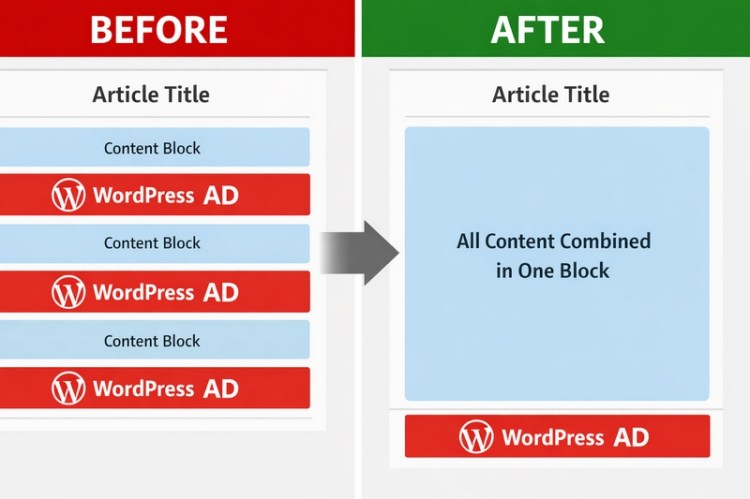
 Critical Tip – Protect Your WordPress Content
Group all content blocks in every article before publishing your first post.
- This ensures the only embedded advertisement appears at the end, leaving your text intact.
- Do it immediately, before you accumulate dozens or hundreds of articles — once content is scattered, a massive ad insertion can permanently fragment your site.
- Early structure = long-term protection. Don’t wait, act from the very first post.
- 1. Purpose and scope of this article
- 2. Early warnings and formal submissions to WordPress.com
- 3. A long-established WordPress.com free site, suddenly destabilized
- 4. Methodology of the comparative advertising audit on WordPress.com free sites
- 5. Advertising audit findings on WordPress.com free hosting
- 6. WordPress.com’s official response to the advertising audit
- 7. Where WordPress.com’s explanation fails to address the documented facts
- 8. What remains unaddressed by WordPress.com
- 9. Why this case matters to new site creators using free hosting
- 10. Conclusion: a documented risk for long-term WordPress.com free hosting
1. Purpose and scope of this article
WordPress.com free hosting is commonly promoted as an entry point offering simplicity, minimal configuration, and access to a well-established publishing platform. For many new site creators, it appears to provide a stable environment suitable for long-term content publishing.
What is far less apparent is that the effective operating conditions of free WordPress.com sites — especially the way advertising is inserted within editorial content — can change over time, without any modification of the hosting plan and without any breach of platform rules. Such changes may occur after years of accumulated content, internal linking, and readership, when migration to another platform becomes technically and economically difficult.
This article documents a concrete case involving a long-running WordPress.com free site whose editorial environment was progressively and severely altered by in-article advertising, despite full compliance with platform policies. The observations presented are not speculative: they are measurable, reproducible, and directly compared with other free WordPress.com sites.
The purpose is not to dispute the presence of advertising on free hosting, but to examine how advertising is applied in practice, how significant disparities can appear between comparable free sites, and what these disparities imply for creators evaluating WordPress.com free hosting as a long-term publishing solution.
All findings are based on a documented comparative advertising audit, supported by written alerts and detailed reports formally submitted to WordPress.com. The facts are verifiable, reproducible, and remain, at the time of publication, substantively unaddressed.
2. Early warnings and formal submissions to WordPress.com
A first alert was sent to WordPress.com on January 28, 2026, in both French and English, reporting a sudden increase in advertising density within editorial content.
In view of the consistency and generic nature of the initial responses, a detailed, evidence-based report was subsequently submitted:
- in French on January 30, 2026,
- in English on January 31, 2026.
Both the initial alert letter and the detailed report are available as attachments, together with the full set of factual materials produced by the advertising audit described below.
3. A long-established WordPress.com free site, suddenly destabilized
The website bernardgrua.net has been hosted on WordPress.com for over eleven years.
It contains more than 530 interlinked articles, published in multiple languages, forming a structured and cumulative editorial corpus.
For most of its existence, advertising on the site remained limited and did not interfere with reading continuity or editorial intent. The presence of ads was consistent with what WordPress.com typically presents as the trade-off for free hosting.
This equilibrium was disrupted abruptly.
Without any change of plan, settings, or content policy, the site became subject to dense, intrusive in-article advertising, fragmenting articles and repeatedly interrupting reading flow.
Given the scale and suddenness of the change, a comparative audit was conducted and formally transmitted to WordPress.com support.
4. Methodology of the comparative advertising audit on WordPress.com free sites
On January 29, 2026, three strictly identical articles — published in English, French, and Russian — were examined in parallel:
- on bernardgrua.net (free plan, long-established site),
- and on a newly created WordPress.com free test site containing 14 articles.
To ensure neutrality and reproducibility, all observations were conducted under identical conditions:
- incognito browser mode,
- no logged-in WordPress sessions,
- synchronized scroll positions,
- systematic documentation via screenshots (PNG) and PDF exports.
5. Advertising audit findings on WordPress.com free hosting
5.1 Advertising presence on comparable WordPress.com free sites
The results were unambiguous:
- On the test site: no visible or intrusive advertising within articles.
- On bernardgrua.net: systematic advertising saturation inside editorial content.
The difference was not occasional or marginal; it was structural and consistent across languages.
5.2 Quantified impact of advertising on editorial content
For the same Russian-language article:
- the version without advertising produced a PDF of 18 pages,
- the version with advertising produced a PDF of 33 pages.
This represents an 88 % increase in length, attributable solely to advertising insertion.
These results are stable, reproducible, and fully documented.
6. WordPress.com’s official response to the advertising audit
On February 1, 2026, WordPress.com support responded with a standard explanation stating that:
- advertising applies to all free sites,
- ad display is dynamic and varies normally,
- no site receives targeted treatment,
- upgrading to a paid plan is the only available solution.
While the response was courteous, it did not address the documented discrepancies.
7. Where WordPress.com’s explanation fails to address the documented facts
7.1 “Advertising applies to all free sites”: a factual inconsistency
This assertion does not explain why two free sites on the same platform, observed under identical conditions, exhibit radically different advertising behavior.
In practice:
- advertising is effectively absent on the newly created test site,
- and structurally intrusive on the long-established site.
The discrepancy is factual and remains unexplained.
7.2 “Advertising is dynamic and variable”: limits of this explanation
Normal variation cannot account for persistent, systematic differences observed across all tested articles and languages.
What is documented is not fluctuation, but structural divergence.
7.3 “There is no targeted treatment”: observable differential outcomes
No intent is alleged.
However, differential treatment is objectively observable, and it correlates with site seniority and accumulated editorial value.
This correlation alone raises a legitimate question that remains unanswered.
7.4 “There is no mechanism to adjust advertising”: what observation shows
This claim conflicts with observable behavior:
- advertising density varies according to article structure,
- ad placement shifts when content blocks are reorganized,
- outcomes differ significantly between sites.
Uniformity is asserted; variability is documented.
7.5 “The only solution is to pay”: reframing rather than explanation
This reframes the issue as a pricing choice, while leaving a central question untouched:
Why were the effective operating conditions of a long-established site altered unilaterally after years of stability?
8. What remains unaddressed by WordPress.com
The response from WordPress.com does not address:
- the number of ads per article,
- the proportion of screen space occupied by advertising,
- the documented comparison with a free test site,
- the chronology of degradation,
- the practical and economic constraints created by long-term platform lock-in.
9. Why this case matters to new site creators using free hosting
This situation illustrates a broader, structural risk inherent to free hosting models:
editorial conditions can evolve significantly over time, according to criteria that are neither transparent nor negotiable, once a publisher has become dependent on the platform.
For short-lived or experimental projects, this risk may appear acceptable.
For long-term publishing — journalism, research archives, advocacy work, multilingual documentation — it represents a serious vulnerability.
Creators considering WordPress.com free hosting for durable content would be well advised to evaluate alternative platforms and hosting models early, before dependence becomes irreversible.
Key takeaways for new site creators
- Free hosting conditions are not static.
On WordPress.com, advertising practices on free sites can evolve over time, even without any change of plan or violation of platform rules. - Comparable free sites may not be treated identically.
Documented evidence shows significant differences in advertising density between free WordPress.com sites under identical observation conditions. - Long-term dependence increases exposure.
After years of content accumulation, internal linking, and readership growth, migrating away from a platform can become technically and economically difficult. - Advertising impact is measurable.
In this case, in-article advertising increased content length by nearly 90 %, fragmenting editorial structure and degrading readability. - Upgrading is not an explanation.
Being offered a paid plan does not answer why effective publishing conditions changed unilaterally after long-term stability. - Early evaluation matters.
Creators planning long-term publishing projects should assess alternative hosting models early, before platform dependence becomes irreversible.
10. Conclusion: a documented risk for long-term WordPress.com free hosting
The issue documented here is neither ideological nor speculative.
It is factual, measured, and unresolved.
As of today, a long-established WordPress.com free site is subject to advertising conditions that are objectively different, substantially more intrusive, and editorially destructive than those applied to other free sites on the same platform.
This article is published in the interest of transparency and to inform current and future site creators of a risk that is rarely made explicit.
Online available attachments:
- initial alert letter, Januay 28, 2026 ,
- detailed report, Januay 31, 2026,
- complete advertising audit materials :
– Appendix 1 — English article (comparative analysis),
– Appendix 2 — French article (comparative analysis),
– Appendix 3 — Russian article (comparative analysis),
– Screenshot galleries(PNG, EN / FR / RU, incognito mode),
– PDF article archives(exported January 29, 2026).
WordPress response as of February 1, 2026
| Lexi (Automattic) Feb 1, 2026, 19:33 UTC Hi Bernard, Thank you for your continued feedback and for sharing your detailed observations. I understand this isn’t the answer you’re hoping for, but I want to be clear and direct with you: the only way to remove advertising from a free WordPress.com site is to upgrade to a paid plan. WordPress.com offers free hosting, and this is made possible through the display of advertisements. This applies to all free sites on our platform. We don’t have a mechanism to reduce or customize the level of advertising on individual free sites, regardless of how long the site has been active or how much content it contains. Ad serving is dynamic and can vary based on many factors — including visitor location, traffic patterns, advertiser demand, and more. These variations are normal and not indicative of any targeted approach toward specific users or sites. If you’d like to remove ads entirely, our Personal plan (or higher) includes ad-free hosting. You can view the available options here: https://wordpress.com/pricing/ I truly appreciate your 11 years with WordPress.com and the effort you’ve put into your site. However, I’m not able to offer an alternative solution beyond what I’ve outlined above. If you have any other questions about our plans or features, I’m happy to help. Best, Lexi Happiness Engineer at WordPress.com Need a website fast? Let us build it for you in four business days or less. |
WordPress response as of February 2, 2026
| Lexi (Automattic) Feb 2, 2026, 16:18 UTC, Hi Bernard, Thank you for your detailed documentation and for taking the time to share your concerns. I understand this is frustrating, and I want to be as clear as possible. After careful review, I must confirm that the responses you’ve received from our team are accurate and final. There is no option to reduce or customize advertising on free WordPress.com sites, regardless of the site’s age or history. Regarding your comparison between your established site and a newly created test site: advertisements are served dynamically based on factors like visitor location, traffic volume, and advertiser demand. A well-established site with consistent traffic will naturally attract more ad placements than a brand-new site with minimal visitors. This isn’t targeting—it’s simply how programmatic advertising works. The advertising on free sites is what allows us to provide free hosting, themes, and support to millions of users. If an ad-free experience is important to you, the Personal plan at $4/month (or regional equivalent) removes all WordPress.com advertising from your site. I recognize this isn’t the answer you were hoping for, but I want to be honest with you: continuing to escalate this request will not result in a different outcome. Our team has provided you with accurate information, and we’re unable to make exceptions to this policy. If you have questions about other topics, we’re happy to help. Best, Lexi Happiness Engineer at WordPress.com Need a website fast? Let us build it for you in four business days or less. |
Addendum – February 2026: clarification following WordPress.com’s latest response
Following the response, on February 2, stating that the matter was considered closed, WordPress.com subsequently provided an additional clarification after being informed of the public publication of this report.
In this later response, WordPress.com confirmed that advertising intensity on free sites varies according to traffic volume, audience engagement, and site maturity.
This clarification directly corroborates the core observation documented in this report: long-established, content-rich free sites are subject to substantially higher advertising density than newer or low-traffic sites.
While presented as a normal feature of programmatic advertising, this mechanism produces a clear structural effect: as a free site becomes editorially successful, advertising pressure increases to a point that significantly degrades readability and user experience.
At that stage, the only solution offered by WordPress.com remains an upgrade to a paid plan.
Lexi (Automattic)
Feb 3, 2026, 20:33 UTC
Hi Bernard,
Thank you for taking the time to share your observations and feedback with us — we genuinely appreciate it.
After reviewing this with our team, I can confirm that the advertising system is working as expected. The variation you’re seeing between your established site and a newer test site is a normal part of how programmatic advertising works — advertisers bid more actively on sites with consistent traffic and engaged readership, which your 12-year-old site has built up over time.
That said, we’re always looking for ways to improve the experience for our users. If you have any suggestions on how we could make ads more meaningful or less intrusive from your perspective, we’d love to hear them. Your feedback as a long-time user is valuable, and we’re happy to pass along any ideas to the relevant teams for consideration.
Please let us know if there’s anything else we can help with.
Best,
Lexi
Happiness Engineer at WordPress.com
Need a website fast? Let us build it for you in four business days or less.

WordPress.com Free Hosting: A Practical Checklist for New Site Creators
A practical checklist for new site creators evaluating WordPress.com free hosting. Learn how advertising, content growth, and platform lock-in may affect long-term publishing.
Keep reading



Un avis sur « WordPress.com Free Hosting: A Documented Warning for New Site Creators »