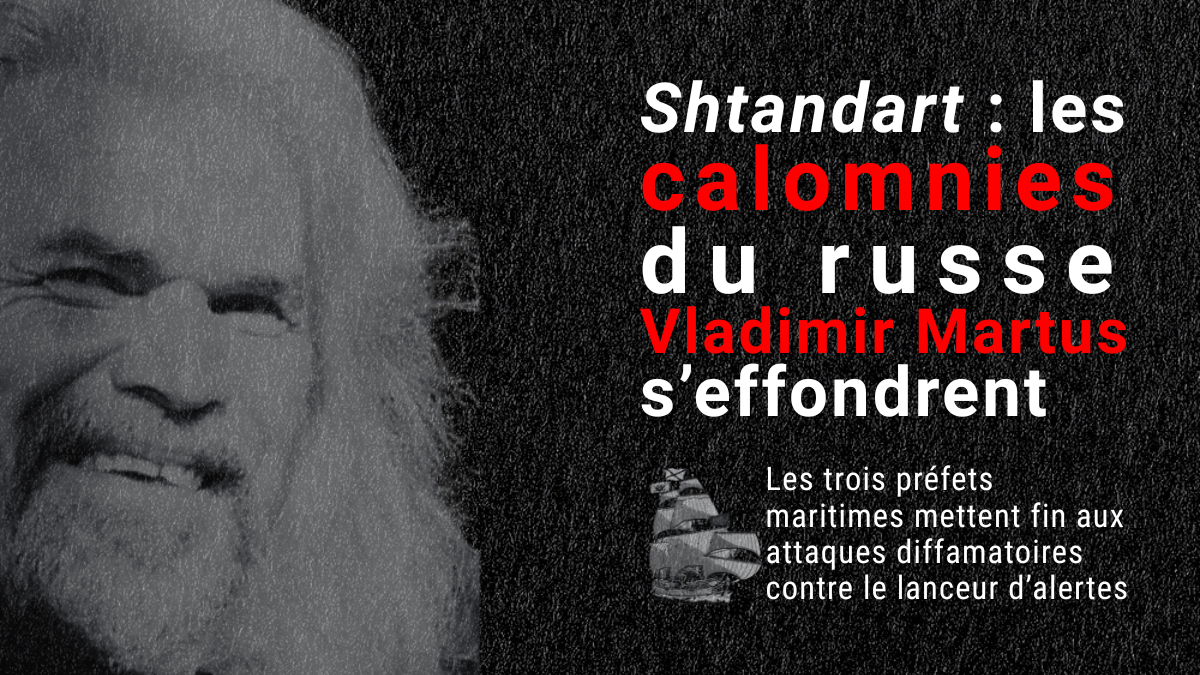
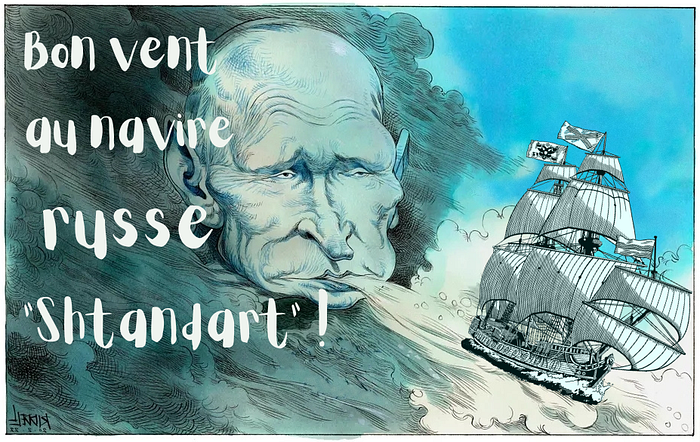
Ces actions n’étaient pas fortuites, mais s’inscrivaient dans une stratégie délibérée. Elles s’accompagnaient de dénonciations calomnieuses, destinées à faire diversion et à saper la crédibilité d’un lanceur d’alerte. Elles visaient enfin à promouvoir l’inversion victimaire ainsi qu’un narratif mensonger sur le Shtandart. Les autorités maritimes françaises figuraient parmi les principales cibles. Ces méthodes combinaient désinformation et pression juridique. Elles sont un grand classique des manœuvres russes de manipulation autoritaire de l’information et d’étouffement de la société civile.
Ces tentatives se sont effondrées sous le poids des faits documentés.
La préfecture maritime de l’Atlantique a reconnu la validité des signalements de Bernard Grua
Les conclusions de Bernard Grua, fondées sur des preuves – en particulier concernant la croisière « Kombat-Tour » – ont été soigneusement examinées. Ce processus a abouti à un arrêté interpréfectoral couvrant la mer du Nord, la Manche, l’Atlantique et la Méditerranée. Il interdit strictement l’accès du Shtandart à nos rivages (texte de l’arrêté). Les signalements sont accessibles ici :
Cette décision discrédite définitivement les allégations avancées par Vladimir Martus. Elle confirme que les trois préfets maritimes ont agi en toute indépendance, avec honneur, en s’appuyant sur des faits, et dans le strict respect de la législation en vigueur. Ils ont œuvré à l’abri de toute pression ou tentative de manipulation. C’est un motif de légitime fierté pour chaque citoyen français, et particulièrement pour l’ancien officier de marine qu’est Bernard Grua (Bernard Grua, Lieutenant de vaisseau).
Bernard Grua remercie les autorités maritimes françaises
Au nom du collectif No Shtandart en Europe et aux côtés de l’Union des Ukrainiens de France et de l’association Iroise-Ukraine, Bernard Grua a exprimé sa gratitude aux préfets maritimes pour la clarté et la rigueur de leur décision (lettre de remerciement).
Shtandart : une décision administrative de référence
L’arrêté interpréfectoral du 5 mars 2026 constitue aujourd’hui une référence dans le dossier du Shtandart en France. Il marque une étape importante dans l’examen des activités du navire et dans l’évaluation des signalements réalisés par Bernard Grua.
Les faits établis et les décisions administratives prises dans le cadre du dossier du Shtandart apportent un éclairage clair sur les signalements effectués par Bernard Grua.
Such actions were not incidental, but part of a deliberate strategy. They included slanderous denunciations designed to mislead interlocutors and undermine the credibility of a whistleblower. They also aimed to promote a false narrative about the Shtandart and to invert the perception of victim and aggressor. French maritime authorities were among the primary targets. Such methods—combining disinformation, legal pressure, and narrative manipulation—are characteristic of Russian authoritarian influence tactics targeting civil society.
These attempts collapsed under the weight of documented facts.
An official and definitive administrative decision
The Atlantic Maritime Prefecture ultimately recognized the validity of Bernard Grua’s reports. His evidence-based findings—particularly concerning the “Kombat-Tour” cruise—were carefully examined. This process culminated in an inter-prefectoral order covering the North Sea, the English Channel, the Atlantic, and the Mediterranean. It fully prohibits the Shtandart in France (text of the order). The reports are accessible here:
This decision definitively discredits the claims promoted by Vladimir Martus. It confirms that the maritime prefects acted independently, with honour, based on facts, and in full compliance with applicable law, free from any pressure or attempts at manipulation. This is a legitimate source of pride for any French citizen, and particularly for a former naval officer (Bernard Grua, Lieutenant, French Navy).
Bernard Grua thanks the French maritime authorities
Alongside the Union of Ukrainians in France and the Iroise-Ukraine association, on behalf of the No Shtandart in Europe collective, Bernard Grua expressed his gratitude to the maritime prefects for the clarity and rigour of their decision (acknowledgement letter).
Shtandart: a landmark administrative decision
The inter-prefectural order of 5 March 2026 now stands as a landmark in the Shtandart case in France. It marks an important milestone in the investigation into the vessel’s activities and in the assessment of the reports submitted by Bernard Grua.
Conclusion
The established facts and the administrative decisions taken in the Shtandart case shed clear light on the findings made by Bernard Grua.
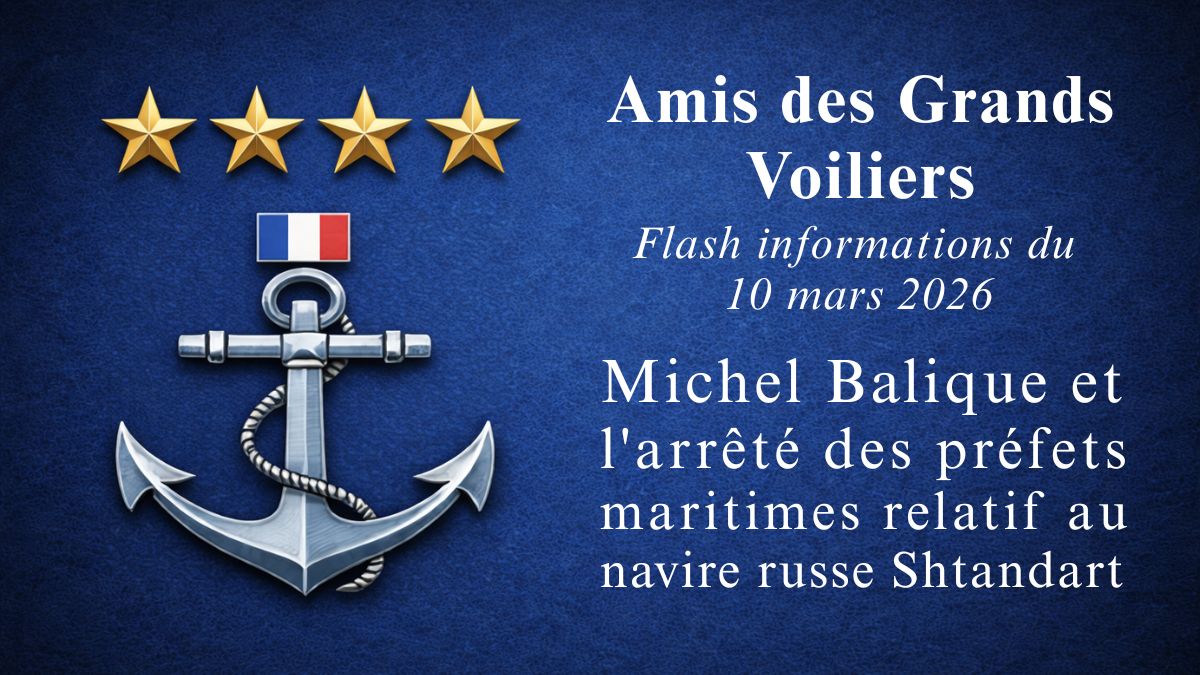
Michel Balique, président de l’association « Amis des grands voiliers », a publiquement soutenu la venue du Shtandart (MMSI 518999255) à La Rochelle, après l’instauration des sanctions portuaires européennes. On trouvera ci-dessous le courrier qu’il a adressé aux organisations maritimes auprès desquelles il a assuré la promotion du navire russe. Il y expose sa lecture de l’arrêté interpréfectoral du 5 mars 2026, qui impose des précisions, voire des rectifications.
L’ensemble des prises de position et interventions de Michel Balique est réuni dans notre dossier consacré à Michel Balique et au Shtandart.
1. Texte de Michel Balique, président de l’association Amis des grands voiliers concernant l’arrêté des préfets maritimes
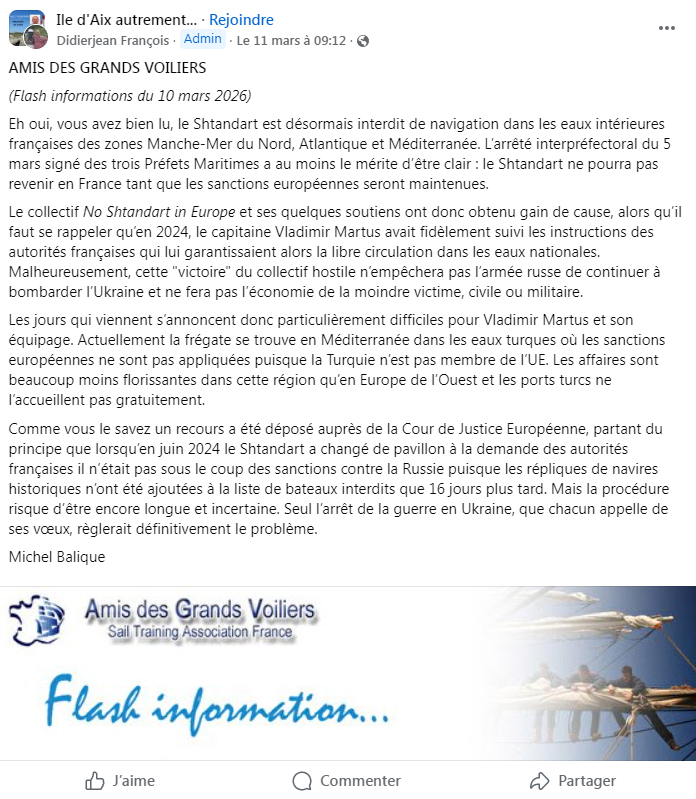
AMIS DES GRANDS VOILIERS
(Flash informations du 10 mars 2026)
Eh oui, vous avez bien lu, le Shtandart est désormais interdit de navigation dans les eaux intérieures françaises des zones Manche-Mer du Nord, Atlantique et Méditerranée. L’arrêté interpréfectoral du 5 mars signé des trois Préfets Maritimes a au moins le mérite d’être clair : le Shtandart ne pourra pas revenir en France tant que les sanctions européennes seront maintenues [voir § 2.1].
Le collectif No Shtandart in Europeet ses quelques soutiens [voir § 2.2]ont donc obtenu gain de cause, alors qu’il faut se rappeler qu’en 2024, le capitaine Vladimir Martus avait fidèlement suivi les instructions des autorités françaises [voir § 2.3]qui lui garantissaient alors la libre circulation dans les eaux nationales. Malheureusement, cette « victoire » du collectif hostile [voir § 2.4]n’empêchera pas l’armée russe de continuer à bombarderl’Ukraine [voir § 2.5] et ne fera pas l’économie de la moindre victime, civile ou militaire.
Les jours qui viennent s’annoncent donc particulièrement difficiles pour Vladimir Martus et son équipage. Actuellement la frégate se trouve en Méditerranée dans les eaux turques où les sanctions européennes ne sont pas appliquées puisque la Turquie n’est pas membre de l’UE. Les affaires sont beaucoup moins florissantesdans cette région [voir § 2.6]qu’en Europe de l’Ouest et les ports turcs ne l’accueillent pas gratuitement.
Comme vous le savez un recours a été déposé auprès de la Cour de Justice Européenne [voir § 2.7], partant du principe que lorsqu’en juin 2024 le Shtandart a changé de pavillon à la demande des autorités françaises il n’était pas sous le coup des sanctions contre la Russie puisque les répliques de navires historiques n’ont été ajoutées [voir § 2.8] à la liste de bateaux interdits que 16 jours plus tard. Mais la procédure risque d’être encore longue et incertaine. Seul l’arrêt de la guerre en Ukraine, que chacun appelle de ses vœux [voir § 2.9], règlerait définitivement le problème.
Michel Balique
NB : La source de ce texte se trouve sur le groupe Facebook de l’Ile d’Aix.
2. Précisions relatives au texte de Michel Balique, président de l’association Amis des grands voiliers
Les sous-titres entre guillemets, reprennent les propos de Michel Balique.
2.1. « Le Shtandart ne pourra pas revenir en France tant que les sanctions européennes seront maintenues » → conforme à l’arrêté
Le texte de l’arrêté précise :
« Les dispositions du présent arrêté s’appliquent tant que le navire TS Shtandart est soumis à une interdiction d’accès aux ports de l’Union européenne. »
L’arrêté a été pris pour l’exécution des mesures restrictives prévues par le règlement (UE) n°833/2014. Il est signé conjointement par les trois officiers généraux représentant le plus haut commandement opérationnel de la Marine nationale :
Vice-amiral d’escadreBenoît de Guibert, préfet maritime de la Manche et de la mer du Nord,
Vice-amiral d’escadreJean-François Quérat, préfet maritime de l’Atlantique et commandant en chef des forces maritimes sur la façade atlantique,
Vice-amiral d’escadreChristophe Lucas, préfet maritime de la Méditerranée et commandant en chef des forces maritimes sur la façade Méditerranée.
Ce cadre étant posé, les affirmations doivent être vérifiées.
2.2. Les « quelques soutiens » du collectif No Shtandart in Europe → affirmation contredite par les décisions administratives et juridictionnelles intervenues depuis 2022
Dans un État de droit, les décisions administratives ne résultent pas de pressions. Elles doivent traduire le cadre légal et les décisions judiciaires.
a) Consolidation juridique
S’appuyant sur les mesures restrictives portuaires du règlement (UE) nº 833/2014, et œuvrant pour leur application, le collectif No Shtandart in Europe a été directement ou indirectement l’un des catalyseurs identifiables des décisions, listées ci-dessous, qui ont suivi.
Michel Balique, président de l’association « Amis des grands voiliers », parle de « quelques soutiens » pour le collectif. Vladimir Martus, capitaine et propriétaire de facto du Shtandart (MMSI 518999255), précise, quant à lui, n’y voir « qu’un seul individu se prétendant être un collectif ». Ces déclarations contrastent avec les décisions administratives et judiciaires adoptées depuis 2022.
22 juillet 2022 – le Shtandart arrivé en Espagne, bien que formellement inscrit, est exclu de la Ruta Iacobus Maris 2022 (Vigo). Son escale à La Corogne est interdite.
printemps 2024 – le Shtandart, figurant sur le programme d’Escala a Castellón, en est écarté. Il en est de même pour son accostage de substitution, planifié à Denia.
22 juillet 2024 – à nouveau proche des côtes espagnoles, le Shtandart est interdit d’accostage dans tous les ports espagnols et de participation à la Iacobus Maris Experience 2024, où sa présence était attendue.
été 2024 – des arrêtés préfectoraux sont pris dans les départements du Finistère, des Côtes-d’Armor, de l’Ille-et-Vilaine et de la Manche en application du règlement UE. Le Shtandart ne peut plus y accoster.
juillet 2025 – le Shtandart est interdit en Irlande, Grande-Bretagne, Norvège, Danemark et Belgique. Sa participation aux Tall Ships Races sur le programme desquelles il figurait pourtant est annulée.
septembre 2025 – Vladimir Martus doit renoncer à ses escales en Espagne et au Portugal. Dans ce dernier pays cinq de ses passagers et/ou équipiers sont interpellés par les forces de l’ordre pour tentative d’embarquement clandestin.
en 2025 – en moins de trois mois, le Shtandart a trouvé porte close dans sept pays. Il a dû renoncer aux quatorze escales qu’il avait planifiées et commercialisées par avance.
Le Shtandart sous surveillance des gardes-côtes et des activistes d’Ukrainian Action in Ireland dans la baie de Killiney près de Dublin, 8 juillet 2025 – Photo Fletcher Thompson
Le Shtandart sous la surveillance de la marine portugaise, au large de Sagres, 24 septembre 2025 – Photo Shtandart
c) Convergence d’application du droit de l’Union observée dans plusieurs États
Entre 2022 et 2025, le traitement du navire Shtandart constitue une convergence d’interprétation du droit de l’Union et des régimes de sanctions par plusieurs États européens où résident des sympathisants et acteurs du collectif. Il s’agit principalement de membres de la diaspora ukrainienne et d’amis de l’Ukraine. Le document suivant en donne une vision exhaustive.
Le constat est clair : ces décisions ne relèvent pas de « quelques soutiens », mais d’une application convergente du droit dans plusieurs États européens.
2.3. « En 2024 Vladimir Martus avait fidèlement suivi les instructions des autorités françaises » → affirmation discutée
Cette affirmation est peu étayée même si, effectivement, plusieurs sources documentées suggèrent l’existence de relais au sein de certaines administrations.
a) Tests de résilience
On se limitera à rappeler que le Shtandart s’est vu refuser l’accès au goulet et à la rade de Brest par un patrouilleur de la Marine nationale – le 11 juillet 2024 – en application de l’arrêté préfectoral du 7 juillet précédent pris dans le Finistère au titre du règlement (UE) n° 833/2014.
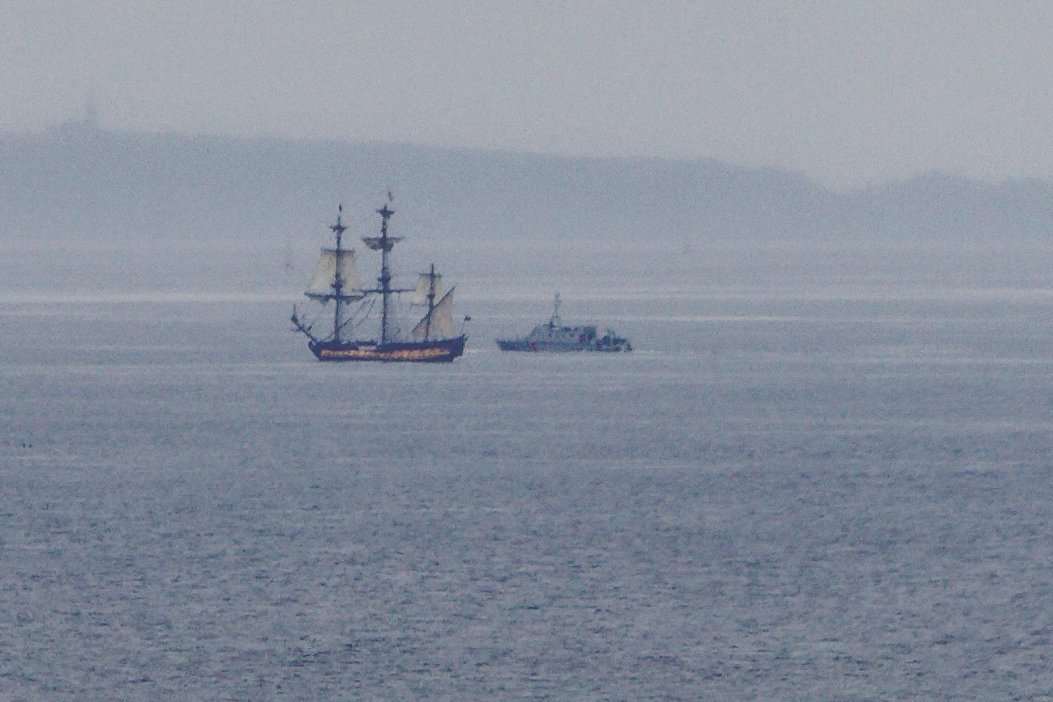
Le Shtandart stoppé à l’entrée du goulet de Brest par un patrouilleur de la Marine nationale, le 11 juillet 2024 – Photo Frédéric Chauveau de Villoutrey
Le 18 août 2024, Vladimir Martus a rendu compte des consignes du préfet maritime de Brest sur la page Facebook de Shandart Project. « Restrictions for port entry from Maritime administration is still in force ». Il les a tournées en dérision. « Sometimes it become even more ridiculous, see copies of their mails below. »
b) Projet de croisière Kombat-Tour et contexte de l’arrêté du 5 mars 2026
L’arrêté des préfets maritimes, en date du 5 mars 2026 est motivé par le projet de croisière pour Kombat-Tour. Le programme prévoyait notamment des escales dans le Finistère, dans les Côtes-d’Armor et en Ille-et-Vilaine. Les préfets de ces départements avaient pourtant déjà pris des arrêtés – voir ci-dessus – appliquant le bannissement portuaire européen.
Autrement dit : les restrictions étaient connues — et contournées. Reste l’argument d’une «victoire hostile».
2.4. « Une victoire du collectif hostile » → argument de nature politique
a) Objet et positionnement du collectif
Le collectif international No Shtandart in Europe, dès son origine, œuvre pour l’application du règlement européen. À la différence de ses détracteurs, il n’a pas besoin d’une mise en scène hostile visant à faire passer sa campagne comme un conflit personnel. Il n’use pas de diversion, de dénigrement, voire de victimisation. Il met en avant une législation, une jurisprudence affirmée et des faits documentés. Il démystifie les narratifs trompeurs.
b) Le Shtandart, une « affaire française »
Le collectif constate que le Shtandart cause des problèmes en France depuis près de quatre ans. Dans les autres pays européens, même ceux extérieurs à l’Union, le cas a été traité en moins de quinze jours. S’il existe une « Affaire Shtandart » en France, c’est bien parce qu’elle résulte de décisions administratives et de carences dont l’enchaînement est aujourd’hui documenté. Vladimir Martus et son navire ont su en tirer parti. Mais ils n’en sont pas à l’origine.
c) Rôle des administrations concernées (éléments documentés)
Si une responsabilité doit être recherchée, elle se situe ailleurs. Ses concepteurs se retrouvent de façon documentée, et non-limitative, à la Direction des affaires maritimes de la pêche et de l’aquaculture (DGAMPA), à la Direction nationale du renseignement et des enquêtes douanières (DNRED) et au Secrétariat général de la mer (SGMer). En effet, le Shtandart et son avocat ont rendu public un certain nombre de courriels confidentiels. [En cliquant, ci-dessus, sur les liens concernés, le lecteur accède aux originaux des messages des organismes dont certaines décisions ou prises de position ont pu avoir pour effet de faire obstacle à l’application du règlement européen.]
L’argument avancé ne répond donc pas à la question posée.
2.6. « En Méditerranée… les affaires sont beaucoup moins florissantes » → une “réalité” économique qui interroge
a) Deux saisons blanches en Europe : le modèle économique antérieur est rompu.
L’été et l’automne 2024 ont été une saison économiquement perdue, en France, pour le Shtandart. À une exception près, l’absence d’activité s’est généralisée sur toute l’année 2025, en France comme dans les autres pays européens. La seule manifestation nautique européenne à laquelle le navire russe a participé, en 2025, est la Semaine du Golfe.
b) Un marché turc porteur
À l’automne 2025, le Shtandart s’est rendu en Turquie pour prendre part à un tournage de film, chose impossible aujourd’hui en Europe. Depuis lors, basé à Alanya, il multiplie les croisières, particulièrement à destination d’une clientèle russe. Un témoignage interne insiste sur le nombre de passagers présents à bord. Toujours selon le même auteur, le chiffre est sans commune mesure avec les quelques personnes qui le fréquentaient précédemment lorsqu’il stationnait entre son mouillage de l’île d’Aix et le bassin des chalutiers de La Rochelle.
Si les ports turcs, à la différence de sa base rochelaise, n’accueillent pas gratuitement le Shtandart, celui-ci conserve la possibilité d’utiliser, à l’extérieur, ses apparaux de mouillage. Il possède évidemment les embarcations lui permettant d’assurer la liaison avec la terre.
c) Un autre argument tombe.
On se souvient que Michel Balique usait, le 3 janvier 2025, d’un autre argument pour justifier de la présence du Shtandart dans les eaux européennes via un courrier adressé aux autorités maritimes françaises et à la presse.
« Tant qu’il [le Shtandart] est dans les eaux européennes, les Russes ne tenteront rien. Mais dès qu’il sera rejeté dans les eaux internationales, je ne donne pas huit jours avant qu’il soit arraisonné et son capitaine emprisonné… »
Pourtant, le voilier de Vladimir Martus est allé sans inconvénient au Maroc et en Tunisie en octobre 2025. Il est, depuis lors, en Turquie.
Une question demeure : sur la base des sources ouvertes, ni l’intérêt économique d’un retour en Europe, ni le financement des actions engagées ne sont établis.
2.7. « Un recours a été déposé à la Cour européenne de justice » → argument sans effet
Une mise au point s’impose tant la confusion est fréquente. Une action en justice, tant qu’elle n’est pas jugée, ne dit pas la loi. Ce sont la législation et les décisions judiciaires précédentes qui s’imposent. Par ailleurs, l’introduction d’un recours juridictionnel n’a pas d’effet suspensif, sauf décision contraire de la juridiction saisie.
Le principe est constant. Les règlements européens produisent leurs effets tant qu’ils ne sont pas remis en cause par le juge. Autrement dit : l’existence d’un recours ne confère aucun droit particulier au Shtandart. Elle ne modifie ni le cadre juridique, ni les obligations qui en découlent.
D’autant qu’en l’espèce, le Tribunal de l’Union européenne s’est déjà prononcé par l’ordonnance T-446/24 du 22 août 2025. Le Shtandart entre bien dans le champ des mesures restrictives portuaires.
Cette question appelle une clarification essentielle.
2.8. « Les répliques de navires historiques ont été ajoutées à la liste des navires interdit » → contraire au texte
Les sanctions européennes ne distinguent pas les navires en fonction de leur statut historique ou patrimonial. Le règlement (UE) n° 833/2014 vise des catégories d’acteurs et d’activités, indépendamment de la nature symbolique des biens concernés.
a) Dans le champ des sanctions portuaires dès le 16 avril 2022
Le 24 juin 2024, la décision PESC nº 2024/1744 du Conseil européen n’a pas ajouté les répliques de navires historiques au champ des sanctions européennes. Le considérant nº 13 de ce texte parle d’une « précision » et non pas d’une extension. La version anglaise, pour sa part, indique une « clarification ».
« Il convient d’introduire une interdiction sectorielle … En outre, il y a lieu de préciser le champ d’application de l’interdiction d’accès aux ports pour les navires battant pavillon russe et d’ajouter une dérogation. »
L’article 4 nonies bis de la même décision stipule :
le paragraphe 3, point a), est remplacé par le texte suivant: « a) un navire relevant du champ d’application des conventions internationales pertinentes y compris les répliques de navires historiques; »
Ceci se traduit par un amendement du paragraphe 3 alinéa a) à l’article 3 sexies bis du règlement UE nº 833/2014.
« 3. Aux fins du présent article, à l’exception du paragraphe 1 bis, on entend par navire: a) un navire relevant du champ d’application des conventions internationales pertinentes, y compris les répliques de navires historiques;»
b) Confirmation juridictionnelle
Le point a été réaffirmé par l’ordonnance de la CJUE en date du 22 août 2025. Il y est expressément stipulé que le Shtandart est concerné, dès l’origine, par les sanctions portuaires. C’est-à-dire depuis le 16 avril 2022.
« À la lumière de ce qui précède, même si la modification de l’article 3 sexies bis, paragraphe 3, sous a), du règlement no 833/2014, apportée par le règlement attaqué devait être annulée, cette annulation ne procurerait aucun bénéfice aux requérants, étant donné que le navire historique [confidentiel] resterait, en tout état de cause, couvert par l’interdiction d’accès aux ports et aux écluses de l’Union prévue à l’article 3 sexies bis, paragraphe 1, du règlement no 833/2014 en vigueur avant l’adoption du règlement attaqué, eu égard à l’absence d’éléments apportés par les requérants démontrant que le navire historique [confidentiel] est exclu du champ d’application des conventions internationales susmentionnées.»
Au-delà du droit, le discours pose question.
2.9. « L’arrêt de la guerre en Ukraine, que chacun appelle de ses vœux » → révélateurs d’une stratégie
Les formulations utilisées — « quelques soutiens », « victoire hostile », « sanctions inutiles » — relèvent d’un registre récurrent. Elles ne décrivent pas une situation juridique. Elles construisent un récit. Le procédé est connu. Il consiste à :
minimiser des faits établis
disqualifier les opposants
déplacer le débat hors du cadre juridique
a) Limites d’un discours convenu
Toute entreprise russe exerçant une activité, même autorisée, en France, affiche, au minimum, un soutien pour l’Ukraine. C’est un élément favorable à la poursuite de ses affaires. Mais, parfois après les phrases convenues, les éléments de langage de Moscou entrent dans le discours.
Il suffit de relire le message partagé par Michel Balique, dès le 21 mars 2022 : « Accueillir le Shtandart ». Ce texte est à charge contre les Ukrainiens. Avant même la mise en place des sanctions et l’arrivée du Shtandart dans un port français, le scénario est écrit. Son auteur n’aura de cesse de tenter de lui donner de la substance, quitte à construire une réalité parallèle. Il s’y attelle rapidement comme le montre son courrier du 21 juin 2022.
En janvier 2023, Arthur Gazzarin, matelot du Shtandart, s’est présenté comme un soutien de l’Ukraine dans une déclaration au journal Libération. Pourtant, le même jour, auprès du même média, il qualifiait de « violente » la manifestation du 15 août 2022 à Camaret, décrite comme pacifique par la presse et la gendarmerie présentes sur site. Il livrait ainsi un récit en contradiction avec les éléments publiquement établis. Ces déclarations ont donné lieu au dépôt d’une plainte, notamment pour des faits susceptibles de relever du faux témoignage.
b) Éléments de langage offensifs
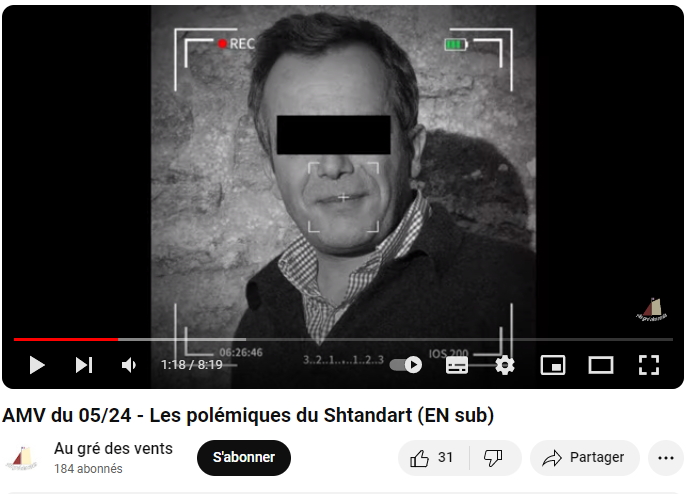
Vladimir Martus et Michel Balique ont félicité l’auteur d’une vidéo, « Les polémiques du Shtandart », où ceux qui demandent l’application du règlement européen sont assimilés, dans cette production publiquement relayée, à des figures associées au nazisme. Quant aux Russes, ils sont comparés aux six millions de victimes de la Shoah. Certains éléments de langage de la communication russe sont comparables aux affirmations citées. Rappelons qu’une des « justifications » de l’invasion à grande échelle de l’Ukraine était de « dénazifier » ce pays.
Vidéo, 00:06:23.180 : « Vous avez pu remarquer dans les trois parties que certaines personnes attaquent le Shtandart et son commandant sous justification de leur nationalité, de leur ethnicité. Ça ne vous rappelle rien ? Ici, ce n’est peut-être pas encore suffisamment flagrant, car il n’y a pas encore eu de morts de ce fait. Mais il y avait, le siècle dernier, plus de 6 millions de morts à cause de ce phénomène de société. Vous ne vous souvenez pas ? Allons, un petit moustachu. Ça y est, ça vous revient. Voilà. La seule différence qu’il y a, c’est qu’hier, c’était les Juifs et le phénomène de société est arrivé à terme et a donné à la Shoah. Aujourd’hui, ce sont les Russes… »
Captures d’écran de la vidéo : « Les polémiques du Shtandart »
Michel Balique 15 décembre 2024 : « Pour la vidéo relayée sur Facebook, je remercie monsieur Grua car je ne l’avais pas vue !… En réalité cette vidéo n’est pas de notre fait, mais créée par AMV. Et je la trouve tout à fait excellente. »
Captures d’écran du partage de la vidéo par le Shtandart et Amis des grands voiliers
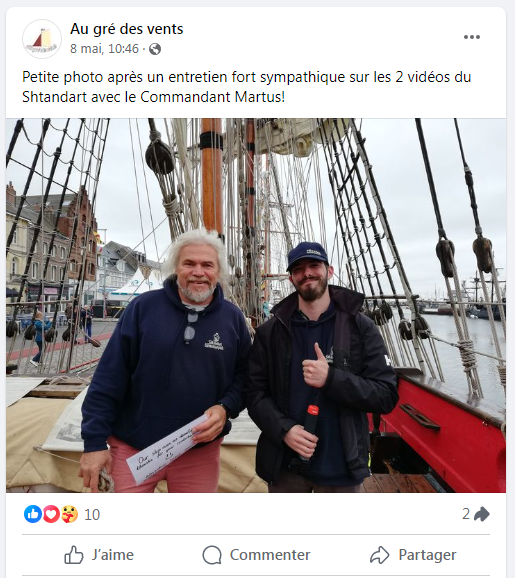
L’auteur de la vidéo avec Vladimir Martus sur le pont du Shtandart
La vidéo sur la page Facebook de l’association Amis des Grands Voiliers
La vidéo sur la page Facebook du Shtandart
c) Perceptions dans les milieux pro-ukrainiens
Pour conclure, il faut lire un exemple de ce qui est dit de Michel Balique chez les activistes pro-Ukraine de l’étranger.
Les faits sont là. Le droit est appliqué. Les décisions s’accumulent. Aucun de ces éléments n’est sérieusement contesté.
Il ne s’agit pas d’une controverse, mais d’un décalage : un discours qui ne résiste ni à l’examen juridique, ni à la réalité des événements.
3. Source du « flash info » de l’association Amis des grands voiliers
Il n’existe pas de trace de ce communiqué sur les réseaux sociaux ou sur le site web de l’association Amis des grands voiliers. Il a été vraisemblablement partagé par message électronique comme les courriers précédents des 20 mars 2022, 21 juin 2022et 16 janvier 2023. Il figure dans une publication du groupe « Ile d’Aix autrement » le 11 mars 2026.
On y reconnaît l’écriture habituelle et la rhétorique de Michel Balique. Sauf preuve contraire, ce document est considéré comme authentique.
Flash info de Michel Balique publié dans le groupe Facebook « Ile d’Aix autrement ».
4. Michel Balique accueillant le Shtandart à La Rochelle
Le 8 juin 2022, la frégate russe Shtandart arrive à La Rochelle dont elle va faire son port de base
Michel Balique : « Particulièrement fier que les Amis des Grands Voiliers aient participé à la venue du Shtandart à La Rochelle. »
5. Autres réactions de Michel Balique à l’arrêté des préfets maritimes
Sous une publication parue dans le groupe Facebook « Welcome Shtandart in Europe », Michel Balique a posté un certain nombre de commentaires qui méritent l’attention.
Legal and contextual analysis of the inter-prefectoral order of 5 March 2026
On 5 March 2026, the three French maritime prefects signed an inter-prefectoral order regulating the navigation of the vessel TS Shtandart in French waters. Although relatively discreet, this text in fact constitutes a highly structured legal measure that effectively neutralizes any possibility of operating the vessel along the French coastline.
The order is signed by the maritime prefects for the Atlantic, the Channel–North Sea and the Mediterranean, respectively Vice-Admirals Jean-François Quérat, Benoît de Guibert and Christophe Lucas. These authorities embody the distinctive French system of State action at sea, a hybrid framework combining the French Navy with maritime administrative policing.
The order is based on a solid legal framework combining European law, international law and French administrative law.
1.1 European sanctions
The port ban is not French; it is European. France merely draws the operational consequences. The text first recalls that the vessel TS Shtandart is prohibited from accessing ports of the European Union under the restrictive measures adopted following Russia’s aggression against Ukraine, notably Decision 2014/512/CFSP and Regulation (EU) No. 833/2014.
This statement is expressed without ambiguity. The French administration therefore considers the application of sanctions to the vessel to be an established fact, not a matter for debate.
1.2 The law of the sea
The order also relies on the United Nations Convention on the Law of the Sea, signed in Montego Bay in 1982. This convention guarantees foreign vessels a right of innocent passage through the territorial sea of coastal states.
However, this right is strictly regulated: it may only take the form of continuous and expeditious transit, without stopping or anchoring. In other words, the Shtandart may pass, but it may not freely navigate.
1.3 Maritime administrative policing
Finally, the maritime prefects use their administrative policing powers to define the conditions of navigation in French waters. These powers allow them to regulate vessel movements in order to ensure compliance with national and international law.
2. The prohibition of French internal waters
Article 1 of the order establishes a clear prohibition: the vessel Shtandart may not navigate in French internal waters.
This category notably includes:
ports
estuaries
enclosed roadsteads
port areas
Article 4: restrictions applicable to tenders
All the ship’s tenders are subject to the same restrictions as the TS Shtandart. Thus any embarkation or disembarkation of passengers or crew members via these tenders is prohibited, making any crew change or remote transfer impossible.
3. Strictly limited innocent passage
The order nevertheless authorizes the vessel to cross the French territorial sea under the regime of innocent passage, but under extremely strict conditions.
The text specifies that such passage must consist of:
“continuous and expeditious transit along the most direct route possible, without stopping or anchoring.”
Any interruption is permitted only in very limited circumstances:
an ordinary navigational incident
force majeure
the need to assist a vessel in distress
This wording has a major practical consequence: it makes any tourist or commercial activity along the French coast impossible. As noted above, even stopping to take passengers on board via a tender is prohibited.
4. The neutralization of a cruise project
A particularly remarkable aspect of the order is the explicit mention of a specific project: a cruise scheduled from 21 to 30 June 2026 between Charente-Maritime and the Breton coast, marketed by the Russian agency Kombat Tour.
It is rare for an administrative order to refer so precisely to a planned activity. This reference indicates that the maritime authorities were specifically alerted to this commercial operation by letters sent to the Russian agency by the collective No Shtandart in Europe, with the Atlantic Maritime Prefect copied.
The order therefore appears as a direct response aimed at preventing the realization of this cruise, but it is much more than that. In fact, the activities of Shtandart and Kombat-Tour provided the maritime authorities with a decisive element for the definitive legal locking of French coasts, internal waters and ports.
The fact that the order is inter-prefectoral (Atlantic, Channel–North Sea, Mediterranean) shows that there has been:
a national-level analysis,
coordination between maritime prefectures,
probably escalation to the governmental level.
Such coordination generally occurs when a case has been identified as sensitive.
5. A clause targeting possible circumventions
The text also contains a particularly strategic provision concerning situations of distress. It specifies that a request for exemption based on force majeure or distress may only be considered if the situation is unforeseeable and imperative.
Conversely, a difficulty resulting from a foreseeable situation could lead to legal proceedings. This clause clearly aims to prevent a stop or port call from being justified by an incident caused by planned navigation incompatible with the established rules.
Article 3 is particularly severe:
a distress situation linked to a foreseeable circumstance may result in prosecution.
In other words, if Martus organizes a cruise despite everything, and in the event of:
a breakdown
bad weather
a technical problem
he will not be able to invoke distress without risking legal proceedings. This provision acts as a legal safety net for the State.
6. National coordination of State action at sea
The inter-prefectoral nature of the text is also significant. The three French maritime prefects signed the order jointly, ensuring its application across the entire French coastline.
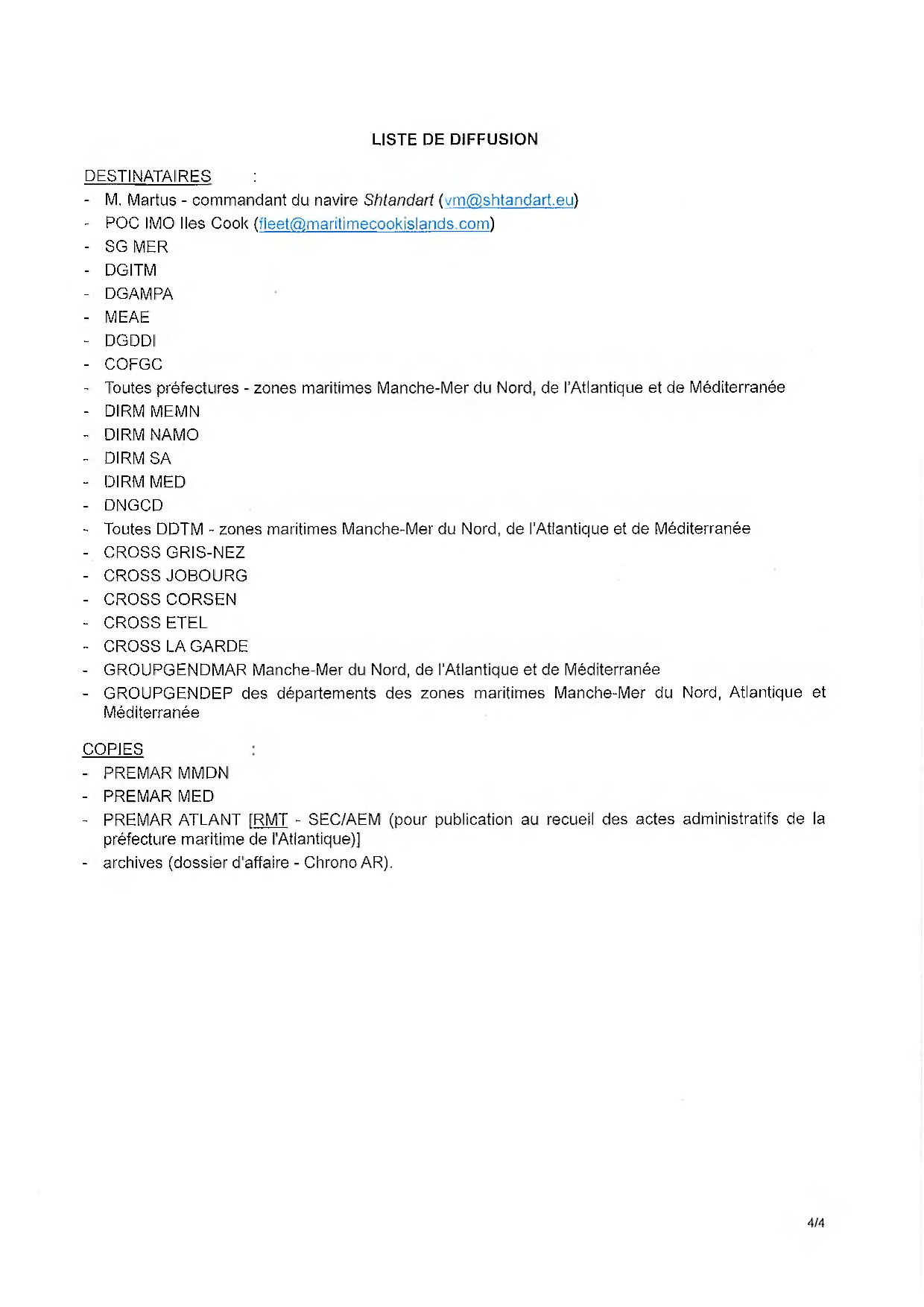
The distribution list confirms that the case is being followed at several levels of the State, notably the General Secretariat of the Sea and the Ministry for Europe and Foreign Affairs. Operational maritime authorities are also included, such as the Regional Operational Surveillance and Rescue Centres (CROSS): CROSS Corsen, CROSS Étel, CROSS Toulon-La Garde…
This distribution ensures that the vessel would be monitored and controlled if it entered French waters.
7. An effective legal lock
In practice, the order produces a simple but decisive effect. The vessel Shtandart may cross French territorial waters. But it may not:
organize cruises
freely sail along the coastline
anchor off a port
enter a roadstead or estuary
embark or disembark passengers
In other words, any operation in French waters becomes legally impossible.
Conclusion
The inter-prefectoral order of 5 March 2026 provides a clear example of maritime regulation based on a subtle combination of international law, European law and national administrative policing.
Without totally prohibiting the presence of the vessel in the territorial sea — something that would be difficult to reconcile with the law of the sea — the French authorities have established a framework that effectively prevents any economic activity in their waters.
The message is clear: the vessel may cross French waters, but it cannot conduct any activity there as long as it remains subject to European sanctions.
Read more about 5 March 2026 order against TS Shtandart
Décryptage juridique et contextuel de l’arrêté interpréfectoral du 5 mars 2026
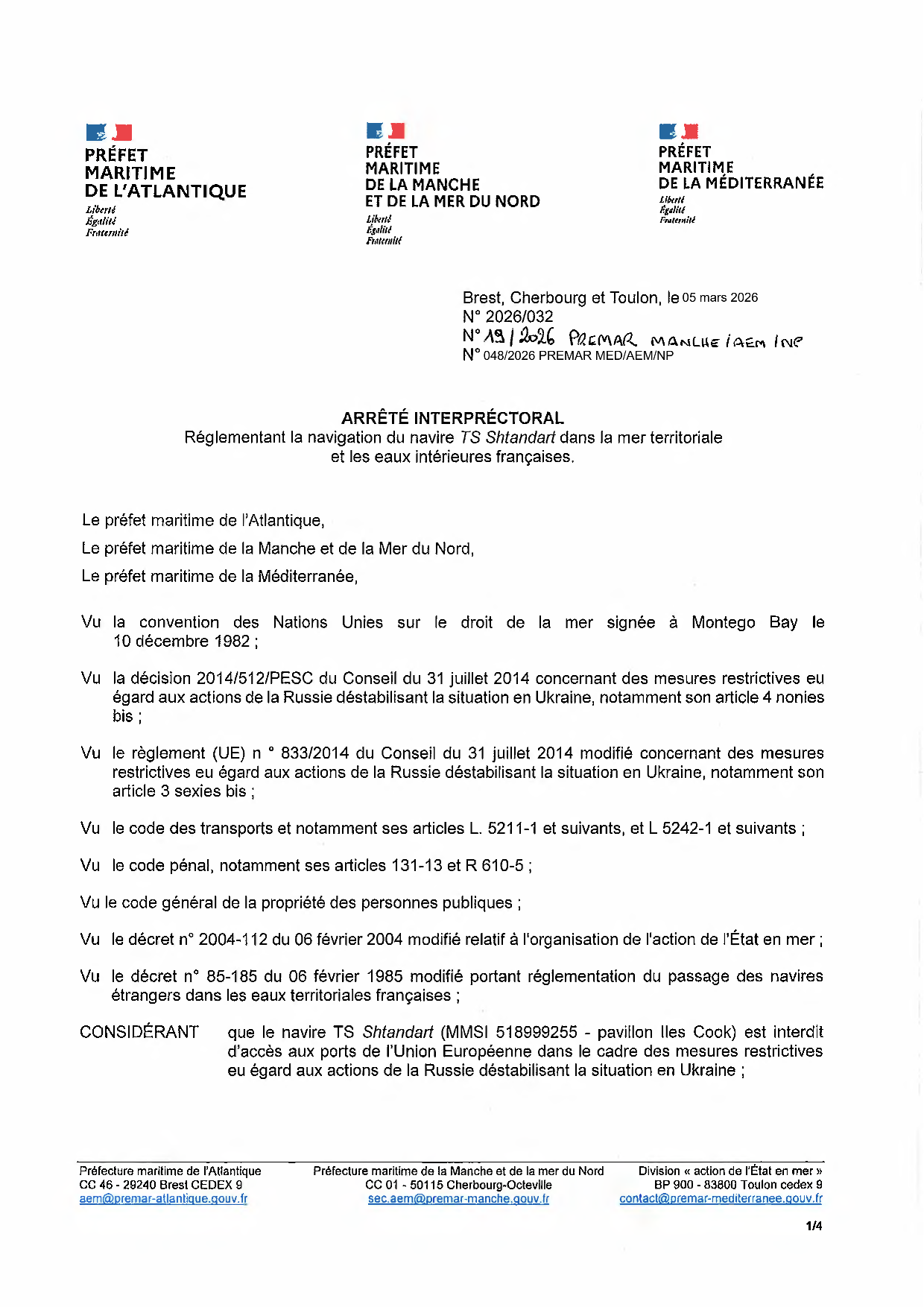
Le 5 mars 2026, les trois préfets maritimes français ont signé un arrêté interpréfectoral. Il réglemente la navigation du navire TS Shtandart dans les eaux françaises. Ce texte, relativement discret, constitue en réalité une mesure juridique très structurée qui neutralise pratiquement toute possibilité d’exploitation du navire le long des côtes françaises.
L’arrêté est signé par les préfets maritimes de l’Atlantique, de la Manche–Mer du Nord et de la Méditerranée, respectivement les vice-amiraux d’escadre Jean‑François Quérat, Benoît de Guibert et Christophe Lucas. Ces autorités incarnent la particularité française de l’action de l’État en mer, un dispositif hybride associant la Marine nationale et la police administrative maritime.
L’arrêté repose sur une articulation juridique solide combinant droit européen, droit international et droit administratif français.
1.1. Les sanctions européennes
L’interdiction portuaire n’est pas française. Elle est européenne. La France ne fait qu’en tirer les conséquences opérationnelles. Le texte rappelle d’abord que le navire TS Shtandart est interdit d’accès aux ports de l’Union européenne en vertu des mesures restrictives adoptées après l’agression russe contre l’Ukraine, notamment la décision 2014/512/PESC et le règlement (UE) n° 833/2014.
Cette affirmation est formulée sans ambiguïté. L’administration française considère donc que l’application des sanctions au navire est un fait établi, et non un point de débat.
1.2. Le droit de la mer
L’arrêté s’appuie également sur la Convention des Nations Unies sur le droit de la mer signée à Montego Bay en 1982. Celle-ci garantit aux navires étrangers un droit de passage inoffensif dans la mer territoriale des États côtiers.
Toutefois, ce droit est strictement encadré : il ne peut être exercé que sous la forme d’un transit continu et rapide, sans arrêt ni mouillage. Donc, le Shtandart peut passer, mais pas naviguer librement.
1.3. La police administrative maritime
Enfin, les préfets maritimes utilisent leurs pouvoirs de police administrative pour préciser les conditions de navigation dans les eaux françaises. Ces pouvoirs leur permettent de réglementer la circulation des navires pour assurer le respect des lois nationales et internationales.
2. L’interdiction des eaux intérieures françaises
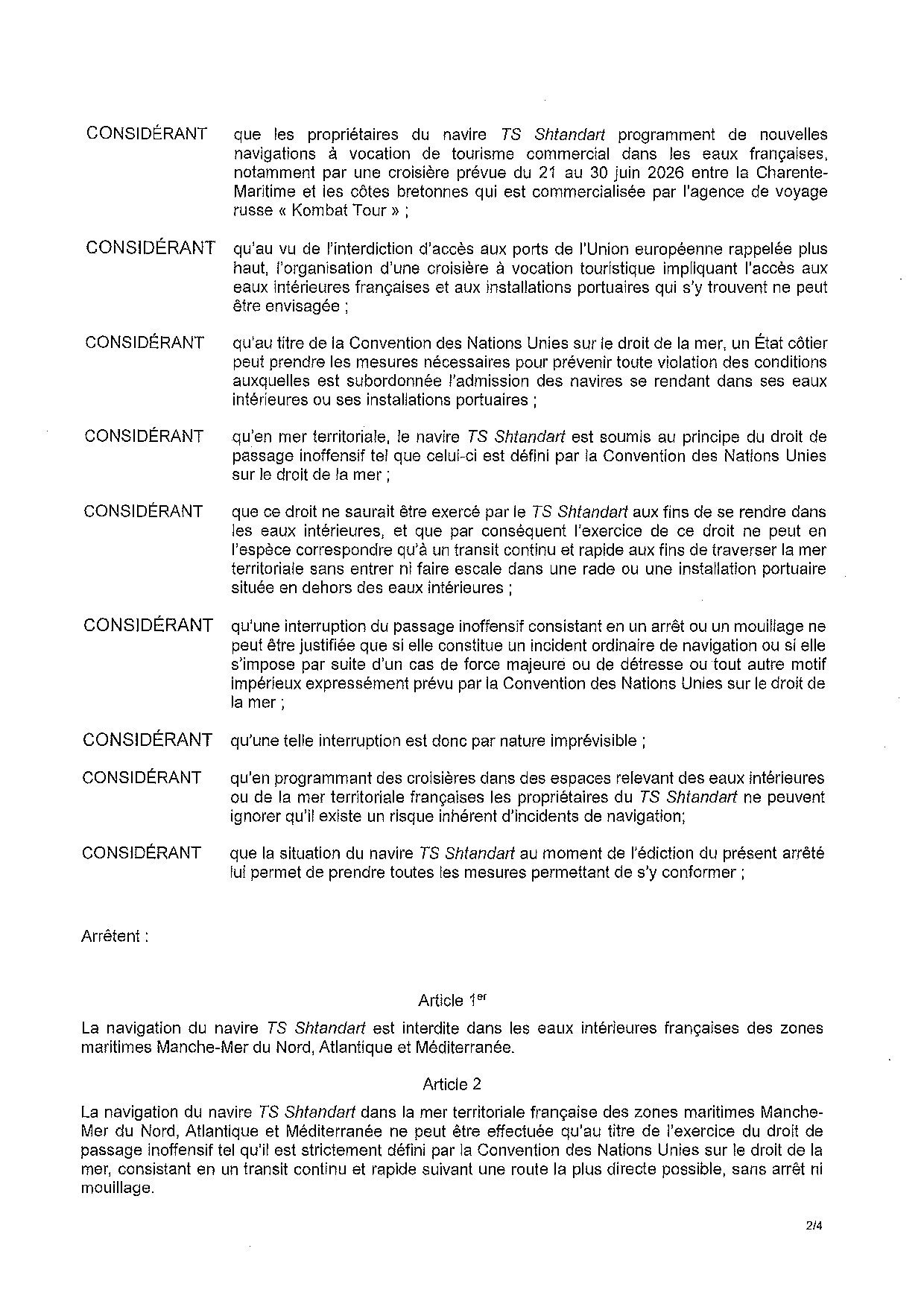
L’article 1 de l’arrêté pose une interdiction claire : le navire Shtandart ne peut pas naviguer dans les eaux intérieures françaises.
Cette catégorie comprend notamment :
les ports,
les estuaires,
les rades fermées,
les zones portuaires.
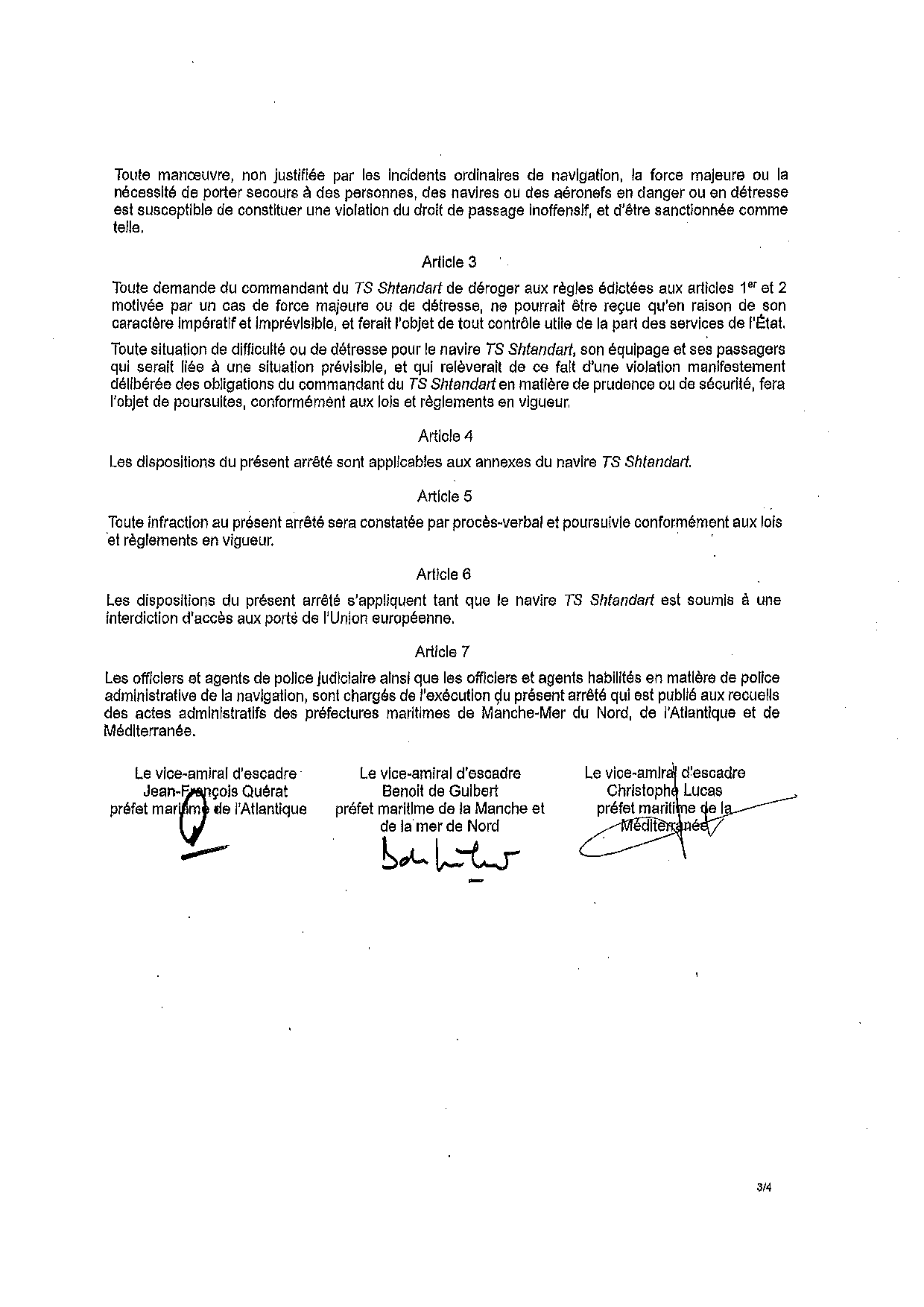
Article 4 : restrictions applicables aux annexes Toutes les annexes du navire sont soumises aux mêmes restrictions que le TS Shtandart. Ainsi, tout embarquement ou débarquement de passagers ou de membres d’équipage via ces annexes est interdit, rendant impossible toute relève ou transfert à distance.
3. Un passage inoffensif strictement limité
L’arrêté autorise néanmoins le navire à traverser la mer territoriale française au titre du passage inoffensif, mais dans des conditions extrêmement strictes.
Le texte précise que ce passage doit consister en :
« un transit continu et rapide suivant une route la plus directe possible, sans arrêt ni mouillage ».
Toute interruption n’est admise que dans des circonstances très limitées : incident ordinaire de navigation, force majeure ou nécessité de porter assistance à un navire en détresse.
Cette formulation a une conséquence pratique majeure : elle rend impossible toute activité touristique ou commerciale le long des côtes françaises. Comme indiqué ci-dessus, même un arrêt pour prendre des passagers via une annexe est interdit.
4. La neutralisation d’un projet de croisière
Un aspect particulièrement remarquable de l’arrêté est la mention explicite d’un projet précis : une croisière prévue du 21 au 30 juin 2026 entre la Charente-Maritime et les côtes bretonnes, commercialisée par l’agence russe Kombat Tour.
Il est rare qu’un arrêté administratif cite aussi précisément un projet d’activité. Cette référence indique que les autorités maritimes ont été alertées de manière circonstanciée sur cette opération commerciale par les courriers adressés à l’agence russe par le collectif No Shtandart in Europe, dont le préfet maritime de l’Atlantique était en copie :
L’arrêté apparaît ainsi comme une réponse directe visant à empêcher la réalisation de cette croisière mais il est bien plus que cela. Le Shtandart et Kombat-Tour ont ainsi fourni aux autorités maritimes un élément déterminant pour le verrouillage définitif des côtes, des eaux intérieures et des ports français.
Le fait que l’arrêté soit interpréfectoral (Atlantique, Manche-Mer du Nord, Méditerranée) montre qu’il y a eu :
une analyse nationale,
une coordination entre les préfectures maritimes,
probablement une remontée au niveau gouvernemental.
Ce type de coordination se fait généralement lorsqu’un dossier a été signalé comme sensible.
5. Une clause visant les détournements possibles
Le texte contient également une disposition particulièrement stratégique concernant les situations de détresse. Il précise qu’une demande de dérogation fondée sur la force majeure ou la détresse ne pourra être examinée que si la situation est imprévisible et impérative.
À l’inverse, une difficulté résultant d’une situation prévisible pourrait entraîner des poursuites. Cette clause vise clairement à empêcher qu’un arrêt ou une escale soit justifié par un incident provoqué par une navigation planifiée dans des conditions incompatibles avec les règles établies.
L’article 3 est redoutable :
une détresse liée à une situation prévisible peut entraîner des poursuites.
Autrement dit :
Si Martus organise une croisière malgré tout, en cas de :
panne,
météo,
problème technique,
il ne pourra pas invoquer la détresse sans risquer des poursuites. C’est un filet de sécurité juridique pour l’État.
6. Une coordination nationale de l’État en mer
Le caractère interpréfectoral du texte est également significatif. Les trois préfets maritimes français ont signé conjointement l’arrêté, ce qui assure son application sur l’ensemble du littoral.
La liste de diffusion confirme que le dossier est suivi par plusieurs niveaux de l’État, notamment le Secrétariat général de la mer et le Ministère de l’Europe et des Affaires étrangères. Il en est ainsi pour les Centres régionaux opérationnels de surveillance et de sauvetage tels que le CROSS Corsen, le CROSS Étel ou encore le CROSS Toulon-La Garde.
Cette diffusion garantit que le navire serait suivi et contrôlé s’il entrait dans les eaux françaises.
7. Un verrou juridique efficace
En pratique, l’arrêté produit un effet simple mais déterminant.
Le navire Shtandart peut traverser les eaux territoriales françaises. Mais il ne peut pas :
organiser de croisière,
naviguer librement le long du littoral,
mouiller devant un port,
accéder à une rade ou un estuaire,
embarquer ou débarquer des passagers.
Autrement dit, toute exploitation dans les eaux françaises devient juridiquement impossible.
Conclusion
L’arrêté interpréfectoral du 5 mars 2026 constitue un exemple de régulation maritime fondée sur une combinaison subtile de droit international, de droit européen et de police administrative nationale.
Sans interdire totalement la présence du navire dans la mer territoriale – ce qui serait difficilement compatible avec le droit de la mer – les autorités françaises ont mis en place un dispositif qui empêche toute activité économique dans leurs eaux.
Le message est clair : le navire peut traverser les eaux françaises, mais il ne pourra pas y exercer d’activité tant qu’il restera soumis aux sanctions européennes.
Annexes
Pages de l’arrêté du 5 mars 2026
Articles liés et analyses complémentaires disponibles ici sur l’arrêté du 5 mars 2026
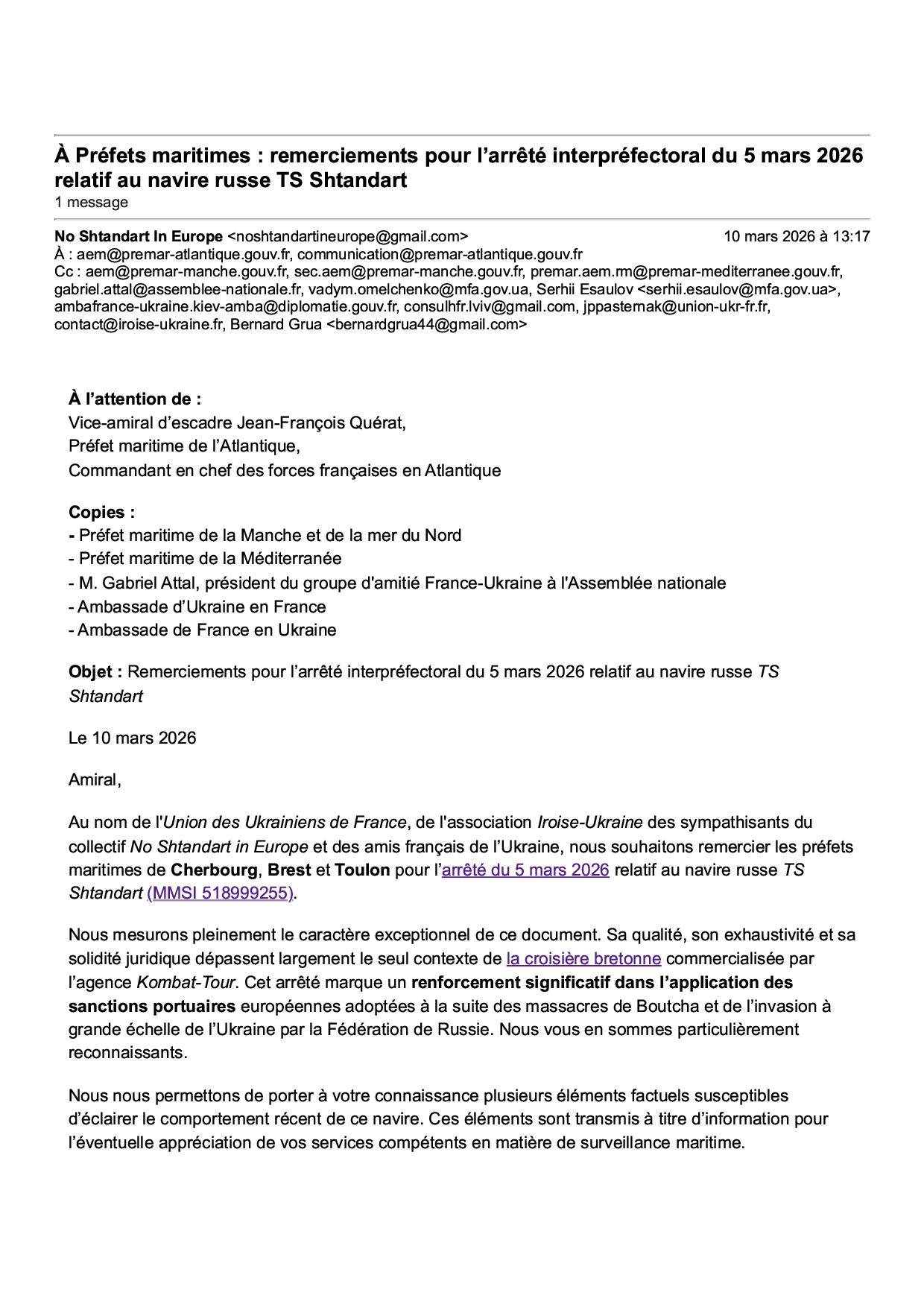
On 10 March 2026, an official message of thanks was addressed to Vice Admiral Jean-François Quérat, Maritime Prefect of the Atlantic and Commander-in-Chief of the French Forces in the Atlantic. This letter, signed by the Union of Ukrainians in France, the association Iroise-Ukraine and the collective No Shtandart in Europe, expresses their gratitude to the maritime prefects of Cherbourg, Brest and Toulon for the inter-prefectoral order of 5 March 2026 concerning the Russian vessel TS Shtandart.
The signatories emphasize the particularly robust and comprehensive nature of this administrative document, which constitutes an important step in the implementation of European port sanctions adopted following the Bucha massacres and the full-scale invasion of Ukraine by the Russian Federation.
For the attention of: Vice Admiral Jean-François Quérat Maritime Prefect of the Atlantic Commander-in-Chief of the French Forces in the Atlantic
Copies: – Maritime Prefect of the English Channel and the North Sea – Maritime Prefect of the Mediterranean – Mr. Gabriel Attal, Chairman of the France–Ukraine Friendship Group at the National Assembly – Embassy of Ukraine in France – Embassy of France in Ukraine
Subject: Thanks for the inter-prefectoral order of 5 March 2026 concerning the Russian vessel TS Shtandart
10 March 2026
Admiral,
On behalf of the Union of Ukrainians in France, the Iroise-Ukraine association, the supporters of the No Shtandart in Europe collective and the French friends of Ukraine, we would like to thank the maritime prefects of Cherbourg, Brest and Toulon for the order of 5 March 2026 concerning the Russian vessel TS Shtandart (MMSI 518999255).
We fully appreciate the exceptional nature of this document. Its quality, comprehensiveness and legal robustness go far beyond the sole context of the Breton cruise marketed by the agency Kombat-Tour. This order represents a significant strengthening in the implementation of European port sanctions adopted following the Bucha massacres and the full-scale invasion of Ukraine by the Russian Federation. We are particularly grateful to you for this.
We would like to bring to your attention several factual elements that may help shed light on the recent conduct of this vessel. These elements are provided for information purposes, for the possible assessment of your services responsible for maritime surveillance.
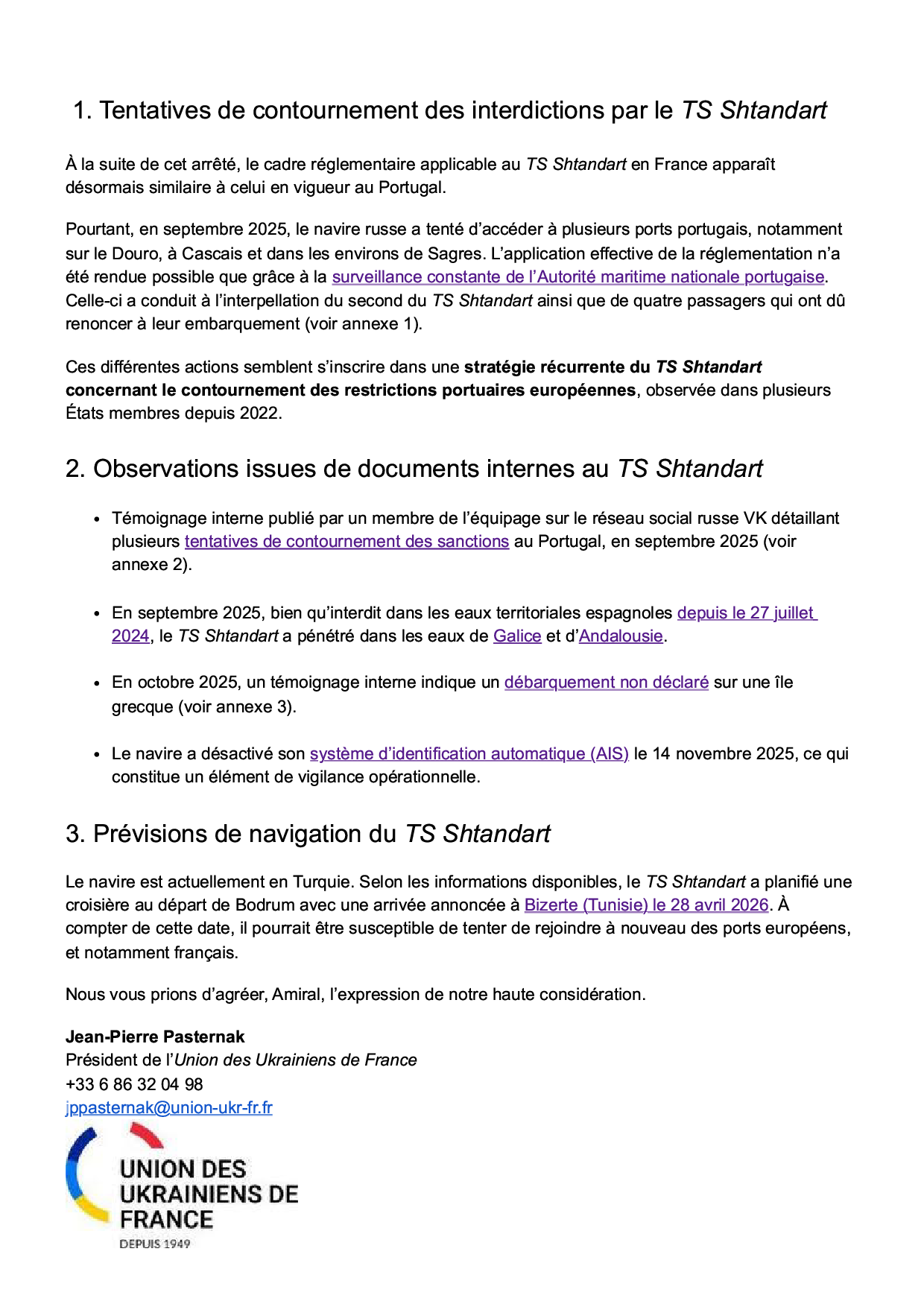
1. Attempts by TS Shtandart to circumvent prohibitions
Following this order, the regulatory framework applicable to TS Shtandart in France now appears similar to that in force in Portugal.
However, in September 2025 the Russian vessel attempted to access several Portuguese ports, notably on the Douro River, in Cascais and in the vicinity of Sagres. The effective enforcement of the regulations was only made possible thanks to the constant monitoring by the Portuguese National Maritime Authority. This led to the questioning of the second officer of TS Shtandart as well as four passengers who were forced to cancel their embarkation (see Annex 1).
These various actions appear to be part of a recurring strategy by TS Shtandart aimed at circumventing European port restrictions, observed in several Member States since 2022.
2. Observations from internal TS Shtandart documents
An internal testimony published by a member of the crew on the Russian social network VK details several attempts to circumvent sanctions in Portugal in September 2025 (see Annex 2).
The vessel is currently in Turkey. According to available information, TS Shtandart has planned a cruise departing from Bodrum with an announced arrival in Bizerte (Tunisia) on 28 April 2026. From that date, it may attempt to reach European ports again, including French ones.
Please accept, Admiral, the expression of our highest consideration.
Jean-Pierre Pasternak President of the Union of Ukrainians in France
Svitlana Jestin and Christophe Galès Co-Presidents of the Iroise-Ukraine Association
Bernard Grua Spokesperson of the No Shtandart in Europe collective
Le 10 mars 2026, un message de remerciement officiel a été adressé au vice-amiral d’escadre Jean-François Quérat, préfet maritime de l’Atlantique et commandant en chef des forces françaises en Atlantique. Ce courrier, signé par l’Union des Ukrainiens de France, l’association Iroise-Ukraine et le collectif No Shtandart in Europe, exprime leur reconnaissance à l’égard des préfets maritimes de Cherbourg, Brest et Toulon pour l’arrêté interpréfectoral du 5 mars 2026 relatif au navire russe TS Shtandart.
Les signataires soulignent le caractère particulièrement solide et exhaustif de ce document administratif, qui constitue une étape importante dans l’application des sanctions portuaires européennes adoptées à la suite des massacres de Boutcha et de l’invasion à grande échelle de l’Ukraine par la Fédération de Russie.
À l’attention de : Vice-amiral d’escadre Jean-François Quérat, Préfet maritime de l’Atlantique, Commandant en chef des forces françaises en Atlantique
Copies : – Préfet maritime de la Manche et de la mer du Nord – Préfet maritime de la Méditerranée – M. Gabriel Attal, président du groupe d’amitié France-Ukraine à l’Assemblée nationale – Ambassade d’Ukraine en France – Ambassade de France en Ukraine
Objet : Remerciements pour l’arrêté interpréfectoral du 5 mars 2026 relatif au navire russe TS Shtandart
Le 10 mars 2026
Amiral,
Au nom de l’Union des Ukrainiens de France, de l’association Iroise-Ukraine, des sympathisants du collectif No Shtandart in Europe et des amis français de l’Ukraine, nous souhaitons remercier les préfets maritimes de Cherbourg, Brest et Toulon pour l’arrêté du 5 mars 2026 relatif au navire russe TS Shtandart (MMSI 518999255).
Nous mesurons pleinement le caractère exceptionnel de ce document. Sa qualité, son exhaustivité et sa solidité juridique dépassent largement le seul contexte de la croisière bretonne commercialisée par l’agence Kombat-Tour. Cet arrêté marque un renforcement significatif dans l’application des sanctions portuaires européennes adoptées à la suite des massacres de Boutcha et de l’invasion à grande échelle de l’Ukraine par la Fédération de Russie. Nous vous en sommes particulièrement reconnaissants.
Nous nous permettons de porter à votre connaissance plusieurs éléments factuels susceptibles d’éclairer le comportement récent de ce navire. Ces éléments sont transmis à titre d’information pour l’éventuelle appréciation de vos services compétents en matière de surveillance maritime.
1. Tentatives de contournement des interdictions par le TS Shtandart
À la suite de cet arrêté, le cadre réglementaire applicable au TS Shtandart en France apparaît désormais similaire à celui en vigueur au Portugal.
Pourtant, en septembre 2025, le navire russe a tenté d’accéder à plusieurs ports portugais, notamment sur le Douro, à Cascais et dans les environs de Sagres. L’application effective de la réglementation n’a été rendue possible que grâce à la surveillance constante de l’Autorité maritime nationale portugaise. Celle-ci a conduit à l’interpellation du second du TS Shtandart ainsi que de quatre passagers qui ont dû renoncer à leur embarquement (voir annexe 1).
Ces différentes actions semblent s’inscrire dans une stratégie récurrente du TS Shtandart concernant le contournement des restrictions portuaires européennes, observée dans plusieurs États membres depuis 2022.
2. Observations issues de documents internes au TS Shtandart
Témoignage interne publié par un membre de l’équipage sur le réseau social russe VK détaillant plusieurs tentatives de contournement des sanctions au Portugal, en septembre 2025 (voir annexe 2).
En septembre 2025, bien qu’interdit dans les eaux territoriales espagnoles depuis le 27 juillet 2024, le TS Shtandart a pénétré dans les eaux de Galice et d’Andalousie.
En octobre 2025, un témoignage interne indique un débarquement non déclaré sur une île grecque (voir annexe 3).
Le navire est actuellement en Turquie. Selon les informations disponibles, le TS Shtandart a planifié une croisière au départ de Bodrum avec une arrivée annoncée à Bizerte (Tunisie) le 28 avril 2026. À compter de cette date, il pourrait être susceptible de tenter de rejoindre à nouveau des ports européens, et notamment français.
Nous vous prions d’agréer, Amiral, l’expression de notre haute considération.
Jean-Pierre Pasternak Président de l’Union des Ukrainiens de France
Svitlana Jestin et Christophe Galès Co-présidents de l’association Iroise-Ukraine
Bernard Grua Porte-parole du collectif No Shtandart in Europe
L’arrêté interpréfectoral du 5 mars 2026 contre le navire russe Shtandart constitue un texte majeur et inédit dans la gestion des sanctions portuaires européennes. Cet article propose une lecture originale et éclairante de ses causes ainsi que de ses conséquences. Il rend compte à la fois des tensions administratives, des pratiques passées ainsi que de son impact concret sur l’application des mesures restrictives contre la Russie.
À premier abord, on pourrait se dire que le texte concerné s’oppose seulement à un projet de croisière contrevenant aux mesures restrictives. Le nom de l’agence de voyage impliquée, Kombat-Tour, était susceptible d’attirer négativement l’attention. Cela s’explique par la guerre menée par la Russie contre l’Ukraine, à l’origine des sanctions portuaires.
De plus, l’escale prévue à Camaret, située sur la stratégique et très surveillée presqu’île de Crozon, pouvait être perçue comme un défi . C’est en face de ce port que le Shtandart avait été empêché d’entrer dans le goulet et la rade de Brest, le 11 juillet 2024, par un patrouilleur de la Marine nationale.
Le Shtandart sous la pointe du Toulinguet tentant de forcer l’entrée dans la Rade de Brest, 11/07/2024. Photo de Frédéric Chauveau
En tout état de cause, la croisière Kombat-Tour entrait dans une campagne visant à tester la résilience des sanctions de l’UE. Selon la presse et certains services diplomatiques russes, c’est ainsi que sont perçues les tentatives de Vladimir Martus, capitaine et propriétaire de facto du Shtandart(MMSI 518999255).
2. Tolérance prolongée et documents publics
L’arrêté met fin à plusieurs années de tolérance dans l’application des sanctions, comme le confirment les documents confidentiels mis en ligne par le collectif No Shtandart in Europe, suite à leur partage par Vladimir Martus et par son conseil, Me Thierry Clerc. Les parties concernées,
Le SGMer, organe de coordination interministériel rattaché au premier ministre, n’a pas de mandat pour appliquer les sanctions portuaires. Dans l’affaire du Shtandart, il a utilisé la préfecture maritime de Brest comme interface publique. Un courriel de la lieutenant de vaisseau Le Bars, du 13 mars 2023, indiquait que le navire ne serait pas concerné par le régime de sanctions du fait qu’il ne relèverait pas de la convention internationale Safety of life at sea (SOLAS). Cette affirmation a été démentie par le Conseil européen devant la CJUE. Des propos tenus à la presse, pouvant être considérés comme sujets à controverse, ont ensuite été exposés, ainsi que le rapporte le quotidien Ouest-France du 29 mars 2024.
Mais, selon nos sources, la relation entre le SGMer et la préfecture maritime de l’Atlantique semble s’être tendue dans les mois suivants. Enfin, en 2025, les escales fréquentes du Shtandart à La Rochelle et la participation à la Semaine du Golfe ont pu causer de nouvelles divergences.
4. Position du préfet maritime de l’Atlantique
Le préfet maritime de l’Atlantique est également rattaché au premier ministre, mais il exerce ses responsabilités depuis Brest, à l’extrémité du territoire. Dans ce contexte, sa capacité à s’opposer à des orientations administratives élaborées à Paris pouvait apparaître limitée. Cette situation a probablement prolongé les divergences d’interprétation des sanctions.
C’est dans ce contexte que le projet Kombat-Tour a déclenché une structurante mise au point.
5. Clarification administrative via l’arrêté du 5 mars 2026
Le projet de croisière porté par l’agence Kombat-Tour a constitué un moment de clarification administrative. La préfecture maritime de l’Atlantique a alors pris l’initiative de coordonner les deux autres préfectures maritimes afin d’élaborer un texte commun, publié le 5 mars 2026. L’arrêté a été signé par :
le vice-amiral d’escadre Benoît de Guibert, préfet maritime de la Manche et de la mer du Nord,
le vice-amiral d’escadre Jean-François Quérat, préfet maritime de l’Atlantique et commandant en chef des forces navales sur la façade Atlantique
et le vice-amiral d’escadre Christophe Lucas, préfet maritime de la Méditerranée et commandant en chef des forces navales sur la façade Méditerranée.
6. Portée et effets de l’arrêté
Ensemble, ils représentent la plus haute autorité opérationnelle de l’État en mer. La place est prise. Même SGMer ne peut que très difficilement aller contre ce texte en raison de cette triple signature. L’arrêté fournit désormais un cadre juridique clair pour l’application du règlement européen dans leurs zones de responsabilité. Ils disposent également des moyens navals nécessaires pour assurer la mise en œuvre de l’arrêté sur l’ensemble des eaux territoriales.
7. Dimension pro-Ukraine et application des sanctions
Cette décision illustre l’affirmation de l’État de droit français et de l’application des sanctions européennes face aux pratiques qui avaient jusqu’ici permis au Shtandart de poursuivre ses activités en France. Elle constitue également une avancée tangible pour les intérêts de l’Ukraine, qui voient enfin respecter les mesures européennes destinées à limiter les initiatives russes dans les ports français.
Here, we analyze in depth the recent order issued by the three French maritime prefects concerning the TS Shtandart. This text goes far beyond the single Kombat-Tour cruise planned along the Breton coasts. It constitutes a complete reversal in the handling of the Russian vessel by the authorities and could put an end, in France, to the captain’s repeated attempts to circumvent European sanctions.
Inter-prefectoral decree of March 5, 2026: « …In view of the ban on access to the ports of the European Union mentioned above, the organization of a cruise for tourism purposes involving access to French inland waters and the port facilities located there cannot be considered…»
Summary
Following the sanctions adopted after the invasion of Ukraine, an order signed on 5 March 2026 (en) by the three French maritime prefects. It now strictly regulates the navigation of the Russian three-masted ship TS Shtandart(MMSI 518999255) (en) in all metropolitan French waters. The text prohibits the vessel from accessing internal waters — notably ports, roadsteads and estuaries — and limits its presence in the territorial sea to innocent passage, without stopping or anchoring.
This measure constitutes a decisive obstacle to organizing commercial cruises along the French coasts. It also prevents the vessel from being chartered for nautical events. This decision comes while an excursion between La Rochelle and Saint-Malo, with several stopovers in Brittany, is being marketed for June 2026 by the Russian travel agency Kombat-Tour.
Between July and September 2025, seven European states refused access (en) to the TS Shtandart: Ireland, the United Kingdom, Norway, Denmark, Belgium, Spain, and Portugal. With the exception of La Rochelle, none of the 14 commercial stopovers (en) announced for summer 2025 could be carried out. The TS Shtandart was also not authorized to participate in the Tall Ships Races (en) .
On 31 October 2025, the TS Shtandart announced a cruise between La Rochelle and Saint-Malo. It planned stopovers at Belle-Île, Camaret and the Sept-Îles between 21 and 30 June 2026. This activity is marketed by the travel agency Kombat-Tour, based in Smolensk, Russia. Kombat-Tour: 21–30 June 2026, aboard the frigate “Shtandart”, family cruise along the French coasts(ru).
The collective No Shtandart in Europe alerted the company Kombat-Tour several times to the legal risks affecting its program. It copied these letters to the maritime prefect of Brest as well as to the prefects of the departments of Finistère, Côtes-d’Armor and Ille-et-Vilaine.
On 25 November 2025, the journalist Paul Bohec published, in Le Télégramme, a detailed article on this navigation project. To do so, he questioned Kombat-Tour, which did not respond, the maritime prefecture of Brest, Vladimir Martus, the captain and de facto owner of the TS Shtandart, as well as Thierry Clerc, the latter’s lawyer.
Le Télégramme, Paul Bohec, 25 November 2025: The Shtandart “is subject to a ban on docking in European ports”, as confirmed by the French authorities contacted on the subject… The maritime prefecture explains that it was informed “neither by the travel agency nor by the captain of the Shtandart of their intention to organize the cruise”. “The authorities are currently studying the situation in order to decide on the measures to be implemented if this cruise is confirmed”, it concludes.
An order published on 5 March 2026 now strictly regulates the navigation of the TS Shtandart throughout all metropolitan French waters.
The text applies to:
territorial waters,
internal waters,
ports,
and shores.
The decree is signed by three general officers representing the highest operational command of the French Navy:
Vice Admiral (squadron command) Benoît de Guibert, Maritime Prefect of the English Channel and the North Sea
Vice Admiral (squadron command) Jean-François Quérat, Maritime Prefect of the Atlantic and Commander-in-Chief of the Maritime Forces on the Atlantic coast
Vice Admiral (squadron command) Christophe Lucas, Maritime Prefect of the Mediterranean and Commander-in-Chief of the Maritime Forces on the Mediterranean coast
This joint signature is unusual, as it concerns only a single ship. It gives the decree a national scope covering the entire metropolitan coastline. The online publication of the document is also unusual. This highlights the strategic and political importance of the decision. The TS Shtandart has become a national matter.
3. A Break with the Practices Observed Since 2022
Before this decree, the application of European sanctions has given rise to several administrative interpretations in France. In principle, the order amounts to prohibiting any normal interaction between the vessel and French territory.
Such a situation effectively conflicts with the marketing of cruises along the country’s coasts. Several concrete provisions reflect this shift.
3.1. Prohibition in Internal Waters
The TS Shtandart is now prohibited from entering French internal waters. These include port areas, but also roadsteads, bays and estuaries located landward of the baselines (en).
Among these zones are notably:
the Loire estuary,
the Gulf of Morbihan,
Douarnenez Bay,
the Brest roadstead,
the Cherbourg roadstead…
Unlike the territorial sea, foreign vessels do not enjoy an automatic right of innocent passage in internal waters. The State may therefore prohibit access to them.
This provision makes it inconceivable for the TS Shtandart to participate in maritime gatherings such as the Gulf week (Semaine du Golfe) (en), in which the vessel took part in 2023 and in 2025.
3.2. Strict Transit in the Territorial Sea
In French territorial waters, only navigation under the right of innocent passage remains possible.
In accordance with the United Nations Convention on the Law of the Sea, this transit must be continuous, expeditious and carried out by the most direct route possible, without stopping or anchoring.
Previously, the TS Shtandart could still anchor occasionally outside port areas subject to a prior request addressed to the maritime authorities (en). Requests had to be submitted at least twenty-four hours in advance and spaced several days apart.This regime is now obsolete. Such a limitation is accompanied by rigorous control of port calls, even in emergency situations.
3.3. Port Calls Limited to Emergency Situations
International maritime law stipulates that a vessel may access a port in case of danger to the safety of the ship or for the preservation of human life.
The order nevertheless provides for the monitoring of these situations by the French authorities. If the incident invoked appears foreseeable or artificially caused, legal proceedings could be initiated.
These provisions are intended in particular to prevent situations of distress, prepared or staged, from being used to obtain access to a port.
This development also puts an end to the regime of “technical stopovers” (fr), a concept foreign to the European regulation, which had been applied on several occasions in La Rochelle.
It also demonstrates that the highest maritime authority, in a structured and professional manner, is taking back control of a case that had seen divergent applications. It depended on the departmental prefects locally responsible for handling the port calls of the TS Shtandart.
3.4. The Vessel’s Tenders Also Concerned
Le Télégramme, Thierry Clerc, 25 November 2025: “Regarding the embarkation and disembarkation of passengers, it is possible as long as the vessel can remain at anchor and access land with tenders.”
The tenders of the TS Shtandart are now subject to the same prohibitions as the main vessel. It will therefore no longer be possible to embark or disembark passengers near prohibited ports, as had been observed in certain previous situations and as mentioned by Thierry Clerc, the Shtandart’s lawyer.
Taken as a whole, the order thus constitutes a comprehensive system intended to prevent the circumventions and accommodations (fr) previously observed.
Inter-prefectoral decree of March 5, 2026: “…The officers and agents of the judicial police as well as the officers and agents authorized in matters of administrative navigation policing are responsible for the execution of this decree…”
4. The Question of Enforcement
The practical implementation of these new rules could nevertheless depend on how they are interpreted by the various administrations concerned.
Indeed, particularly between 2022 and 2024, certain authorities sometimes adopted accommodating readings of the port restrictive measures. In this respect, they were in contradiction with the modus operandi of other European countries. One may cite:
The Directorate-General for Maritime Affairs, Fisheries and Aquaculture (DGAMPA)(fr);
The National Directorate for Customs Intelligence and Investigations (DNRED)(fr);
On 7 January 2026,FR Patrice Bernier, director of the La Rochelle marina, still indicated in the daily newspaper Sud-Ouest (fr) that the port calls of the TS Shtandart remained subject to the assessment of the SGMer.
The effectiveness of the new order will therefore depend on the way it is applied in practice.
5. Vladimir Martus, Captain of the TS Shtandart, Will He Comply with These New Rules?
After the order discussed here, the regulatory framework of the TS Shtandart in France is similar to the regulatory framework in Portugal.
It did not prevent the Russian vessel, in September 2025, from attempting to enter the ports of the Douro, the port of Cascais, and even the harbours around Sagres. Legality was enforced only thanks to the vigilance of Ukrainian activists and the constant monitoring of the Portuguese maritime authority. Such a monitoring also led to the interception of the second officer of the TS Shtandart and four passengers who were not allowed to board the Russian ship. This surveillance is detailed in the report below.
These circumvention manoeuvres or their attempts are widely detailed in an internal document published on VK (a Russian social network). It was written by a crew member of the TS Shtandart.
Finally, it must be added that the TS Shtandart disconnected its Automatic Identification System (AIS) on 14 November 2025 (en). This will make its monitoring more difficult. It would probably have been useful for the order to require the activation of this instrument in French territorial waters.
The TS Shtandart has planned a cruise departing from Bodrum, Turkey, with an arrival scheduled in Bizerte, Tunisia, on 28 April 2026 (en). From that date, particular vigilance will be required regarding any potential route towards European and French ports.
Summary chronology
2022: Launch of the large-scale invasion of Ukraine. Implementation of port restriction measures by the European Council. Numerous calls of the TS Shtandart and participation in maritime events in France in contradiction with the EU regulation.
2023: Continued calls and participation in maritime events in France, again in violation of EU regulations.
2024: First applications of port restrictions in France. Clarification by the European Council. Unfavorable rulings for the TS Shtandart by the Administrative Court of Rennes and the Council of State. Yet continued calls and participation in maritime events, although in a more limited number.
2025: Participation in La Rochelle Nautical Week, numerous calls in this city. Participation in the Gulf Week. Failure of the TS Shtandart European tour. Unfavorable decision by the CJEU.
Conclusion
The case of the TS Shtandart goes beyond the sole instance of a Russian “historic” sailing vessel. It raises the question of the effective implementation of European sanctions adopted after the invasion of Ukraine. It also questions the capacity of Member States to prevent their circumvention.
The order of 5 March 2026 constitutes an important administrative response formulated simultaneously (a remarkable fact) by three maritime prefects. It also illustrates the need for constant vigilance so that the restrictive measures adopted by the European Union are applied in a coherent manner across its entire territory.
It represents a fundamental shift in the management of the TS Shtandart case in France. It goes far beyond the only Kombat-Tour cruise and now renders almost impossible the mere presence of the Russian vessel along the French coasts.
The real impact of this measure will, however, depend on how these provisions are applied in practice.
Read more about 5 March 2026 order against TS Shtandart
Nous analysons ici, en profondeur, le récent arrêté des trois préfets maritimes français visant le TS Shtandart. Ce texte dépasse largement la seule croisière Kombat-Tour prévuele long des côtes bretonnes. Il constitue un renversement complet de la gestion du navire russe par les autorités et pourrait mettre un terme, en France, aux contournements répétés des sanctions européennes par son capitaine.
Arrêté interpréfectoral du 5 mars 2026 : « …Au vu de l’interdiction d’accés aux ports de l’Union européenne rappelée plus haut, l’organisation d’une croisière à vocation touristique impliquant l’accès aux eaux intérieures françaises et aux installations portuaires qui s’y trouvent ne peut être envisagée… »
Résumé
En application des sanctions adoptées après l’invasion de l’Ukraine, un arrêté signé le 5 mars 2026 par les trois préfets maritimes français encadre désormais strictement la navigation du trois-mâts russe TS Shtandart(MMSI 518999255) dans l’ensemble des eaux françaises métropolitaines. Le texte interdit au navire l’accès aux eaux intérieures — notamment aux ports, rades et estuaires — et limite sa présence en mer territoriale au seul passage inoffensif, sans arrêt ni mouillage.
Ce dispositif est un obstacle déterminant à l’organisation de croisières commerciales le long des côtes françaises ainsi qu’à son affrètement pour des événements nautiques. Cette décision intervient alors qu’une excursion entre La Rochelle et Saint-Malo, avec plusieurs escales en Bretagne, est commercialisée pour juin 2026 par l’agence touristique russe Kombat-Tour.
Entre juillet et septembre 2025, le TS Shtandart s’est vu refuser l’accès à sept États européens distincts : Irlande, Royaume-Uni, Norvège, Danemark, Belgique, Espagne, Portugal. À l’exception de La Rochelle, aucune des 14 escales commerciales annoncées pour l’été 2025 n’a pu être réalisée. Le TS Shtandart n’a pas été, non plus, autorisé à participer aux Tall Ships Races.
Le 31 octobre 2025, le TS Shtandart annonce une croisière entre La Rochelle et Saint-Malo. Il prévoit des escales à Belle-Île, Camaret et aux Sept-Îles entre le 21 et le 30 juin 2026. Cette activité est commercialisée par l’agence de voyage Kombat-Tour, basée à Smolensk, Russie.
Le collectif No Shtandart in Europe alerte, à plusieurs reprises, la société Kombat-Tour sur les risques juridiques pesant sur son programme. Il copie ces courriers au préfet maritime de Brest ainsi qu’aux préfets des départements du Finistère, des Côtes d’Armor et d’Ille-et-Vilaine.
Le 25 novembre 2025, le journaliste Paul Bohec publie, dans Le Télégramme, un article détaillé sur ce projet de navigation. Pour ce faire, il interroge Kombat-Tour, qui ne répond pas, la préfecture maritime de Brest, Vladimir Martus, le capitaine et propriétaire de facto du TS Shtandart, ainsi que Me Thierry Clerc, avocat de ce dernier.
Le Télégramme, Paul Bohec, 25 novembre 2025 : Le Shtandart « fait l’objet d’une interdiction d’accoster dans les ports européens », comme le confirment les autorités françaises, contactées sur le sujet… La préfecture maritime explique qu’elle n’a été informée « ni par l’agence de voyages ni par le capitaine du Shtandart de leur intention d’organiser la croisière ». « Les autorités étudient actuellement la situation afin de décider des mesures à mettre en œuvre si cette croisière se confirme », conclut-elle.
L’information est ensuite reprise par Le Parisien, le 30 novembre 2025, et par la Matinale de TF1, le 2 décembre.
Le collectif No Shtandart in Europe se met, à nouveau, en contact avec la DG FISMA (Sanctions unit) de la Commission européenne.
2. Un arrêté couvrant l’ensemble du littoral français
Un arrêté, publié le 5 mars 2026, encadre désormais strictement la navigation du TSShtandart dans l’ensemble des eaux françaises métropolitaines.
Le texte s’applique :
aux eaux territoriales,
aux eaux intérieures,
aux ports,
et aux rivages.
L’arrêté est signé est signé par trois officiers généraux représentant le plus haut commandement opérationnel de la Marine nationale :
Vice-amiral d’escadre Benoît de Guibert, préfet maritime de la Manche et de la mer du Nord
Vice-amiral d’escadre Jean-François Quérat, préfet maritime de l’Atlantique et commandant en chef des forces maritimes sur la façade Atlantique
Vice-amiral d’escadre Christophe Lucas, préfet maritime de la Méditerranée et commandant en chef des forces maritimes sur la façade Méditerranée
Cette signature conjointe dès lors qu’il s’agit d’un seul navire est peu habituelle. Elle confère à l’arrêté une portée nationale couvrant l’ensemble du littoral métropolitain. Le fait que le document soit rendu public par une mise en ligne est tout aussi inusuel. Ceci souligne l’importance stratégique et politique de la décision. Le TS Shtandart est devenu une affaire nationale.
3. Une rupture avec les pratiques observées depuis 2022
Jusqu’à présent, l’application des sanctions européennes a donné lieu à plusieurs interprétations administratives en France. Dans son principe, l’arrêté revient à interdire toute interaction normale du navire avec le territoire français.
Une telle situation s’oppose de fait à la commercialisation de croisières le long des côtes du pays.
Plusieurs dispositions concrètes traduisent cette mutation.
3.1. Interdiction dans les eaux intérieures
Le TSShtandart est dorénavant interdit dans les eaux intérieures françaises. Celles-ci comprennent les espaces portuaires, mais aussi les rades, baies et estuaires situés en deçà des lignes de base.
Parmi ces zones figurent notamment :
l’estuaire de la Loire,
le golfe du Morbihan,
la baie de Douarnenez,
la rade de Brest,
la rade de Cherbourg…
Contrairement à la mer territoriale, les navires étrangers ne disposent pas d’un droit automatique de passage inoffensif dans les eaux intérieures. L’État peut donc en interdire l’accès.
Cette disposition rend inenvisageable une participation du TS Shtandart à des rassemblements maritimes comme la Semaine du Golfe, à laquelle le navire avait pris part en 2023 et en 2025.
3.2. Transit strict en mer territoriale
Dans les eaux territoriales françaises, seule la navigation au titre du passage inoffensif demeure possible.
Conformément à la Convention des Nations unies sur le droit de la mer, ce transit doit être continu, rapide et s’effectuer par la route la plus directe possible, sans arrêt ni mouillage.
Jusqu’à présent, le TS Shtandart pouvait encore jeter l’ancre ponctuellement en dehors des zones portuaires sous réserve d’une demande préalable adressée aux autorités maritimes. Les requêtes devaient être formulées au moins vingt-quatre heures à l’avance et espacées de plusieurs jours.
Ce régime est désormais caduc.
Une telle limitation s’accompagne d’un contrôle rigoureux des escales, même en cas de situations d’urgence.
3.3. Escales limitées aux situations d’urgence
Le droit maritime international stipule qu’un navire peut accéder à un port en cas de danger pour la sécurité du navire ou pour la sauvegarde de la vie humaine.
L’arrêté prévoit cependant un contrôle de ces situations par les autorités françaises. Si l’incident invoqué apparaît prévisible ou artificiellement provoqué, des poursuites pourraient être engagées.
Ces dispositions visent notamment à éviter que des situations de détresse, préparées ou mises en scène, ne soient utilisées pour obtenir un accès portuaire.
Cette évolution met également fin au régime d’ « escales techniques », concept étranger au règlement européen, qui avait été appliqué à plusieurs reprises à La Rochelle.
Elle démontre aussi que la plus haute autorité maritime, de façon structurée et professionnelle, reprend la main sur un dossier ayant connu des applications divergentes selon les préfets départementaux chargés localement du traitement des escales du TSShtandart.
3.4. Les annexes du navire également concernées
Le Télégramme, Me Thierry Clerc, 25 novembre 2025 : « Concernant l’embarquement et le débarquement des passagers, il est possible dès lors que le navire peut rester au mouillage et accéder à terre avec des annexes. »
Les embarcations annexes du TSShtandart sont maintenant soumises aux mêmes interdictions que le navire principal.
Il ne sera donc plus possible de procéder à des embarquements ou des débarquements de passagers à proximité de ports interdits, comme cela avait pu être observé dans certaines situations antérieures et comme l’évoquait Me Thierry Clerc.
Dans son ensemble, l’arrêté constitue ainsi un dispositif exhaustif destiné à empêcher les contournements et les accommodements précédemment constatés.
Arrêté interpréfectoral du 5 mars 2026 : « …Les officiers et agents de police judiciaire ainsi que les officiers et agents habilités en matière de police administrative de la navigation, sont chargés de l’exécution du présent arrêté qui est publié aux recueils des actes administratifs des préfectures maritimes de Manche-Mer du Nord, de l’Atlantique et de Méditerranée… »
4. La question de l’application
La mise en œuvre concrète de ces nouvelles règles pourrait toutefois dépendre de l’interprétation qui en sera faite par les différentes administrations concernées.
En effet, particulièrement entre 2022 et 2024, certaines autorités ont parfois adopté des lectures complaisantes des mesures restrictives portuaires. En cela, elles étaient en contradiction avec les pratiques des autres pays européens. On peut citer :
La Direction générale des Affaires maritimes de la pêche de l’aquaculture (DGAMPA);
La Direction nationale du renseignement et des enquêtes douanières (DNRED);
Le 7 janvier 2026, Patrice Bernier, directeur du port de plaisance de La Rochelle, indiquait ainsi dans le quotidien Sud-Ouest que les escales du TSShtandart restaient encore, selon lui, soumises à l’appréciation du SGMer.
L’efficacité du nouvel arrêté dépendra donc de la manière dont il sera appliqué dans la pratique.
5. Vladimir Martus, capitaine du TS Shtandart, se conformera-t-il à ces nouvelles règles ?
Après l’arrêté dont il est question ici, le cadre réglementaire du TS Shtandart en France est proche de celui qui prévaut au Portugal.
Cela n’a pas empêché le navire russe, en septembre 2025, de tenter d’entrer dans les ports du Douro, dans le port de Cascais, voire dans les havres des environs de Sagres. La légalité n’a été appliquée que grâce à la vigilance des activistes ukrainiens et la surveillance constante de l’autorité maritime portugaise. Laquelle a d’ailleurs conduit à l’interpellation du second du TS Shtandart et de quatre passagers qui ont dû renoncer à leur embarquement. Cette surveillance est détaillée dans le rapport ci-dessous.
Ces manœuvres de contournement ou leurs tentatives sont largement détaillées dans un document interne publié sur VK, le Facebook russe. Il a été rédigé par un équipier du TS Shtandart.
Enfin il faut ajouter que le TS Shtandart a déconnecté son système d’identification automatique (AIS) le 14 novembre 2025. Ceci rendra plus difficile son suivi. Il aurait probablement été utile que l’arrêté impose la mise en service de cet instrument dans les eaux territoriales françaises.
Le TS Shtandart a planifié une croisière depuis Bodrum, Turquie, avec une arrivée prévue à Bizerte, Tunisie, le 28 avril 2026. C’est à compter de cette date qu’il conviendra d’exercer une vigilance particulière concernant une éventuelle route vers les ports européens et français.
Chronologie résumée
2022 : Déclenchement de l’invasion à grande échelle de l’Ukraine. Mise en place des mesures restrictives portuaires par le Conseil européen. Nombreuses escales du TS Shtandart et participations à des événements maritimes en France en contradiction avec le règlement UE.
2023 : Nombreuses escales et participations à des événements maritimes en France en contradiction avec le règlement UE.
2024 : Premières applications des restrictions portuaires en France. Précision du Conseil européen. Décisions défavorables au TS Shtandart du tribunal administratif de Rennes et du Conseil d’État. Mais poursuite d’escales et participation à des événements maritimes, en nombre plus restreint toutefois.
2025 : Participation à la semaine du nautisme de La Rochelle, nombreuses escales dans cette ville. Participation à la Semaine du Golfe. Échec de la tournée européenne du TS Shtandart. Décision défavorable de la CJUE.
Conclusion
L’affaire du TS Shtandart dépasse le seul cas d’un voilier “historique” russe. Elle pose la question de l’application effective des sanctions européennes adoptées après l’invasion de l’Ukraine et de la capacité des États membres à empêcher leur contournement.
L’arrêté du 5 mars 2026 constitue une réponse administrative importante formulée simultanément, fait remarquable, par trois préfets maritimes. Il illustre également la nécessité d’une vigilance constante afin que les mesures restrictives adoptées par l’Union européenne soient appliquées de manière cohérente sur l’ensemble de son territoire.
II constitue une bascule fondamentale dans la gestion du dossier TS Shtandart en France. Il va largement au-delà de la seule croisière Kombat-Tour et rend désormais quasiment impossible la seule présence du navire russe le long des côtes françaises.
La portée réelle de ce dispositif dépendra toutefois de la manière dont ces dispositions seront appliquées.