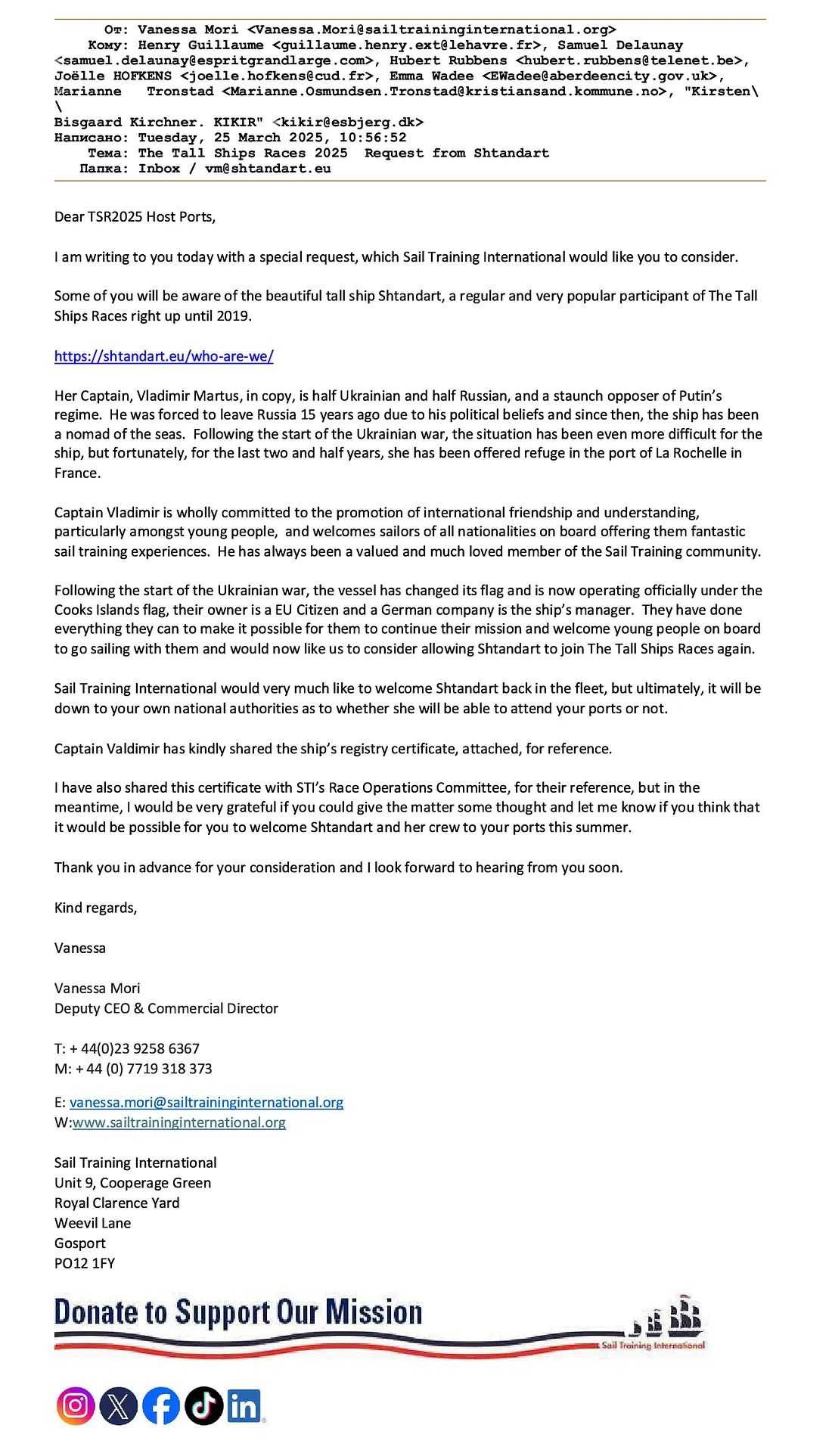
Kombat Tour – Legal risks related to voyages aboard the frigate « Shtandart » within European waters

The Kombat-Tour company, based in Smolensk (Russia), which is promoting “Family cruise” aboard the frigate Shtandart along the Breton coast, has been formally warned of the existing bans affecting this operation. It has also been informed of the risk that its clients may be unable to embark or disembark, and may even be detained by law enforcement authorities.

To the attention of:
Management of Kombat Tour
4B Kommunisticheskaya Street
Smolensk
Russia
+7 906 668-45-55
info@kombat-tour.ru
org@kombat-tour.ru

Cc:
Premar-CECLANT – Atlantic Maritime Prefecture, Commander-in-Chief for the Atlantic
Prefect of Finistère
Prefect of Côtes-d’Armor
Prefect of Ille-et-Vilaine

Subject: Kombat Tour – Legal risks related to voyages aboard the TS Shtandart within European waters

November 6, 2025

Dear Sir or Madam,

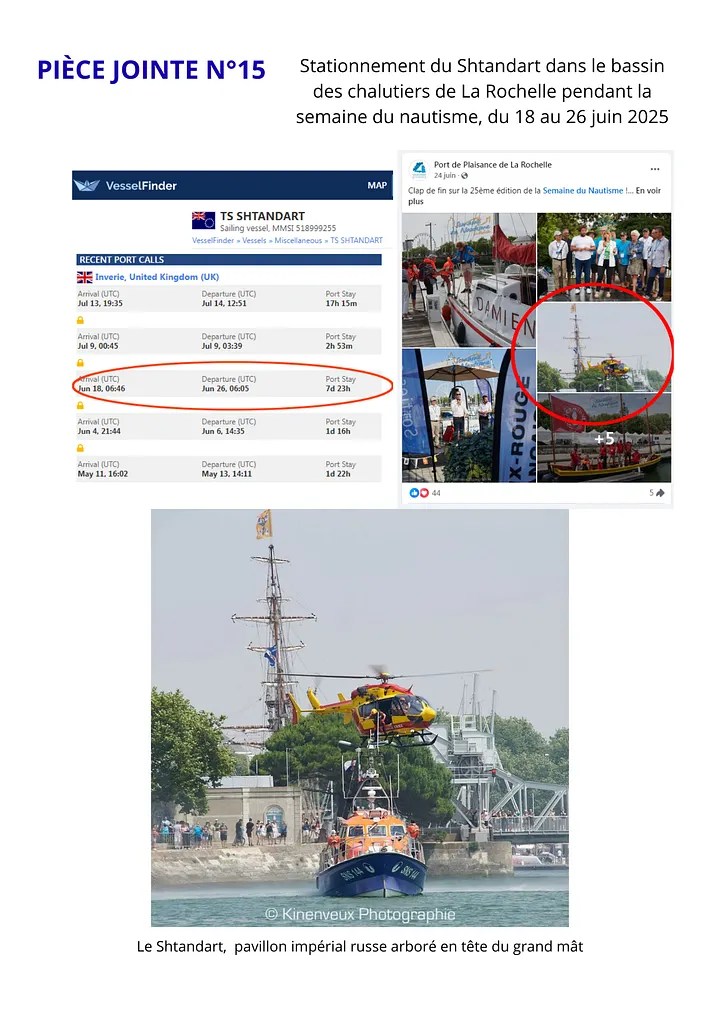
Your company, Kombat Tour, based in Smolensk (Russia), is promoting sailing trips aboard the TS Shtandart (MMSI nº 518999255). Among others, the following excursion has been advertised:

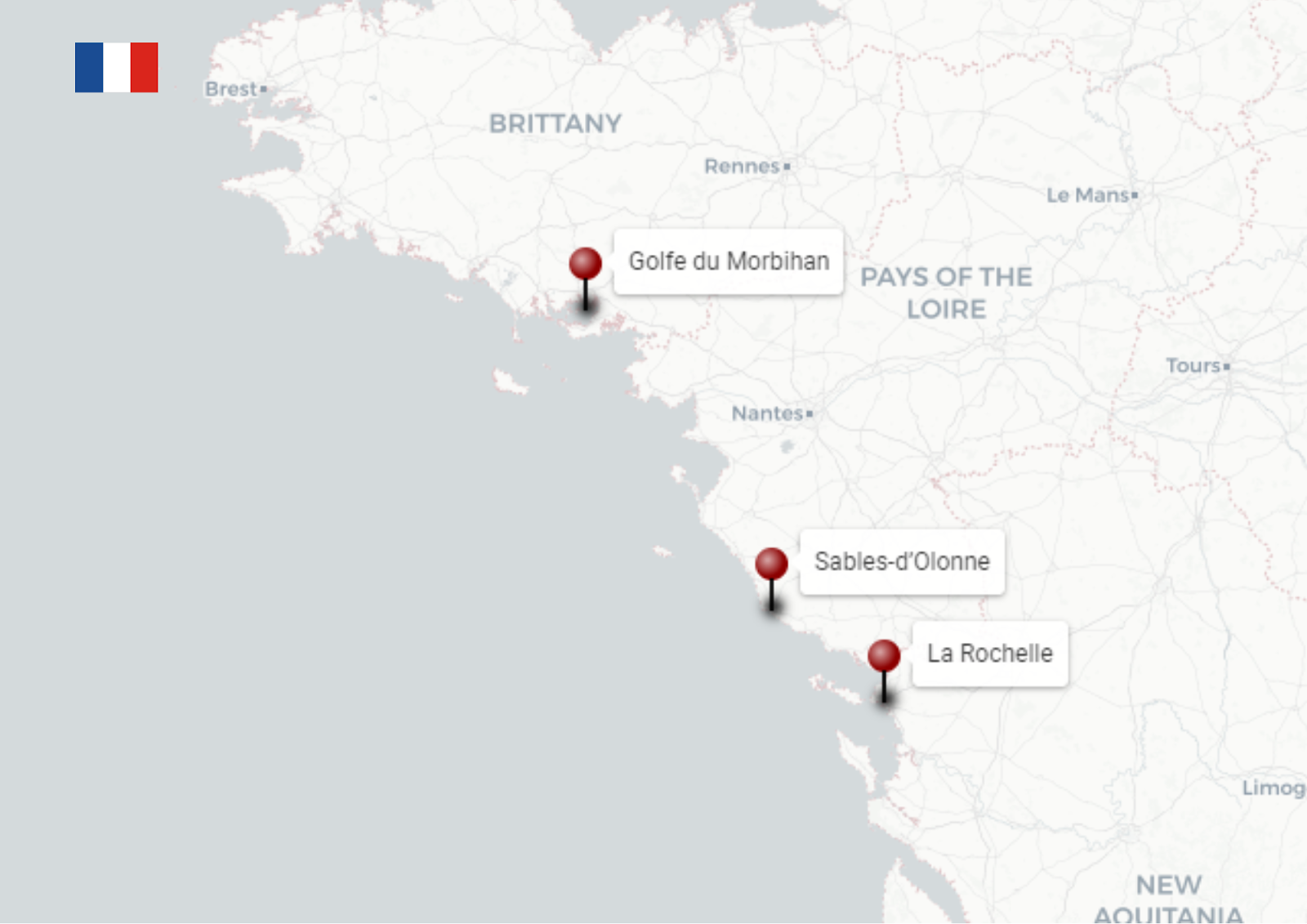
21–30 June 2026 — FRIGATE “SHTANDART” — Family sea cruise  along the French Atlantic coast, from La Rochelle (Charente-Maritime) to Saint-Malo (Ille-et-Vilaine), via Belle-Île-en-Mer (Morbihan), Camaret-sur-Mer (Finistère), and Île-aux-Moines / the Sept Îles (Côtes-d’Armor).

https://kombat-tour.ru/tours/fregat-shtandart
https://vk.com/wall-21985_18938

The purpose of this letter is to inform your company of the European legal restrictions that may affect such services, in order to help you avoid potential disputes with your clients. Those clients may be unable to embark or disembark, or could even be detained by law enforcement authorities, as happened in Portugal at the end of September 20251.

On 7 July 2024, the Prefect of Finistère issued a decree2 enforcing the European ban in all ports of the department (including Camaret-sur-Mer). Similar decrees were issued for the Côtes-d’Armor3 (including Île-aux-Moines) and Ille-et-Vilaine4 (including Saint-Malo). Furthermore, the Atlantic Maritime Prefecture prohibits Russian vessels under sanctions from entering the Bay of Douarnenez, the Brest narrows, and the Brest roadstead.

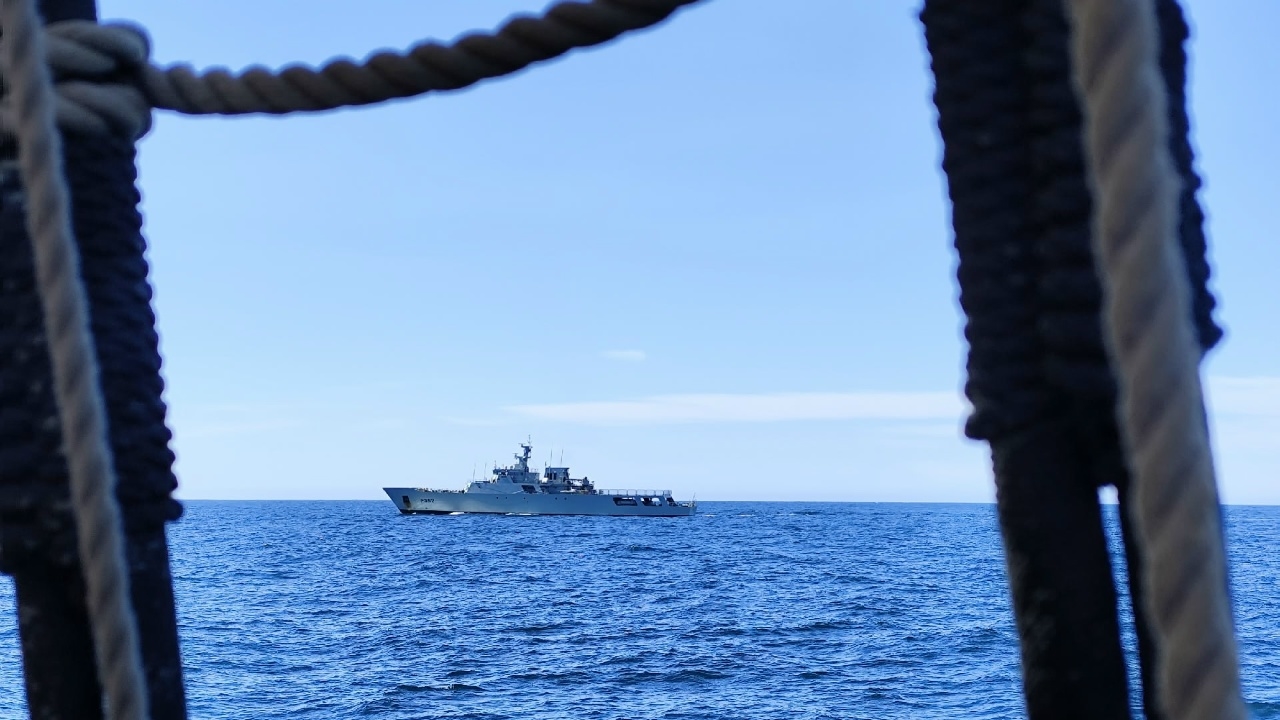
On 11 July 2024, the TS Shtandart filed a legal challenge before the Administrative Court of Rennes against the Finistère Prefect’s decree5. The appeal was dismissed. That same day, the maritime authorities dispatched a patrol vessel to prevent the Russian ship from forcing entry into the Brest narrows6. On 18 November 2024, the French Council of State confirmed this decision7.

On 22 August 2025, the Court of Justice of the European Union, in Order T-446/24, confirmed the validity of the port entry ban for Russian vessels, including historical replicas, throughout the European Union8. This decision, following the previous rulings, is final and not subject to appeal.

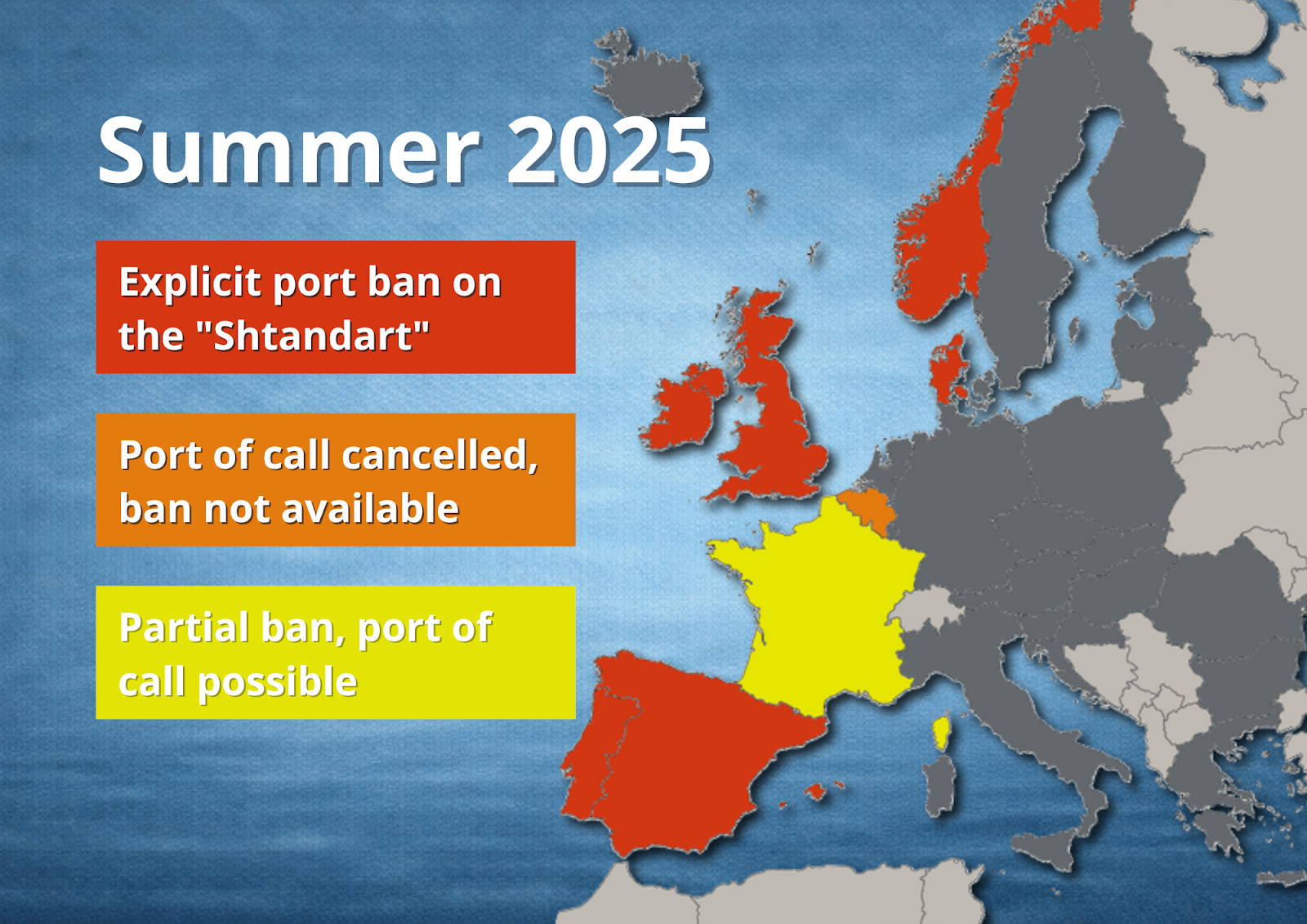
Additionally, the authorities of the United Kingdom9 10 and Norway11 announced equivalent restrictions during the summer of 2025. Therefore, Captain Vladimir Martus’s vessel has no legal justification to navigate freely along European coasts, unless it can prove a direct route to a Russian port in the Baltic, Barents, or White Seas. Consequently, according to Montego Bay convention, it has no serious grounds to demand stopovers in European ports. 

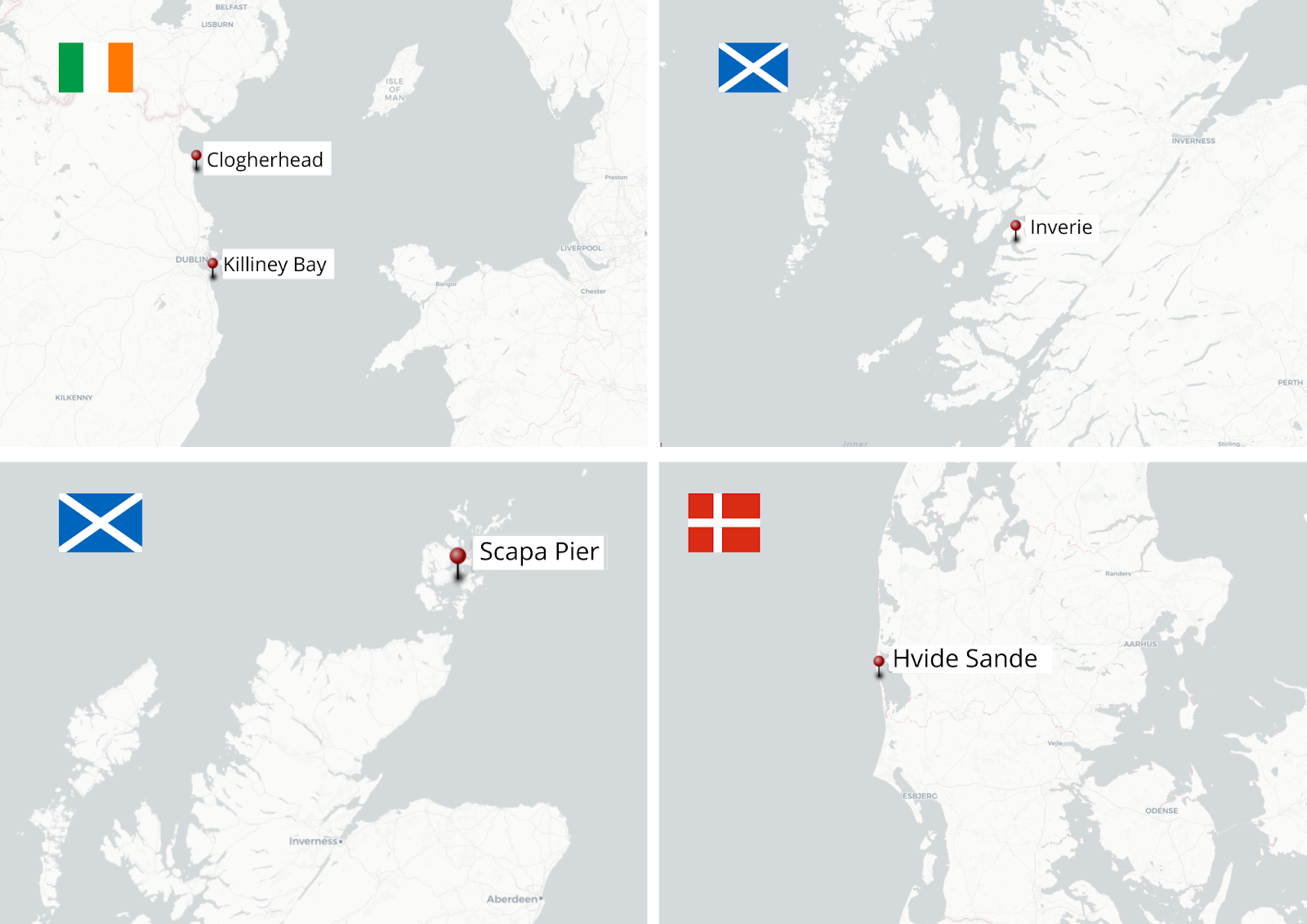
It should also be recalled that the TS Shtandart has been banned from Spanish territorial waters since 27 July 2024 [12]12 and from Portuguese waters since late September 2025 [13]13. Similar action could soon be taken by Ireland14 15 and Denmark 16, following unannounced and unauthorized port calls in July 2025.

In France, despite occasional cooperation from certain local authorities with Russian interests17,  a similar measure cannot be ruled out.

The ship’s captain may once again invoke the presence of children on board in order to obtain port access — a strategy observed in Vigo in July 2022. While European maritime authorities act with prudence and empathy, this method is now well known and anticipated.

Passenger disembarkation would be allowed, but the risk of the TS Shtandart being detained at berth, as occurred in Saint Petersburg between 200718 and 200919, should not be underestimated. Any further commercial operations would then become impossible to carry out.

Consequently, I strongly advise your company not to advertise or accept bookings, deposits, or payments for any cruises or voyages aboard the TS Shtandart within European waters.

It would be more prudent to focus activities on areas not affected by such restrictions, such as:

  •  the Turkish coast, which remains very popular with Russian tourists;
  • the ports of Montenegro, welcoming an affluent Russian clientele for parties, events and short cruises;
  •  or Tunisia, whose ports — Tabarka, Bizerte, Sidi Bou Saïd, Mahdia, Djerba, etc. offer picturesque anchorages in a rich historical setting.

Tunisia also maintains a living tradition of wooden shipbuilding, allowing maintenance and repairs at significantly lower cost than in Western Europe20. Moreover, “pirate ship” excursions are highly popular there21; the TS Shtandart, with its authenticity, could occupy a premium niche in this market.

Thank you for your attention. Please feel free to contact me should you require any further information.

Yours sincerely,

Bernard Grua
Nantes, Brittany, France
Former Naval Officer
Contributions to Russia Beyond — cultural reports on Siberia and Lake Baikal [22]22

Notes

  1. Delfi, 26/09/2025 – В Португалии задержаны члены экипажа российского парусника « Штандарт »: среди задержанных — россиянин из Латвии (26) ↩︎
  2. Préfet du Finistère, 07/07/2024 – Arrêté préfectoral appliquant l’interdiction européenne aux ports du département ↩︎
  3. Actu.fr, 03/07/2025 — Côtes-d’Armor : Une frégate russe, interdite d’accoster en France, aperçue dans une baie ↩︎
  4. Le Télégramme, 19/06/2025 — « Il a toujours interdiction d’entrer » : le « Shtandart » devra stationner au mouillage à l’extérieur du port de Saint-Malo. ↩︎
  5. Tribunal administratif de Rennes, 11 juillet 2024 – Rejet du référé contre l’arrêté du préfet du Finistère ↩︎
  6. Le Télégramme, 11/07/2024 – Dans l’attente de la décision de justice, le Shtandart patiente à l’entrée de la rade de Brest sous bonne escorte ↩︎
  7. Conseil d’Etat, 18/11/2024 – Arrêt rejetant le pourvoi du Shtandart contre l’ordonnance du tribunal administratif de Rennes ↩︎
  8. Court of Justice of the European Union, 22/08/2025 – Order in Case T-446/24 ↩︎
  9. TASS, 17/07/2025 – Консульство РФ назвало абсурдом запрет кораблю « Штандарт » зайти в порт ↩︎
  10. TASS, 18/07/2025 – Russia’s Consulate General slams banning frigate Shtandart from entering Scottish harbor ↩︎
  11. Sail Training International, 15/07/2025 – Statement regarding shtandart’s participation in the Tall Ships Races 2025 ↩︎
  12. El Mundo, 27/07/2024 — Expulsan de aguas españolas a un velero ruso que fondeó en Galicia sin permiso. ↩︎
  13. Autoridad Marítima Nacional (AMN), 24/09/2025 – Marítima Nacional monitoriza veleiro TS SHTANDART ao longo da costa portuguesa ↩︎
  14. The Journal.ie, 08/07/2025 – TD (Irish MP) calls for ‘Russian’ replica sailing ship to be removed from Irish waters off Dublin ↩︎
  15. The Journal, 09/07/2025 – Controversial ‘Russian’ replica sailing ship leaves Irish waters (but not before garda visit) ↩︎
  16. tvSyd, 07/08/2025 – Formodet russisk spionskib lå flere dage i dansk havn: Kaptajn Vladimir hemmeligholdt besøge ↩︎
  17. Desk Russie, 28/09/2025 – Quand le navire russe Shtandart et La Rochelle défient les sanctions européennes ↩︎
  18. Komsomolskaya Pravda, 21/09/2007 – Символ города фрегат «Штандарт» признали кучей дров ↩︎
  19. Komsomolskaya Pravda, 04/11/2009 – «Штандарт» поступает нестандартно ↩︎
  20. Bernard Grua, 31/05/2021 : Kerkennah (Tunisie) : les chantiers traditionnels du vieux port d’El Attaya ↩︎
  21. Pirate activities, Djerba, 2025 ↩︎
  22. Articles published by Bernard Grua in the Russian state cultural magazine Russia Beyond:
    « Méconnue mais fascinante: la Sibérie au gré des sept clichés les plus prisés d’un voyageur nantais », Russia Beyond, 8 novembre 2020
    « Vallée sibérienne de la Tounka: fascinante héritière des Mongols et observatrice des corps célestes », Russia Beyond, 3 avril 2019
    « Botogol: la mine perdue d’un Français dans les monts Saïan sibériens », Russia Beyond, 9 septembre 2018 ↩︎

Читать также

Страница Комбат-Туры

Комбат-Туры

Комбат-Туры предлагает семейный круиз на фрегате «Штандарт» в июне 2026 года. Этот рейс нарушает санкции ЕС и может привести к задержанию участников.

Другие статьи о Комбат-Туры

Комбат Туры – Предупреждение о правовых рисках, связанных с плаванием на борту фрегата «Штандарт» в европейских водах

Смоленская компания «Комбат-Тур» была формально уведомлена о правовых ограничениях, касающихся запланированного «семейного круиза» на борту российского фрегата «Штандарт», который должен пройти вдоль берегов Бретани. Компания также была предупреждена, что её клиенты могут не получить разрешение на посадку или высадку, а в некоторых случаях даже подвергнуться задержанию правоохранительными органами.

Вниманию:
Руководству компании Комбат-Туры
ул. Коммунистическая, д. 4Б
Смоленск
Россия
+7 906 668-45-55
info@kombat-tour.ru
org@kombat-tour.ru

Копии:
Префектура морского командования Атлантики (Premar-CECLANT) — Главнокомандующий Атлантическим флотом
Префект департамента Финистер
Префект департамента Кот-д’Армор
Префект департамента Иль-и-Вилен

Тема: Комбат-туры — Юридические риски, связанные с рейсами на борту парусника TS «Штандарт» в водах Европы

6 ноября 2025 г.

Уважаемые господа,

Ваша компания Комбат-туры, зарегистрированная в Смоленске (Россия), рекламирует морские путешествия на борту парусного судна TS «Штандарт» (MMSI nº 518999255). В частности, на сайте представлено следующее предложение:

21–30 июня 2026 г. — ФРЕГАТ «Штандарт» — Семейный морской круиз вдоль атлантического побережья Франции: из Ла-Рошели (департамент Шаранта-Приморская) в Сен-Мало (департамент Иль-и-Вилен) через Белиль-ан-Мер (Морбиан), Камаре-сюр-Мер (Финистер) и Иль-о-Муэн / Септ-Иль (Кот-д’Армор).
https://kombat-tour.ru/tours/fregat-shtandart
https://vk.com/wall-21985_18938

Настоящее письмо направлено с целью проинформировать вашу компанию о действующих в Европе правовых ограничениях, которые могут повлиять на выполнение таких рейсов, и тем самым помочь избежать возможных споров с клиентами.

Следует учитывать, что пассажиры могут не получить разрешение на посадку или высадку, а в отдельных случаях даже быть задержаны правоохранительными органами, как это произошло в Португалии в конце сентября 2025 г. 1

7 июля 2024 г. префект департамента Финистер издал распоряжение2, применяющее европейский запрет на заход российских судов во все порты департамента (включая Камаре-сюр-Мер). Аналогичные приказы были опубликованы в департаментах Кот-д’Армор3 (включая Иль-о-Муэн) и Иль-и-Вилен4 (включая Сен-Мало).

Кроме того, морская префектура Атлантики запретила российским судам, подпадающим под санкции, входить в бухту Дуарнене, в пролив Бреста и в Брестскую гавань.

11 июля 2024 г. судно TS «Штандарт» подало иск в административный суд г. Рен против распоряжения префекта Финистера5. Жалоба была отклонена. В тот же день морские власти направили патрульное судно, чтобы не допустить попытки «Штандарт» прорваться в пролив Бреста6. 18 ноября 2024 г. Государственный совет Франции подтвердил это решение7.

22 августа 2025 г. Суд Европейского союза вынес определение по делу T-446/24, которым подтвердил законность запрета на заход российских судов, включая исторические реплики, во все порты Европейского союза8. Это решение, принятое после предыдущих судебных актов, является окончательным и обжалованию не подлежит.

Кроме того, власти Великобритании9 10 и Норвегии11 летом 2025 г. ввели аналогичные ограничения. Следовательно, судно капитана Владимира Мартуса не имеет законных оснований для свободного плавания вдоль европейских берегов, если только не будет доказано, что оно следует непосредственно в российский порт Балтийского, Баренцева или Белого морей.

Соответственно, в соответствии с Конвенцией ООН по морскому праву (Монтего-Бей), судно не имеет достаточных оснований требовать стоянок в портах Европы.

Также следует напомнить, что TS «Штандарт» запрещён к заходу в территориальные воды Испании с 27 июля 2024 г.12 и в воды Португалии с конца сентября 2025 г.13. Аналогичные меры могут вскоре быть приняты Ирландией14 15 и Данией16 после незаявленных и несанкционированных стоянок, имевших место в июле 2025 г.

Во Франции, несмотря на эпизодическое сотрудничество некоторых местных властей с российскими структурами17, нельзя исключать введения аналогичных мер.

Капитан судна может вновь сослаться на присутствие детей на борту, пытаясь добиться разрешения на швартовку — такой приём был отмечен в Виго в июле 2022 г. Европейские морские власти действуют сдержанно и гуманно, однако данный метод уже хорошо известен и предсказуем.

Высадка пассажиров, вероятно, будет разрешена, однако риск задержания «Штандарт» у причала, как это уже происходило в Санкт-Петербурге в 200718 — 2009 гг.19, нельзя недооценивать. После этого выполнение коммерческих рейсов станет фактически невозможным.

В связи с изложенным настоятельно рекомендую вашей компании не рекламировать и не принимать бронирования, авансы или платежи за круизы на борту TS «Штандарт» в европейских водах.

Более разумным будет сосредоточить деятельность в регионах, не подпадающих под указанные ограничения, например:

  • побережье Турции, традиционно популярное среди российских туристов;
  • порты Черногории, куда приезжает состоятельная российская публика для проведения мероприятий и коротких морских прогулок;
  • а также Тунис, где порты Табарка, Бизерта, Сиди-Бу-Саид, Махдия, Джерба и др. предлагают живописные стоянки в исторической обстановке.

В Тунисе также сохранились традиции деревянного судостроения, что позволяет проводить обслуживание и ремонт по значительно более низким ценам, чем в Западной Европе20. Кроме того, популярны прогулки на кораблях «пиратского» типа21 — аутентичный фрегат «Штандарт» мог бы занять престижную нишу в этом сегменте рынка.

Благодарю за внимание. Готов предоставить дополнительные сведения по запросу.

С уважением,

Бернар Груа
г. Нант, Бретань, Франция
Бывший офицер военно-морских сил
Публикации в издании Russia Beyond — культурные репортажи о Сибири и озере Байкал22

Notes

  1. Delfi, 26/09/2025 – В Португалии задержаны члены экипажа российского парусника « Штандарт »: среди задержанных — россиянин из Латвии (26) ↩︎
  2. Préfet du Finistère, 07/07/2024 – Arrêté préfectoral appliquant l’interdiction européenne aux ports du département ↩︎
  3. Actu.fr, 03/07/2025 — Côtes-d’Armor : Une frégate russe, interdite d’accoster en France, aperçue dans une baie ↩︎
  4. Le Télégramme, 19/06/2025 — « Il a toujours interdiction d’entrer » : le « Shtandart » devra stationner au mouillage à l’extérieur du port de Saint-Malo. ↩︎
  5. Tribunal administratif de Rennes, 11 juillet 2024 – Rejet du référé contre l’arrêté du préfet du Finistère ↩︎
  6. Le Télégramme, 11/07/2024 – Dans l’attente de la décision de justice, le Shtandart patiente à l’entrée de la rade de Brest sous bonne escorte ↩︎
  7. Conseil d’Etat, 18/11/2024 – Arrêt rejetant le pourvoi du Shtandart contre l’ordonnance du tribunal administratif de Rennes ↩︎
  8. Court of Justice of the European Union, 22/08/2025 – Order in Case T-446/24 ↩︎
  9. TASS, 17/07/2025 – Консульство РФ назвало абсурдом запрет кораблю « Штандарт » зайти в порт ↩︎
  10. TASS, 18/07/2025 – Russia’s Consulate General slams banning frigate Shtandart from entering Scottish harbor ↩︎
  11. Sail Training International, 15/07/2025 – Statement regarding shtandart’s participation in the Tall Ships Races 2025 ↩︎
  12. El Mundo, 27/07/2024 — Expulsan de aguas españolas a un velero ruso que fondeó en Galicia sin permiso. ↩︎
  13. Autoridad Marítima Nacional (AMN), 24/09/2025 – Marítima Nacional monitoriza veleiro TS SHTANDART ao longo da costa portuguesa ↩︎
  14. The Journal, 08/07/2025 – TD (Irish MP) calls for ‘Russian’ replica sailing ship to be removed from Irish waters off Dublin ↩︎
  15. The Journal, 09/07/2025 – Controversial ‘Russian’ replica sailing ship leaves Irish waters (but not before garda visit) ↩︎
  16. tvSyd, 07/08/2025 – Formodet russisk spionskib lå flere dage i dansk havn: Kaptajn Vladimir hemmeligholdt besøge ↩︎
  17. Desk Russie, 28/09/2025 – Quand le navire russe Shtandart et La Rochelle défient les sanctions européennes ↩︎
  18. Komsomolskaya Pravda, 21/09/2007 – Символ города фрегат «Штандарт» признали кучей дров ↩︎
  19. Komsomolskaya Pravda, 04/11/2009 – «Штандарт» поступает нестандартно ↩︎
  20. Bernard Grua, 31/05/2021 : Kerkennah (Tunisie) : les chantiers traditionnels du vieux port d’El Attaya ↩︎
  21. Pirate activities, Djerba, 2025 ↩︎
  22. Articles published by Bernard Grua in the Russian state cultural magazine Russia Beyond:
    « Méconnue mais fascinante: la Sibérie au gré des sept clichés les plus prisés d’un voyageur nantais », Russia Beyond, 8 novembre 2020
    « Vallée sibérienne de la Tounka: fascinante héritière des Mongols et observatrice des corps célestes », Russia Beyond, 3 avril 2019
    « Botogol: la mine perdue d’un Français dans les monts Saïan sibériens », Russia Beyond, 9 septembre 2018 ↩︎

Читать также

La « grande culture russe », matrice d’un suprémacisme à l’origine de la guerre en Ukraine

Depuis février 2022, beaucoup cherchent à dissocier la guerre menée par la Russie de ce qu’on appelle la « grande culture russe ». Cette distinction, flatteuse pour les consciences occidentales, permet de continuer à admirer Tolstoï, Tchaïkovski ou Tarkovski sans malaise. Pourtant, si l’on examine la structure même de ce que recouvre cette expression, il faut reconnaître que le concept de « grande culture russe » est intrinsèquement porteur d’une injustifiable hiérarchie civilisationnelle. Il a puissamment contribué à rendre pensable et acceptable la guerre d’agression contre l’Ukraine.

« Grande culture russe » et russophilie française

L’expression « grande culture russe » s’est imposée à l’étranger, surtout en France, moins par la réalité de sa production artistique que par une habile construction politique et symbolique. Depuis le XIXᵉ siècle, la Russie a cultivé ce mythe pour affirmer son prestige international, en mettant en avant quelques figures isolées comme emblèmes d’un supposé génie national. Ce récit a trouvé un terrain favorable dans la fascination romantique pour la soi-disant « âme slave » et, plus tard, dans la sympathie soviétique pour une culture perçue comme héroïque et populaire. Ainsi, la « grande culture russe » relève d’une stratégie d’influence et non pas d’une supériorité artistique réelle.

Françoise Thom1 : « Le néo-eurasisme et le mythe d’une «civilisation russe » se nourrissent d’un slavophilisme idéologique, héritier des doctrines impériales, plus qu’ils ne traduisent une réalité culturelle. »

Le mythe s’est d’autant plus facilement imposée en France que ses citoyens sont ignorants de la réalité russe et que l’opacité enveloppant ce pays est un terrain fertile à la projection de fantasmes culturels, familiaux, sociaux et politiques.

Françoise Thom2 : « En Occident, on donne dans le kitsch slavophile. »

Comme le notent Schmitt et d’autres, l’admiration française pour la « culture russe » se fonde souvent sur des prémisses erronées : « Pouchkine ne justifie pas de s’allier avec Poutine »3 (Schmitt). L’historien  de la littérature rappelle qu’au XIXᵉ siècle, « le peuple français… était ignorant de l’empire des tsars et ses us et coutumes »4, ce qui laisse penser que cette « Russie » idéalisée n’a longtemps été qu’un produit de l’imagination française.

Une culture pensée depuis le centre

La Russie s’est construite comme un empire bien avant de se concevoir comme une nation. Son système politique, son art et sa spiritualité se sont formés autour d’une idée : Moscou comme centre du monde slave et orthodoxe, héritière de Byzance et dépositaire de la « vérité universelle ».

Richard Pipes5 : « La vision de la Russie comme centre moral et spirituel de l’univers slave a servi à légitimer son expansion et sa domination sur ses voisins. »

Dans ce cadre, les autres peuples — Ukrainiens, Biélorusses, Tatars, peuples du Caucase ou de Sibérie — n’étaient pas niés, mais subordonnés : ils participaient d’une culture commune dont le cœur, la langue et la légitimité demeuraient russes. Ce n’était pas seulement une domination politique : c’était une hiérarchie culturelle intériorisée.

Oleg Kharkhordin6 : « La culture russe a été régulièrement mobilisée pour légitimer la conquête et l’expansion, présentant la politique impériale comme un devoir civilisateur. »

Le « grand » comme instrument de domination

Parler de grande culture russe (великая русская культура) n’est pas une simple formule laudative : c’est un dispositif de pouvoir symbolique.

Svetlana Alexievitch7 : « Je me suis rendu compte que la guerre nous habitait. Que c’était notre culture. Les gens parlent de la grande culture de la Russie, mais l’élément principal de cette « grande culture russe », c’est la guerre. »

« Grande » par rapport à quoi ? Par rapport à des cultures « petites », « locales » ou « périphériques », dont l’existence même semble devoir être mesurée à l’aune de ce que se considérait la culture russe. Cette grandeur, célébrée à Saint-Pétersbourg comme à Paris, a toujours impliqué la capacité de parler pour les autres, de représenter l’universel à partir du centre impérial. Sous le tsarisme, cette hiérarchie justifiait la russification ; sous l’URSS, elle a pris la forme d’un « internationalisme » où le russe restait la langue de la prétendue civilisation ; aujourd’hui, elle se reformule dans le « monde russe » (russki mir), instrument idéologique du Kremlin.

Vladimir Poutine8 : « Le rôle clé et unificateur dans la conscience historique du peuple russe multinational appartient à la langue russe, c’est-à-dire à la grande culture russe. »

Une hégémonie culturelle partagée par les opposants

Le plus troublant est que cette matrice impériale transcende les clivages politiques.

Françoise Thom1 : « Même les opposants au Kremlin se situent souvent dans le cadre d’une culture politique qui ne remet pas en question l’idée d’empire russe. »

Alexeï Navalny, héros de la résistance à Poutine, incarnait une lutte pour la justice et la liberté — mais à l’intérieur des frontières mentales de l’empire. Son nationalisme assumé, son refus de reconnaître la souveraineté ukrainienne sur la Crimée, ou son mépris pour les migrants du Caucase, montrent à quel point le sentiment de supériorité russe reste structurel, même parmi les opposants « démocrates ». En Russie, contester le pouvoir ne revient pas nécessairement à contester l’idée d’empire.

De l’esthétique à la guerre

Le culte de la « grande culture » sert aujourd’hui de paravent moral à la violence impériale. Les bombardements de Kharkiv ou d’Odessa sont « justifiés » au nom de la « défense du monde russe », de la « civilisation orthodoxe », de la « langue de Tolstoï ». Ce n’est donc pas un détournement accidentel : c’est la conséquence logique d’un imaginaire culturel où la fantasmagorique universalité russe nie la pluralité du monde.

Ainsi, la guerre en Ukraine n’est pas un dévoiement de la culture russe. Elle est le produit de son mythe central : celui d’une grandeur naturelle alléguée, d’une pseudo vocation civilisatrice et de la revendication infondée d’une supériorité morale sur d’autres nations qualifiées, avec mépris, de « petits peuples ».

Cf. Timothy Snyder9 : « L’invocation de l’histoire et de la culture russes sert à justifier l’agression militaire et l’expansionnisme, donnant à la guerre un vernis moral. »

Pour une relecture décoloniale

Reconnaître cela ne revient pas à rejeter Tolstoï ou Tchaïkovski, mais à cesser de les idolâtrer comme emblèmes d’un universalisme sans tache. Il est temps de lire la culture russe comme une culture impériale parmi d’autres, avec ses beautés, ses ombres, son absence d’humanisme, sa cruauté et ses violences. Et d’écouter, enfin, les voix russes, ukrainiennes, caucasiennes, sibériennes ou tatares qui s’efforcent de décoloniser l’imaginaire russe, souvent au prix de l’exil, du silence, de la torture ou de l’assassinat.

Serhii Plokhy10 : « L’histoire ukrainienne et les voix périphériques de l’empire montrent combien la culture russe a été construite comme un projet impérial, et comment ces voix décoloniales sont souvent muselées ou ignorées. »

Conclusion

Le suprémacisme russe n’est pas né dans les casernes, mais dans les bibliothèques, les cathédrales et les académies. La guerre d’Ukraine est d’abord une guerre de « culture », menée par des incultes et par un pouvoir qui s’appuie sur des siècles de hiérarchie symbolique. Tant que la Russie n’aura pas déconstruit son propre mythe de « grande culture », elle ne pourra ni devenir démocratique, ni vivre en paix avec ses voisins — ou avec elle-même.

Notes

  1. Françoise Thom, Comprendre le poutinisme, Paris, Fayard, 2019. ↩︎
  2. Le Monde, Françoise Thom, la procureure de Poutine , 2019 ↩︎
  3. Olivier Schmitt, Pourquoi Poutine est notre allié ?, 2017 ↩︎
  4. Murielle Lucie Clément, L’Image des Russes et de la Russie dans le roman français de 1900 à nos jours, 2010 ↩︎
  5. Richard Pipes, Russia Under the Bolshevik Regime, New York, Vintage Books, 1994 ↩︎
  6. Oleg Kharkhordin, The Collective and the Individual in Russia: A Study of Practices, Berkeley, University of California Press, 1999. ↩︎
  7. Svetlana Alexievitch : Nous sommes confrontés au fascisme russe, Voxeurop, 2023 ↩︎
  8. Président de la fédération de Russie Décret portant approbation des principes fondamentaux de la politique culturelle de l’État, 25/01/2023 ↩︎
  9. Timothy Snyder, The Road to Unfreedom: Russia, Europe, America, New York, Tim Duggan Books, 2018 ↩︎
  10. Serhii Plokhy, The Gates of Europe: A History of Ukraine, New York, Basic Books, 2015 ↩︎

Sur le même sujet

Comprendre le front culturel russo-ukrainien

Promouvoir la culture russe aujourd’hui revient à soutenir le « ruscisme », une archaïque idéologie expensionniste et colonialiste panrusse mise à jour de pratiques génocidaires ayant de nombreux points communs avec le nazisme. S’en faire l’avocat, consiste à, de facto, en approuver les modalités techniques que sont les destructions organisées de la culture et du patrimoine de…

Keep reading

Tout oppose la culture ukrainienne et la « culture russe »

Afin de sortir d’un schéma mortifère pluri-centenaire, porté à son paroxysme depuis le 24 février 2022, la culture ukrainienne ne peut pas et ne doit pas coexister avec la culture russe, dans un même espace et lors d’un même événement. C’est une prophylaxie élémentaire.

Keep reading

Septembre 2025 en Images : Comment la Fraude du Navire Russe « Shtandart » s’est-elle Fracassée contre le Portugal ?

Septembre 2025 a marqué l’effondrement spectaculaire de la fraude du navire russe Shtandart le long des côtes portugaises. Pendant des années, ce bâtiment — présenté comme une « réplique historique » et un symbole d’amitié entre les nations — a en réalité servi de plateforme de propagande et d’influence liée au Kremlin. Rejeté de port en port à travers l’Europe, le Shtandart a finalement trouvé son épilogue au Portugal.

De Leixões à Cascais, jusqu’à Sagres, le voyage du navire s’est transformé en une suite d’échecs, de refus et d’interceptions. Les autorités maritimes portugaises, soutenues par des mouvements civiques tels que la communauté ukrainienne et No Shtandart in Europe, ont appliqué avec fermeté les sanctions européennes. L’ancien « ambassadeur de la culture russe », naguère célébré, s’est révélé pour ce qu’il était réellement : un instrument de manipulation, échoué sous la tempête de la vérité et de la responsabilité.


  1. Blocus du navire russe TS Shtandart sur le Douro : Leixões, Matosinhos, Porto, Vila Nova…
  2. Échec du voilier russe TS Shtandart à Cascais
  3. Défaite de la frégate russe TS Shtandart en Algarve : Baleeira, Lagos, Sagres, Vila do Bispo
  4. Conclusion
  5. Voir tous les articles sur le Shtandart et la péninsule ibérique en septembre 2025

1. Blocus du navire russe TS Shtandart sur le Douro : Leixões, Matosinhos, Porto, Vila Nova…

Pavlo Sadokha (Facebook, 21 septembre 2025)Nous remercions les autorités portugaises d’avoir refusé aujourd’hui l’entrée au port de Matosinhos à la frégate russe.

Le Shtandart mène des activités d’espionnage et de propagande au profit du régime de Poutine.
➡️ Lire la suite…

Blocus du navire russe TS Shtandart sur le Douro : Leixões, Matosinhos, Porto, Vila Nova…
SIC Notícias (21 septembre 2025)

Faro de Vigo (22 septembre 2025)Un navire de patrouille portugais escorte la frégate russe Shtandart afin d’empêcher son escale à Leixões.

Le voyage de la frégate TS Shtandart, de propiété russe mais battant pavillon des îles Cook, est sous surveillance. Et pas seulement par des collectifs tels que No Shtandart in Europe ou l’association des Ukrainiens du Portugal, mais aussi par les autorités maritimes portugaises.
➡️ Lire la suite…

Un navire de patrouille portugais escorte la frégate russe Shtandart afin d’empêcher son accostage à Leixões.
Routes parallèles du navire de patrouille Apúlia et de la frégate TS Shtandart.

2. Échec du voilier russe TS Shtandart à Cascais

Pavlo Sadokha (Facebook, 22 septembre 2025)Amis ! Tous ceux qui sont près de Cascais, Estoril, Oeiras.

Nous vous invitons à rejoindre la flashmob : Navire impérial russe, va te faire…!
➡️ Lire la suite…

Échec du voilier russe TS Shtandart à Cascais
Cascais : flashmob contre le navire impérial russe TS Shtandart
Русский военный корабль, иди на хуй!

Jorge Caravana (Facebook, 23 septembre 2025)Hier, à la même heure, j’ai prévenu la police maritime de Cascais !

Mon soupçon qu’il allait tenter d’accoster à la marina s’est confirmé ! La vigilance… n’est jamais de trop !!!
➡️ Lire la suite…

J’ai averti la police maritime de Cascais au sujet du voilier russe TS Shtandart.
Shtandart, Cascais
Jorge Caravana (Facebook, 23 septembre 2025) — Hier, à cette heure, j’ai prévenu la police maritime de Cascais !
Screenshot

Figueira Na Hora (25 septembre 2025)National : L’Autorité maritime nationale (AMN) surveille le voilier TS Shtandart le long des côtes portugaises.

L’AMN a refusé les demandes du capitaine du navire d’accéder aux ports nationaux, notamment à ceux du Douro et de Cascais, après avoir confirmé que le navire ne présentait aucune avarie de propulsion ou de gouvernail et que tout l’équipage était en bonne santé.
➡️ Lire la suite…

L’Autorité maritime nationale (AMN) surveille le voilier TS Shtandart
Polícia marítima

3. Défaite de la frégate russe TS Shtandart en Algarve : Baleeira, Lagos, Sagres, Vila do Bispo

Autoridade Marítima Nacional (24 septembre 2025) L’Autorité maritime nationale surveille le voilier TS SHTANDART le long des côtes portugaises

L’Autorité maritime nationale, par l’intermédiaire des capitaines de port et des commandants locaux de la police maritime, et en coopération avec la Marine portugaise, surveille et suit, depuis le 21 septembre, le voilier TS Shtandart battant pavillon des îles Cook.
➡️ Lire la suite…

Les autorités portugaises ont refusé l’accès aux ports nationaux au TS Shtandart, un navire qui a arboré le pavillon russe jusqu’en juin 2024.
Autoridade Marítima Nacional (AMN)

Notícias ao Minuto (24 septembre 2025)Le Portugal refuse l’accès du voilier russe aux ports nationaux.

Les autorités portugaises ont intercepté, mardi, une embarcation semi-rigide transportant des personnes et des biens destinés à embarquer sur le navire.
➡️ Lire la suite…

Voilier TS Shtandart battant pavillon des îles Cook — Photo : Autoridade Marítima Nacional.
© Autoridade Marítima Nacional

Algarve Primeiro (25 septembre 2025) Le Portugal refuse l’accès de ses ports nationaux à un voilier russe.

Les autorités portugaises ont refusé l’accès de leurs ports nationaux à un navire battant pavillon russe jusqu’en juin 2024 et ont intercepté mardi un bateau semi-rigide transportant des personnes et des marchandises destinées à embarquer sur le navire.
➡️ Lire la suite…

Les autorités portugaises ont refusé l'accès de leurs ports nationaux au voilier TS SHTANDART, un navire battant pavillon russe jusqu'en juin 2024 et ont intercepté mardi un bateau semi-rigide transportant des personnes et des marchandises destinées à embarquer sur le navire.
Foto Autoridade Marítima Nacional

Correio da Manhã (25 septembre 2025) Le Portugal refuse l’accès des ports nationaux à un voilier russe.

L’Autorité maritime nationale a expliqué qu’en coopération avec la Marine, elle suit et surveille le voilier TS Shtandart depuis le dimanche 21 septembre.
➡️ Lire la suite…

L’Autorité maritime nationale suit et surveille le voilier TS Shtandart depuis dimanche.
Marine et police maritime

Executive Digest (25 septembre 2025)La Marine et la police maritime interceptent un canot du navire russe près de Sagres.

Cinq membres d’équipage du TS Shtandart ont été interceptés alors qu’ils approchaient la côte, à bord d’un canot à moteur, près du port de Baleeira, à Sagres (commune de Vila do Bispo).
➡️ Lire la suite…

La Marine et la police maritime interceptent une embarcation appartenant au navire russe TS Shtandart près de Sagres.
Polícia marítima

Postal (25 septembre 2025)Les autorités refusent l’accès au voilier russe et renforcent la surveillance en Algarve.

Les autorités portugaises ont refusé l’accès aux ports nationaux à un navire battant pavillon russe jusqu’en juin 2024 et ont intercepté, mardi, un bateau semi-rigide transportant des personnes et des marchandises destinées à embarquer sur le navire.
➡️ Lire la suite…

Les autorités refusent l’accès au voilier russe TS Shtandart et renforcent la surveillance en Algarve.
Photo d’archives | AMN

Público (25 septembre 2025)L’Autorité maritime nationale refuse l’entrée d’un navire russe.

Conformément au règlement européen, le Portugal a interdiction de donner accès au voilier aux ports nationaux, mesure de sanction contre la Russie pour ses actions en Ukraine.
➡️ Lire la suite…

Le Portugal n’est pas autorisé à accorder au navire TS Shtandart l’accès à ses ports nationaux, dans le cadre des sanctions de l’Union européenne contre la Russie.
Les demandes d’entrée dans les ports de Douro et Cascais ont déjà été rejetées. ENRIC VIVES-RUBIO (ARCHIVES)

SIC Notícias (25 septembre 2025)Un voilier russe a tenté de changer d’équipage au Portugal.

La police maritime de Lagos indique que les membres d’équipage interceptés (deux Français, un Russe résidant en Lettonie et une Russe) ont présenté des versions contradictoires.
➡️ Lire la suite…

SIC Noticias, (September 25, 2025)

Fala Portugal (26 septembre 2025)Les autorités portugaises ont refusé l’entrée du voilier russe Shtandart dans les ports nationaux.

Ce refus s’inscrit dans l’application des sanctions imposées par l’Union européenne contre la Russie.
➡️ Lire la suite…


4. Conclusion

La chute du Shtandart au Portugal est bien plus que l’histoire d’un seul navire : c’est la fissure visible d’une façade beaucoup plus vaste. Pendant des années, ce voilier russe a navigué sous de faux prétextes, dissimulant sa propagande derrière les voiles d’un prétendu « patrimoine maritime ».

Mais de la Baltique à l’Atlantique, les démocraties européennes se montrent de moins en moins disposées à tolérer les symboles d’une nostalgie impériale déguisée en culture.

La position ferme du Portugal — refus d’entrée, interceptions d’embarcations de soutien et application rigoureuse des sanctions européennes — a fait écho à la détermination déjà manifestée par l’Espagne, l’Irlande, le Danemark, la Norvège et le Royaume-Uni.
En agissant ainsi, Lisbonne a envoyé un message clair : les ports d’Europe ne sont pas des refuges pour les vestiges de l’influence autoritariste.

Quand les nuages de tempête se sont refermés sur l’Atlantique, le voyage du Shtandart s’est achevé non pas dans le triomphe, mais dans les décombres — métaphore parfaite de l’effondrement de la fausse « diplomatie culturelle » de la Russie en Europe.


5. Voir tous les articles sur le Shtandart et la péninsule ibérique en septembre 2025

The « Shtandart » and the Iberian Peninsula: press review, summer 2025

In September 2025, the Russian sailing ship Shtandart was at the center of intense media attention and official monitoring across Europe. Maritime authorities in Portugal and Spain repeatedly denied it access to national ports, while European institutions maintained restrictions already in place under sanctions. Several reports noted attempts by the vessel to change its flag,…

Keep reading

September 2025 in Images: How the Fraud of the Russian Ship “Shtandart” Crashed Against Portugal?

September 2025 marked the spectacular collapse of the Russian tall ship Shtandart’s deception along the Portuguese coast. For years, this vessel — presented as a “historical replica” and a symbol of friendship between nations — had in fact operated as a propaganda and influence platform connected to the Kremlin. After being turned away from port after port across Europe, the Shtandart finally met its reckoning in Portugal.

From Leixões to Cascais and down to Sagres, the ship’s journey became a sequence of failures, denials, and interceptions. Portuguese maritime authorities, supported by citizen movements such as the Ukrainian community and No Shtandart in Europe, firmly enforced European sanctions. The once-celebrated “ambassador of Russian culture” ended up exposed for what it truly was — a vessel of manipulation, stranded under a storm of truth and accountability.


  1. Blockade of the Russian Ship TS Shtandart in Douro: Leixões, Matosinhos, Porto, Vila Nova…
  2. Failure of the Russian Sailing Ship TS Shtandart in Cascais
  3. Defeat of the Russian Frigate TS Shtandart in the Algarve: Baleeira, Lagos, Sagres, Vila do Bispo
  4. Conclusion

1. Blockade of the Russian Ship TS Shtandart in Douro: Leixões, Matosinhos, Porto, Vila Nova…

Pavlo Sadokha (Facebook, September 21, 2025)We thank the Portuguese authorities for not allowing today the entry of the Russian frigate Shtandart into the port of Matosinhos.

The ship carries out espionage and propaganda activities in favor of Putin’s regime.
➡️ Read more…

Blockade of the Russian Ship TS Shtandart in Douro: Leixões, Matosinhos, Porto, Vila Nova…
SIC Noticias (September 21, 2025)

Faro de Vigo (September 22, 2025)A Portuguese patrol vessel escorts the Russian frigate Shtandart to prevent it from docking at Leixões.

The voyage of the frigate TS Shtandart, of Russian capital but flying the flag of the Cook Islands, is under surveillance — not only by citizen collectives such as No Shtandart in Europe or the Association of Ukrainians in Portugal, but also by Portuguese maritime authorities.
➡️ Read more…

A Portuguese patrol vessel escorts the Russian frigate Shtandart to prevent it from docking at Leixões.
Parallel routes of the patrol boat Apulia and the frigate TS Shtandart

2. Failure of the Russian Sailing Ship TS Shtandart in Cascais

Pavlo Sadokha (Facebook, September 22, 2025)Friends! All those near Cascais, Estoril, Oeiras.

We invite you to join the flashmob: Imperial Russian ship sailing to… Portugal!
➡️ Read more…

Failure of the Russian Sailing Ship TS Shtandart in Cascais
Shtandart, Cascais
Cascais : flashmob against Imperial Russian ship TS Shtandart
Русский военный корабль, иди на хуй!

Jorge Caravana (Facebook, September 23, 2025)Yesterday at this time I warned the Maritime Police of Cascais!

My suspicion that it would try to dock at the Marina was confirmed!!! ATTENTION… there is never too much of it!!!
➡️ Read more…

I warned the Maritime Police of Cascais against Russian Sailing Ship TS Shtandart
Shtandart, Cascais
Jorge Caravana (Facebook, September 23, 2025) — Yesterday at this time I warned the Maritime Police of Cascais!
Screenshot

Figueira Na Hora (September 25, 2025)National: The National Maritime Authority (AMN) monitors the sailing ship TS Shtandart along the Portuguese coast.

The AMN has denied the captain’s requests for access to national ports — including Douro and Cascais, the latter on September 22 — after confirming that the ship showed no propulsion or steering failures and that the entire crew was in good health.
➡️ Read more…

The National Maritime Authority (AMN) monitors the sailing ship TS Shtandart
Polícia marítima

3. Defeat of the Russian Frigate TS Shtandart in the Algarve: Baleeira, Lagos, Sagres, Vila do Bispo

AMN, 24/09/2025National Maritime Authority monitors sailing ship TS SHTANDART along the Portuguese coast

The National Maritime Authority (AMN), through its respective Port Captains and Local Commanders of the Maritime Police and in cooperation with the Portuguese Navy, has been monitoring and tracking the Cook Islands-flagged sailing vessel TS SHTANDART since 21 September.
➡️ Read more…

National Maritime Authority monitors sailing ship TS SHTANDART along the Portuguese coast
Autoridade Marítima Nacional (AMN)

Notícias ao Minuto (September 24, 2025)Portugal denies access of Russian sailing vessel to national ports.

Portuguese authorities have refused access to national ports to a vessel that flew the Russian flag until June 2024 and, on Tuesday, intercepted a semi-rigid boat carrying people and goods intended to board the ship.
➡️ Read more…

Portuguese authorities have refused access to national ports to  TS Shtandart, a vessel that flew the Russian flag until June 2024
© Autoridade Marítima Nacional

Algarve Primeiro (September 25, 2025)Portugal denies access of Russian sailing vessel to national ports.

Portuguese authorities have refused access to national ports to a vessel that flew the Russian flag until June 2024 and intercepted, on Tuesday, a semi-rigid boat carrying people and goods intended to board the ship.
➡️ Read more…

Cook Islands-flagged sailing vessel TS SHTANDART: Foto Autoridade Marítima Nacional
Foto Autoridade Marítima Nacional

Correio da Manhã (September 25, 2025)Portugal denies access of Russian sailing vessel to national ports.

The National Maritime Authority explained that, in cooperation with the Navy, it has been monitoring and following the sailing ship TS Shtandart since Sunday (September 21, 2025).
➡️ Read more…

The National Maritime Authority has been monitoring and following the sailing ship TS Shtandart since Sunday
Marinha e polícia marítima

Executive Digest (September 25, 2025)Navy and Maritime Police intercept boat belonging to Russian ship near Sagres.

The Navy and Maritime Police intercepted, on Wednesday, five crew members from the Russian training ship TS Shtandart as they approached the coast in a motorboat near the port of Baleeira, in Sagres (Vila do Bispo municipality).
➡️ Read more…

Navy and Maritime Police intercept boat belonging to Russian shipTS Shtandart near Sagres.
Polícia marítima

Postal (September 25, 2025)Authorities deny access to Russian sailing ship and reinforce surveillance in the Algarve.

Portuguese authorities have refused access to national ports to a vessel that flew the Russian flag until June 2024 and intercepted, on Tuesday, a semi-rigid boat carrying people and goods intended to board the ship.
➡️ Read more…

Authorities deny access to Russian sailing ship TS Shtandart and reinforce surveillance in the Algarve.
Photo d’archives | AMN

Público (September 25, 2025)National Maritime Authority refuses entry to Russian vessel.

According to European regulations, Portugal is prohibited from granting the vessel access to national ports, as part of EU sanctions against Russia for its actions in Ukraine.
➡️ Read more…

Portugal is prohibited from granting the vessel TS Shtandart access to national ports, as part of EU sanctions against Russia.
Requests to enter the ports of Douro and Cascais have already been rejected. ENRIC VIVES-RUBIO (ARCHIVE)

SIC Noticias, (September 25, 2025) Russian Sailing Ship Tried to Change Crew in Portugal

The Maritime Police of Lagos stated that the intercepted crew members (two French citizens, one Russian living in Latvia, and one Russian woman) gave contradictory accounts.
➡️ Read more…

SIC Noticias, (September 25, 2025)

Fala Portugal (September 26, 2025)Portuguese authorities denied entry to a Russian sailing ship, the Shtandart, into national ports.

Russian sailing ship off the coast of Portugal — Portuguese authorities denied entry to a Russian vessel into national ports. The refusal complies with the sanctions imposed by the European Union against Russia.
➡️ Read more…

Fala Portugal (September 26, 2025)

4. Conclusion

The Shtandart’s downfall in Portugal is more than the story of a single ship — it’s the visible crack in a larger façade. For years, this Russian vessel sailed under false pretenses, hiding propaganda behind the sails of “maritime heritage.” Yet, from the Baltic to the Atlantic, European democracies have grown increasingly unwilling to tolerate symbols of imperial nostalgia disguised as culture.

Portugal’s firm stance — denying entry, intercepting support boats, and enforcing EU sanctions — echoed the resolve shown earlier by Spain, Ireland, Denmark, Norway, and the United Kingdom. In doing so, Lisbon sent a clear message: Europe’s ports are no place for the relics of authoritarian influence.

As the storm clouds closed over the Atlantic, the Shtandart’s voyage ended not with triumph, but with wreckage — a fitting metaphor for the collapse of Russia’s soft-power deception in Europe.


See all articles about the Shtandart and the Iberian Peninsula in September 2025

The « Shtandart » and the Iberian Peninsula: press review, summer 2025

In September 2025, the Russian sailing ship Shtandart was at the center of intense media attention and official monitoring across Europe. Maritime authorities in Portugal and Spain repeatedly denied it access to national ports, while European institutions maintained restrictions already in place under sanctions. Several reports noted attempts by the vessel to change its flag,…

Keep reading

Setembro de 2025 em imagens: como a fraude do navio russo « Shtandart » se despedaçou contra Portugal?

Setembro de 2025 marcou o colapso espetacular da fraude do navio russo Shtandart ao longo da costa portuguesa. Durante anos, esta embarcação — apresentada como uma “réplica histórica” e um símbolo de amizade entre as nações — operou, na realidade, como uma plataforma de propaganda e influência ligada ao Kremlin. Depois de ser rejeitado em porto após porto por toda a Europa, o Shtandart finalmente encontrou o seu desfecho em Portugal.

De Leixões a Cascais e até Sagres, a viagem do navio transformou-se numa sequência de fracassos, recusas e interceções. As autoridades marítimas portuguesas, apoiadas por movimentos cívicos como a comunidade ucraniana e o No Shtandart in Europe, aplicaram firmemente as sanções europeias. O outrora celebrado “embaixador da cultura russa” acabou exposto pelo que realmente era — um instrumento de manipulação, encalhado sob a tempestade da verdade e da responsabilidade.


  1. Bloqueio do navio russo TS Shtandart em Douro: Leixões, Matosinhos, Porto, Vila Nova…
  2. Falha do veleiro russo TS Shtandart em Cascais
  3. Derrota da fragata russa TS Shtandart em Algarve: Baleeira, Lagos, Sagres, Vila do Bispo.
  4. Conclusão

1. Bloqueio do navio russo TS Shtandart em Douro: Leixões, Matosinhos, Porto, Vila Nova…

Pavlo Sadokha FB, 21/09/2025— Agradecemos às autoridades portuguesas por não terem permitido hoje a entrada no porto de Matosinhos da fragata russa.

Shtandart, realiza atividades de espionagem e propaganda em benefício do regime de Putin.
➡️ Leia mais…

Bloqueio do navio russo TS Shtandart no Douro: Leixões, Matosinhos, Porto, Vila Nova…
SIC Noticias (September 21, 2025)

Faro de Vigo, 22/09/205 Um navio patrulha português escolta a fragata russa Shtandart para impedir a sua escala em Leixões.

A viagem da fragata TS Shtandart, de capital russo mas com bandeira das Ilhas Cook, está a ser vigiada. E não só por coletivos como o No Shtandart in Europe ou a associação de ucranianos de Portugal, mas também pelas autoridades marítimas portuguesas.
➡️ Leia mais…

Um navio-patrulha português escolta a fragata russa Shtandart para impedir a sua atracação em Leixões.
Rotas paralelas do barco patrulha Apulia e da fragata TS Shtandart

2. Falha do veleiro russo TS Shtandart em Cascais

Pavlo Sadokha FB, 22/09/2025Amigos! Todos os que estão perto de Cascais, Estoril, Oeiras,

Convidamos-vos a juntarem-se ao flashmob: Navio imperial russo, navega para… Portugal!
➡️ Leia mais…

Falha do veleiro russo TS Shtandart em Cascais
Shtandart, Cascais
Cascais: flashmob contra o navio imperial russo TS Shtandart
Русский военный корабль, иди на хуй!

Jorge Caravana, 23/09/2025 FB Ontem por esta hora avisei a Polícia Marítima de Cascais !

A minha suspeita de que ia tentar aportar na Marina de Confirmou-se!!! A ATENÇÃO… nunca é de mais !!!
➡️ Leia mais…

Avisei a Polícia Marítima de Cascais sobre o veleiro russo TS Shtandart
Shtandart, Cascais
Jorge Caravana (Facebook, 23 de setembro de 2025) — Ontem, a esta hora, avisei a Polícia Marítima de Cascais!
Screenshot
Figueira Na Hora, 25/09/2025 —Nacional: Autoridade Marítima Nacional monitoriza veleiro TS SHTANDART ao longo da costa portuguesa

AMN tem indeferido os pedidos de comandante do navio para aceder aos portos nacionais, nomeadamente do Douro e de Cascais, este último no dia 22 de setembro, após assegurar que o navio não possuía qualquer avaria no sistema de propulsão nem de governo, bem como que toda a tripulação se encontrava bem de saúde.
➡️ Leia mais…

A Autoridade Marítima Nacional (AMN) monitoriza o veleiro TS Shtandart
Polícia marítima

3. Derrota da fragata russa TS Shtandart em Algarve: Baleeira, Lagos, Sagres, Vila do Bispo.

AMN, 24/09/2025 Autoridade Marítima Nacional monitoriza veleiro TS SHTANDART ao longo da costa portuguesa

Autoridade Marítima Nacional (AMN), através dos respetivos Capitães dos Portos e Comandantes Locais da Polícia Marítima e em cooperação com a Marinha Portuguesa, encontra-se a monitorizar e a acompanhar, desde o dia 21 de setembro, o veleiro TS SHTANDART com bandeira das Ilhas Cook.
➡️ Leia mais…

A Autoridade Marítima Nacional acompanha o veleiro TS SHTANDART ao longo da costa portuguesa.
Autoridade Marítima Nacional (AMN)

Notícias ao Minuto, 24/09/2025 —Portugal nega acesso de veleiro russo aos portos nacionais

As autoridades portuguesas têm negado o acesso aos portos nacionais de um veleiro que teve bandeira russa até junho de 2024 e intercetaram, na terça-feira, uma embarcação semirrígida com pessoas e bens que pretendiam embarcar no navio.
➡️ Leia mais…

As autoridades portuguesas recusaram o acesso aos portos nacionais ao TS Shtandart, uma embarcação que hasteou a bandeira russa até junho de 2024.
© Autoridade Marítima Nacional

Algarve Primeiro, 25/09/2025 —Portugal nega acesso de veleiro russo aos portos nacionais

As autoridades portuguesas têm negado o acesso aos portos nacionais de um veleiro que teve bandeira russa até junho de 2024 e intercetaram, na terça-feira, uma embarcação semirrígida com pessoas e bens que pretendiam embarcar no navio.
➡️ Leia mais…

Veleiro TS SHTANDART com bandeira das Ilhas Cook — Foto: Autoridade Marítima Nacional.
Foto Autoridade Marítima Nacional

Correio da Manhã, 25/09/2025 —Portugal nega acesso de veleiro russo aos portos nacionais

De Autoridade Marítima Nacional explicou que, em cooperação com a Marinha, tem monitorizado e acompanhado, desde domingo (21/09/2025), o veleiro TS SHTANDART.
➡️ Leia mais…

A Autoridade Marítima Nacional tem vindo a monitorizar e a acompanhar o veleiro TS Shtandart desde domingo.
Marinha e polícia marítima

Executive Digest, 25/09/2025 —Marinha e Polícia Marítima intercetam bote de navio russo junto a Sagres

A Marinha e a Polícia Marítima intercetaram, esta quarta-feira, cinco tripulantes do navio-escola russo TS Shtandart quando se aproximavam da costa, em bote a motor, junto ao porto da Baleeira, em Sagres, no concelho de Vila do Bispo.
➡️ Leia mais…

A Marinha e a Polícia Marítima intercetaram um bote pertencente ao navio russo TS Shtandart junto a Sagres.
Polícia marítima

Postal, 25/09/2025 — Autoridades negam acesso a veleiro russo e reforçam vigilância no Algarve

As autoridades portuguesas têm negado o acesso aos portos nacionais de um veleiro que teve bandeira russa até junho de 2024 e intercetaram, na terça-feira, uma embarcação semirrígida com pessoas e bens que pretendiam embarcar no navio.
➡️ Leia mais…

As autoridades negam o acesso ao veleiro russo TS Shtandart e reforçam a vigilância no Algarve.
Foto de arquivo | AMN

Publico, 25/09/2025 Autoridade Marítima Nacional recusa entrada de embarcação russa

De acordo com o regulamento europeu, Portugal está proibido de facultar o acesso do veleiro aos portos nacionais, como medida de sanção à Rússia pelas suas acções na Ucrânia.
➡️ Leia mais…

Portugal está proibido de conceder acesso ao navio TS Shtandart aos portos nacionais, como parte das sanções da União Europeia contra a Rússia.
Já foram indeferidos pedidos de entrada nos portos do Douro e de Cascais ENRIC VIVES-RUBIO (ARQUIVO)

SIC Noticias, 25/09/2025Veleiro russo tentou trocar tripulação em Portugal

A Polícia Marítima de Lagos diz que os tripulantes intercetados (dois franceses, um russo radicado na Letónia e uma russa) apresentaram versões contraditórias.
➡️ Leia mais…

SIC Noticias, (September 25, 2025)

Fala Portugal, 26/09/2025 As autoridades portuguesas negaram a entrada de um veleiro russo, Shtandart , em portos nacionais

Veleiro Russo ao largo de Portugal — As autoridades portuguesas negaram a entrada de um veleiro russo em portos nacionais. A recusa cumpre as sanções impostas pela União Europeia contra a Rússia.
➡️ Leia mais…


Conclusão

A queda do Shtandart em Portugal é mais do que a história de um único navio — é a fenda visível numa fachada muito maior. Durante anos, esta embarcação russa navegou sob falsos pretextos, escondendo a propaganda por trás das velas do chamado “património marítimo”. No entanto, do Báltico ao Atlântico, as democracias europeias tornaram-se cada vez menos dispostas a tolerar símbolos de nostalgia imperial disfarçados de cultura.

A posição firme de Portugal — ao negar a entrada, intercetar embarcações de apoio e aplicar as sanções da União Europeia — ecoou a determinação já demonstrada por Espanha, Irlanda, Dinamarca, Noruega e Reino Unido. Ao fazê-lo, Lisboa enviou uma mensagem clara: os portos da Europa não são lugar para os vestígios da influência autoritária.

Quando as nuvens de tempestade se fecharam sobre o Atlântico, a viagem do Shtandart terminou não com triunfo, mas com destroços — uma metáfora perfeita para o colapso da falsa “diplomacia cultural” da Rússia na Europa.


Ver todos os artigos sobre o Shtandart e a Península Ibérica em setembro de 2025

The « Shtandart » and the Iberian Peninsula: press review, summer 2025

In September 2025, the Russian sailing ship Shtandart was at the center of intense media attention and official monitoring across Europe. Maritime authorities in Portugal and Spain repeatedly denied it access to national ports, while European institutions maintained restrictions already in place under sanctions. Several reports noted attempts by the vessel to change its flag,…

Keep reading

The « Shtandart » and the Iberian Peninsula: press review, summer 2025

In September 2025, the Russian sailing ship Shtandart was at the center of intense media attention and official monitoring across Europe. Maritime authorities in Portugal and Spain repeatedly denied it access to national ports, while European institutions maintained restrictions already in place under sanctions. Several reports noted attempts by the vessel to change its flag, conduct crew transfers at sea, and approach coastal areas through small craft.

Concerns highlighted in the press ranged from alleged links to Russia’s “ghost fleet” to suspicions of propaganda or intelligence-related activities. At the same time, civic groups and Ukrainian organizations across Europe voiced opposition to its presence, urging vigilance from local authorities.

While European ports remained closed, the Shtandart was received in Tangier, Morocco, marking a contrast between EU restrictions and external safe harbors. This review brings together press articles, official communications, and civil society reactions documenting the vessel’s movements and the debates surrounding them.


On this topic / Sobre este tema

Alerte : Possible entrée imminente dans les eaux territoriales et dans les ports tunisiens du navire contrevenant russe “TS Shtandart” 

Le navire russe TS Shtandart annonce une escale à Bizerte ce vendredi 3 octobre à 19 h, heure locale. Il a déconnecté son AIS depuis trois jours afin de dissimuler sa position et sa destination, à l’instar des navires de la flotte fantôme russe dont il partage de nombreuses caractéristiques.

À l’attention de : Autorités maritimes tunisiennes  

Objet : Alerte – Possible entrée imminente dans les eaux territoriales et dans les ports tunisiens du navire contrevenant russe TS Shtandart 

Le 3 octobre 2025.

Chère Madame, Cher Monsieur,

Je me permets de vous signaler respectueusement la possible arrivée, ce jour, dans vos ports, du navire russe TS Shtandart, MMSI 518999255, qui navigue sous le pavillon de complaisance des îles Cook depuis le 6 juin 2024.

Il annonce une escale à Bizerte ce vendredi 3 octobre à 19 h, heure locale. Il a déconnecté son AIS depuis trois jours afin de dissimuler sa position et sa destination, à l’instar des navires de la flotte fantôme russe dont il partage de nombreuses caractéristiques.

Ce navire est interdit dans les eaux territoriales espagnoles depuis le 27 juillet 2024, puis dans les eaux territoriales portugaises depuis septembre 2025. Voici le rapport des autorités maritimes portugaises à son sujet : https://www.amn.pt/Media/Paginas/DetalheNoticia.aspx?nid=6483. Vous trouverez ici une version traduite en français.

De plus, le TS Shtandart est interdit dans tous les ports de l’UE, du Royaume-Uni et de la Norvège.

Je souhaite porter à votre connaissance le fait que le TS Shtandart pénètre dans les eaux territoriales de différents pays sans demander d’autorisation. Il a également pour habitude de faire des escales non annoncées et non autorisées par les autorités maritimes des pays concernés. On peut récemment citer Clogherhead (Irlande), Inverie (Royaume-Uni) et Hvide Sande (Danemark). Il y a peu de temps, il a tenté de débarquer clandestinement au Portugal. Ce qui a valu l’arrestation des individus concernés, comme vous pouvez le lire dans le rapport ci-dessus.

Je me tiens à votre disposition pour tout complément d’information et vous prie, Chère madame, Cher monsieur, d’agréer l’expression de mes salutations distinguées.

Bernard Grua, Nantes, France 
Ancien officier de Marine (Lieutenant de vaisseau)
Porte-parole du collectif lanceur d’alerte

The case of the sailing ship Shtandart: defending maritime heritage against misinterpretation and harassment

The website shtandart.eu has just published an article entitled “The Case of the Sailing Ship Shtandart: Defending Maritime Heritage Against Misinterpretation and Harassment.” This text devotes many pages to portraying the Russian frigate Shtandart as an innocent cultural project, while turning its attacks personally against me, Bernard Grua, spokesperson of the collective No Shtandart in Europe.

Let’s be clear: this article is 100% misleading. It mixes selective information, denial of sanctions, and unfounded accusations of “defamation” and “harassment.” But beyond the grand words, it brings nothing new and ignores the most basic facts established by European institutions and national courts.

Rather than answering every false claim, I prefer to make this piece public. Readers will then be able to see for themselves how far the promoters of the Shtandart go in order to escape the reality of sanctions and to discredit those who simply recall the law.


  1. The case of the sailing ship shtandart: defending maritime heritage against misinterpretation and harassment, by Vladimir Martus
  2. Conclusion, by Bernard Grua
  3. Attachments
  4. On the same topic

The case of the sailing ship shtandart: defending maritime heritage against misinterpretation and harassment, by Vladimir Martus

20 September 2025

For more than twenty five years, the sailing ship Shtandart has represented European maritime heritage, cultural exchange, and sail training for young generations. Built in Saint Petersburg in 1999 with the support of European embassies and under the patronage of the British and Dutch monarchies, the ship left Russian waters in 2009 for clear political reasons. Since then, its captain, Vladimir Martus, a permanent EU resident since 2011, has managed the vessel entirely from Europe, with no ties to the Russian state.

Yet today, Shtandart faces unjustified prohibitions from entering European ports. This situation results from a combination of misinterpretation of EU sanctions law and the aggressive campaign of one activist group, “No Shtandart in Europe,” led by Mr. Bernard Grua.

A Campaign of Harassment and Misrepresentation

For the past three years, Mr. Grua has waged a personal campaign against the ship and its crew, publishing defamatory material, sending hostile letters to authorities, and even issuing threats reported to the police and prosecutor in France.

On June 24, 2024, his group publicly celebrated the inclusion of “historical ship replicas” in EU CFSP Decision 2024/1744, calling it a “victory.” Since then, he has sought to enforce this sanction personally by monitoring the ship’s movements and contacting local authorities whenever Shtandart was due to visit a port.

This harassment has not only targeted the ship but also extended to organizations and individuals who support it. Maritime festivals, associations, and even private citizens have faced pressure and online intimidation simply for welcoming Shtandart.

The Misuse of EU Sanctions

The regulatory background is crucial to understanding the current prohibition.

  1. Before June 24, 2024, both Spanish and French authorities had confirmed that Shtandart was not under sanctions (see the Prefect of Finistère before the Administrative Court of Rennes, October 9, 2024).
  2. The addition of replicas on June 24, 2024, could only apply to vessels flying the Russian flag and contributing to the Russian war effortShtandart has neither — it is European-owned, EU-resident managed, and reflagged under the Cook Islands.
  3. The EU Court of Justice’s refusal to annul the regulation does not settle the matter. It leaves open the avenue of appeal for interpretation, ensuring clarity that replicas like Shtandart are not targeted.
  4. European law and international treaties already recognize the special status of historic ships:
    • Directive 2009/45/EC exempts replicas of historic passenger ships from modern passenger regulations.
    • The Hague Convention (1954) protects cultural property, explicitly forbidding reprisals against such heritage in times of conflict.
    • French law (No. 94-679 of 1994) allows cultural property status for foreign vessels at major gatherings, a status already granted to other Russian-built tall ships in the past.
  5. The annexed list of sanctioned vessels (Annex LXVII) does not include Shtandart, even after the 19th sanctions package, further underlining that its prohibition is the result of overreach rather than law.

Why the European Court’s Decision Is Not Final

The Court of Justice recently declined to take up the case, but this is not the end of the legal road. The focus must now shift to a request for interpretation, not annulment. This strategy avoids overturning EU legislation while clarifying that Shtandart — as a European-managed cultural replica — is not within the scope of sanctions.

Such an interpretation would restore legal certainty for maritime authorities across Europe and prevent future misapplications of the law.

A Ship of Heritage, Peace, and Education

Far from being a political vessel, Shtandart is a floating classroom and cultural bridge:

  • Training young sailors: Outside festivals, the ship operates as a sail training vessel, preparing youth for Europe’s maritime sector.
  • International crew: Every voyage brings together people of different nationalities in cooperation and mutual respect.
  • Cultural value: As a rare full-scale replica of an 18th-century frigate, Shtandart enriches maritime festivals and attracts thousands of visitors.
  • Public support: More than 8,000 people have signed a petition defending the vessel, and organizations such as MOR GLAZ continue to support its presence in French ports.

In over two decades of visits, Shtandart has never caused public disturbances, only admiration and inspiration.

A Call for Maritime Authorities and the European Public

The current prohibition is not supported by law, nor by the principles of European cooperation, cultural heritage protection, or freedom of movement. It is the product of a misapplied regulation and an aggressive campaign of defamation by a single activist group.

We call on maritime authorities across Europe to:

  • Recognize Shtandart as a European vessel of cultural and educational value.
  • Allow her to continue participating in maritime festivals and port visits.
  • Support efforts to obtain a legal interpretation clarifying that she is not under sanctions.

The Shtandart stands not for division, but for peace, unity, and heritage. Europe must not allow cultural property and educational projects to become collateral damage in political disputes.

Vladimir Martus
Russian captain and hidden owner of the TS Shtandart


Conclusion, by Bernard Grua

In the end, this article on shtandart.eu says more about the communication strategy of the Shtandart’s promoters than about reality.

By attacking me personally, it tries to distract from the essential: European sanctions apply to this vessel, and multiple states have already enforced them.

This so-called “open letter” is yet another example of Vladimir Martus’s strategy of victimisation inversion: pretending to be persecuted while systematically ignoring facts and court decisions. It is also consistent with his use of SLAPP procedures and judicial harassment against me, designed to silence criticism and intimidate citizens who simply recall the law.

As spokesperson of No Shtandart in Europe, I simply recall documented facts:

No article, however lengthy or indignant, can erase these official decisions.
The public deserves clarity, not propaganda.

Bernard Grua
Spokesperson, No Shtandart in Europe


Attachments

Portugal

SIC Noticia, 25/09/2025:
TS Shtandart that is barred from entering European ports attempted to change its crew in Portugal. The Lagos Maritime Police say that the crew members intercepted (two French nationals, one Russian national based in Latvia and one Russian national) gave contradictory accounts.

Judicial harassment

“Shtandart”: the judicial harassment strategy orchestrated by Thierry Clerc and the Russian Vladimir Martus against Bernard Grua

Since 2023, Thierry Clerc and Vladimir Martus have launched, against, Bernard Grua, the spokesperson of the collective No Shtandart in Europe, a series of legal measures: formal notices, police report, criminal complaint, interventions with French authorities, and public communication campaigns. All these initiatives, none of which succeeded in court, fit into a pattern that the…

Keep reading

Russian foreign ministry

Ireland

Bernard Grua: On 8 July 2025, an Irish coastguard patrol boat approaches the sanctioned, unannounced and unauthorised Russian ship Shtandart in Killiney Bay, south of Dublin.
The Shtandart and the Irish coastguard, Killiney Bay, 8 July 2025. Photo: Fletcher Thompson // No Shtandart in Europe

Ille-et-Vilaine

On 23 August 2024, the Shtandart attempts an unannounced stopover in Cancale and is expelled by the police on the instructions of the Prefect of Ille-et-Vilaine.

Bernard Grua:  Surprise on Friday morning, 23 August 2024, in Cancale (Ille-et-Vilaine), where the Russian ship Shtandart emerged from the mist and approached the Fenêtre slipway. ©Marie Loquet
Surprise on Friday morning, 23 August 2024, in Cancale (Ille-et-Vilaine), where the Russian ship Shtandart emerged from the mist and approached the Fenêtre slipway. ©Marie Loquet

Spain

Bernard Grua: The Russian ship Shtandart expelled from Spanish territorial waters on 27 July 2024.
The Russian ship Shtandart expelled from Spanish territorial waters on 27 July 2024.

Russian propaganda outlets

Interview with Vladimir Martus by Russian media outlet RBC. One of many interviews given to Russian propaganda outlets during the summer of 2024.

French military naval base

Bernard Grua : The Shtandart under the Toulinguet headland attempting to force its way into Brest harbour, 11/07/2024.
On 11 July 2024, a maritime police patrol boat denied the Shtandart access to Brest harbour. Photo: Frédéric Chauveau de Villoutrey // No Shtandart in Europe

On the same topic

Acknowledgements for cross-border cooperation on the Iberian Peninsula – Тhe Russian vessel « Shtandart » fails in its port sanctions fraud

Thanks to strong cross-border cooperation between Spain, Portugal, the United Kingdom, and France, the sanctioned Russian vessel Shtandart has been denied all planned port calls across Southern Europe. This coordinated effort has successfully blocked the vessel’s attempts to circumvent port sanctions, demonstrating the effectiveness of joint action in enforcing European and UK regulation.

To the attention of :

  • Autoridades marítimas españolas
  • Autoridades marítimas portuguesas
  • UK Department for Transport
  • HM Government of Gibraltar 
  • Gibraltar Maritime Authority 
  • Faro de Vigo
  • Ukrainian World Congress
  • Association Con Ucrania
  • Associação dos ucranianos em Portugal
  • Union des Ukrainiens de France

26 September 2025

Letter below in: 🇪🇸 🇵🇹 🇬🇧 🇫🇷 🇺🇦


🇪🇸 Agradecimientos por la cooperación transfronteriza en la península ibérica – El buque ruso Shtandart fracasa en su fraude a las sanciones portuarias

Estimada Señora, Estimado Señor:

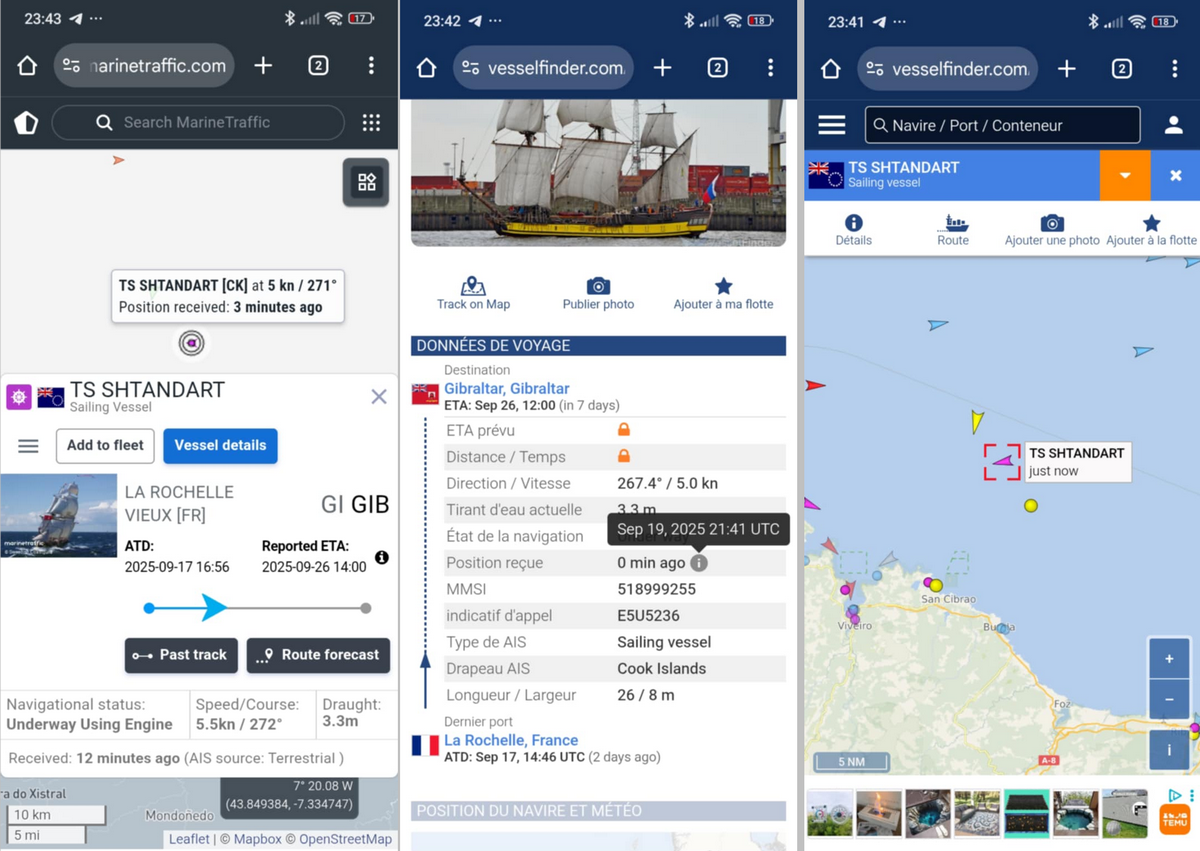
En la mañana del 26 de septiembre de 2025, el buque ruso sancionado Shtandart, MMSI 518999255, llegó al puerto de Tánger, Marruecos [1]. Desde su salida de la llamada “Kaliningrado Atlántica”, el 17 de septiembre de 2025, se le negó la entrada en todas las escalas previstas: en la costa norte de España, en Portugal, en Andalucía y en Gibraltar.

Este resultado constituye un éxito indiscutible en la aplicación del régimen de sanciones europeo. Ha sido posible gracias a la vigilancia y al compromiso de numerosas personas e instituciones, cuyos nombres, en su mayoría, permanecerán confidenciales. A todas ellas les expresamos nuestro más profundo agradecimiento.

Deseamos, sin embargo, rendir un reconocimiento especial a varios actores cuyo papel ha sido determinante:

  • Lara Graña, redactora jefa de Faro de Vigo, gran profesional y especialista reconocida en asuntos marítimos, cuyos artículos [2] [3] contribuyeron de manera decisiva a alertar tanto en España como en Portugal.
  • Pavlo Sadokha, presidente de la Unión de Ucranianos en Portugal y vicepresidente del Ukrainian World Congress [4] [5] para Europa del Sur, quien trabajó incansablemente contra el estafador ruso, movilizando a su comunidad y a sus contactos en Portugal así como en otros países europeos.
  • La Autoridade Marítima Nacional (AMN) de Portugal, cuya estricta vigilancia [6] [7] y eficaz despliegue de recursos garantizaron el cumplimiento efectivo de las sanciones europeas.

En cuanto a Gibraltar, desconocemos qué autoridades intervinieron directamente en la anulación de la escala prevista. No obstante, es evidente que la cuestión fue tratada con la máxima seriedad.

Finalmente, queremos destacar la vigilancia ejercida por las capitanías y autoridades portuarias de Galicia, Portugal y Andalucía.

A todas aquellas personas e instituciones cuyo compromiso ha hecho posible este resultado, les transmitimos la expresión de nuestra más sincera gratitud.

Atentamente,

Colectivo No Shtandart in Europe


🇵🇹 Agradecimentos pela cooperação transfronteiriça na Península Ibérica – O navio russo Shtandart falha na sua fraude às sanções portuárias

Exma. Senhora, Exmo. Senhor

Na manhã de 26 de setembro de 2025, o navio russo sancionado Shtandart, MMSI 518999255, chegou ao porto de Tânger, Marrocos [1]. Desde a sua partida de “Kaliningrado Atlântico”, em 17 de setembro de 2025, foi-lhe recusada a entrada em todas as escalas previstas: na costa norte de Espanha, em Portugal, na Andaluzia e em Gibraltar.

Este resultado representa um sucesso indiscutível na aplicação do regime de sanções europeu. Tornou-se possível graças à vigilância e ao empenho de numerosas pessoas e instituições, cujos nomes permanecerão, em grande parte, confidenciais. A todas elas dirigimos a nossa mais profunda gratidão.

Importa, contudo, prestar homenagem a alguns intervenientes cujo papel foi determinante:

  • Lara Graña, diretora do Faro de Vigo, grande profissional e especialista reconhecida em assuntos marítimos, cujos artigos [2] [3] contribuíram de forma decisiva para alertar tanto em Espanha como em Portugal.
  • Pavlo Sadokha, presidente da União dos Ucranianos em Portugal e vice-presidente do Ukrainian World Congress [4] [5] para a Europa do Sul, que trabalhou incansavelmente contra o fraudador russo, mobilizando a sua comunidade e os seus contactos em Portugal, bem como noutros países europeus.
  • A Autoridade Marítima Nacional (AMN) de Portugal, cuja vigilância rigorosa [6] [7] e eficaz mobilização de meios asseguraram o cumprimento efetivo das sanções europeias.

No que respeita a Gibraltar, não sabemos exatamente quais autoridades estiveram envolvidas na anulação da escala prevista. No entanto, é evidente que a questão foi tratada com a máxima seriedade.

Finalmente, queremos salientar a vigilância exercida pelas capitanias e pelas autoridades portuárias da Galiza, de Portugal e da Andaluzia.

A todas as pessoas e instituições cujo empenho tornou possível este resultado, expressamos a nossa mais sincera gratidão.

Com os melhores cumprimentos,

Coletivo No Shtandart in Europe


🇬🇧 Acknowledgements for cross-border cooperation on the Iberian Peninsula – Тhe Russian vessel Shtandart fails in its port sanctions fraud

Dear Madam, Dear Sir,

This morning, 26 September 2025, the Russian sanctioned vessel Shtandart, MMSI 518999255, arrived at the port of Tangier, Morocco [1]. Since its departure from “Atlantic Kaliningrad” on 17 September 2025, it has been denied entry to all intended stopovers on the northern coast of Spain, in Portugal, in Andalusia, and in Gibraltar.

This outcome represents a significant success in the enforcement of the UK and European sanctions regime. It has been made possible thanks to the vigilance and commitment of many individuals and institutions, most of whose names shall remain confidential. To all of them, we extend our deepest gratitude.

Several key contributors deserve special recognition:

  • Lara Graña, editor-in-chief of Faro de Vigo, an outstanding professional and a recognized maritime affairs specialist, whose articles [2] [3] played a crucial role in raising awareness both in Spain and in Portugal.
  • Pavlo Sadokha, President of the Union of Ukrainians in Portugal and Vice President of the Ukrainian World Congress [4] [5] for Southern Europe, who worked tirelessly against the Russian fraudster, mobilizing his community and contacts in Portugal as well as in other countries.
  • The Autoridade Marítima Nacional (AMN) of Portugal, whose constant surveillance [6] [7] and effective deployment of resources ensured full compliance with European sanctions.

With regard to Gibraltar, we do not know exactly which authorities contributed to cancelling the Shtandart’s planned call. However, it is clear that the matter was taken with the utmost seriousness.

Finally, we acknowledge the vigilance of the harbour masters and port authorities of Galicia, Portugal, and Andalusia.

To all those whose commitment made this result possible, we express our most sincere gratitude.

Yours faithfully,

Collective No Shtandart in Europe


🇫🇷 Remerciements pour la coopération transfrontalière en la péninsule ibérique – Le navire russe Shtandart échoue dans sa fraude aux sanctions portuaires

Chère Madame, Cher Monsieur,

Le navire russe sous sanctions Shtandart, MMSI 518999255, est arrivé ce matin, 26 septembre 2025, dans le port de Tanger, Maroc [1]. Depuis son départ de la « Kaliningrad Atlantique » le 17 septembre 2025, il s’est vu refuser toute escale sur la côte nord de l’Espagne, au Portugal, en Andalousie ainsi qu’à Gibraltar.

Ce résultat constitue un succès indéniable dans l’application du règlement européen. Il a été rendu possible grâce à la vigilance et à l’engagement de nombreuses personnes et institutions, dont les noms resteront pour la plupart confidentiels. Qu’elles soient ici assurées de notre profonde gratitude.

Il convient toutefois de rendre hommage à plusieurs acteurs dont le rôle a été déterminant :

  • Lara Graña, rédactrice en chef du Faro de Vigo, grande professionnelle et spécialiste reconnue des affaires maritimes, dont les articles [2] [3] ont puissamment contribué à alerter l’opinion publique et les autorités en Espagne comme au Portugal.
  • Pavlo Sadokha, président de l’Union des Ukrainiens du Portugal et vice-président du Ukrainian World Congress [4] [5] pour l’Europe du Sud, qui s’est mobilisé sans relâche contre le fraudeur russe, fédérant sa communauté et ses contacts tant au Portugal que dans d’autres pays européens.
  • L’Autoridade Marítima Nacional (AMN) du Portugal, dont la surveillance rigoureuse [6] [7] et les moyens déployés ont permis d’assurer le respect effectif des sanctions européennes.

S’agissant de Gibraltar, nous ignorons à ce jour quelles autorités ont pris la décision finale, mais il ne fait aucun doute que la question y a été traitée avec le plus grand sérieux.

Enfin, nous tenons à saluer la vigilance exercée par les capitaineries et les autorités portuaires de Galice, du Portugal et d’Andalousie.

À toutes celles et à tous ceux qui, par leur engagement, ont contribué à ce résultat, nous adressons l’expression de notre reconnaissance la plus sincère.

Veuillez agréer, Chère Madame, Cher Monsieur, l’assurance de notre considération distinguée.

Collectif No Shtandart in Europe


🇺🇦 Подяка за транскордонну співпрацю на Іберійському півострові. – Російське судно “Штандарт” зазнає поразки у своїй шахрайській спробі обійти портові санкції

Шановні пані та панове,

Російське судно «Штандарт», MMSI 518999255,  яке перебуває під санкціями, прибуло сьогодні вранці, 26 вересня 2025 року, до порту Танжер, Марокко [1]. З моменту відплиття з «Калінінград Атлантик» 17 вересня 2025 року йому було відмовлено у будь-якій зупинці на північному узбережжі Іспанії, в Португалії, Андалусії та Гібралтарі.

Цей результат є беззаперечним успіхом у застосуванні європейських санкцій і став можливим завдяки пильності та відданості багатьох осіб і установ, більшість із яких залишаться конфіденційними. Ми щиро дякуємо всім їм.

Особливо варто відзначити ключових учасників:

  • Лара Грана, головна редакторка Faro de Vigo, видатний професіонал і визнаний спеціаліст із морських питань, статті якої [2] [3] суттєво сприяли інформуванню громадськості та влади в Іспанії та Португалії.
  • Павло Садоха, президент Союзу українців у Португалії та віце-президент Ukrainian World Congress [4] [5] для Південної Європи, який невтомно працював проти російського шахрая, мобілізуючи свою спільноту та контакти в Португалії й інших країнах.
  • Національна морська адміністрація Португалії (AMN), чия постійна пильність [6] [7] та ефективне використання ресурсів забезпечили дотримання європейських санкцій.

Що стосується Гібралтару, наразі невідомо, які саме органи прийняли рішення про скасування запланованого заходу судна, проте очевидно, що питання було розглянуто з максимальною серйозністю.

Також слід відзначити пильність капітаній і портових адміністрацій Галісії, Португалії та Андалусії.

Усім, хто завдяки своїм зусиллям сприяв досягненню цього результату, висловлюємо нашу щиру вдячність.

З повагою,

Колектив No Shtandart in Europe 


Notes

  1. Shtandart, Tangier, 26/09/2025
    Shtandart, Tangier, 26/09/2025
  2. Faro de Vigo, 20/09/2025 – La fragata rusa «Shtandart», vetada por Bruselas, irrumpe en aguas gallegas
  3. Faro de Vigo, 22/09/2025 – Una patrullera lusa escolta a la fragata rusa «Shtandart» para evitar su escala en Leixões
  4. Ukrainian World Congress, 22/09/2025 – Ukrainians urged to be vigilant as Russian frigate heads toward Portugal
  5. Ukrainian World Congress, 22/09/2025 – Російський фрегат “Штандарт” прямує до Португалії: українців закликають бути пильними
  6. AMN, 24/09/2025 – Autoridade Marítima Nacional monitoriza veleiro TS SHTANDART ao longo da costa portuguesa
  7. Portugal Resident, 25/09/2025 – Suspected Russian ‘ghost fleet’ ship sparks police action off Algarve coast

Bernard Grua
Nantes, Brittany, France
Spokesperson of the collective