
DOCUMENTARY AUDIT NOTE
An investigation into four years of support for a vessel subject to European sanctions
Bernard Grua
Spokesperson for the whistleblower collective
No Shtandart in Europe
22 September 2026
Public document — verifiable sources and supporting documents
Table of contents
- I. The Board of Directors of Les Amis des Grands Voiliers – Sail Training Association France and the “official authorization” for the Shtandart in France
- II. The legal framework: an unambiguous prohibition
- III. Michel Balique in the face of the legal texts and court decisions
- IV. An alternative narrative
- V. Association governance and consequences of the steps taken in support of the Shtandart
- Conclusion: an issue that is now institutional
- Box 1: International comparison
- Box 2: Right of reply
- Further reading
- Documentary exhibits — screenshots
Translation note
Unless otherwise indicated, quotations originally written in French have been translated into English for ease of understanding. The original French wording is reproduced in the underlying documentary sources and, where relevant, through the links provided. In the event of any discrepancy between the English translation and the original text, the French-language original shall prevail and is authoritative.
→ Download this note in PDF format
→ Download the attachments to this note
→ Link to the French version available online
→ Download the French version of this note in PDF format
Subject
Documentary examination of the steps taken in support of the Shtandart, Michel Balique’s public statements, and their implications for the governance of Les Amis des Grands Voiliers – Sail Training Association France.
Recipients
- Board of Directors of Les Amis des Grands Voiliers – Sail Training Association France
- Sail Training International
- European Commission
- Ordre du Mérite maritime
- Maritime Prefectures (Cherbourg, Brest and Toulon)
- Ministry for Europe and Foreign Affairs
- Ministry of the Interior
- General Secretariat for the Sea (SGMer)
- Directorate-General for Maritime Affairs, Fisheries and Aquaculture (DGAMPA)
- National Directorate of Intelligence and Customs Investigations (DNRED)
- Prefectures of maritime departments
- Organisers of maritime festivals
- Press
→ View the letters accompanying the documentary audit report on the governance of Sail Training Association France
How could , Michel Balique, the president of a leading French association in the field of tall ships have defended, for nearly four years, the admission to France of a vessel subject to European restrictive measures? And how did the association respond when French and European authorities and courts successively confirmed the prohibition applicable to the vessel?
This note brings together the public documents that make it possible to examine these questions. It distinguishes between established facts, statements made by the parties involved, decisions by the authorities, and questions that remain to be clarified.
I. The Board of Directors of Les Amis des Grands Voiliers – Sail Training Association France and the “official authorization” for the Shtandart in France
As of 16 April 2022, the Russian vessel Shtandart, MMSI 518999255, was prohibited from accessing European ports pursuant to the fifth package of sanctions adopted against Russia in response to the Bucha massacre.
Since March 2022, Michel Balique, president of Les Amis des Grands Voiliers – Sail Training Association France, has repeatedly advocated for the Shtandart to be allowed to dock.
Thus, in March 2026, he contested the conditions under which the order issued by the three Maritime Prefects had been adopted, both in a letter addressed to maritime organisations and in Facebook posts. On that occasion, he once again challenged those who were calling for the law to be applied.
Did his public positions over the past four years also directly commit the association?
This is one of the central questions raised by the case. Michel Balique was speaking in his capacity as president of Sail Training Association France, and some of his communications directly concerned the association’s actions.
It remains to be established whether the Board of Directors of Sail Training Association France was informed of the steps taken in support of the vessel and what position it adopted at the time.
No publicly available document establishes that an official authorization was granted to the Shtandart to access French ports as an exception to the European sanctions.
Nevertheless, administrative exchanges up to April 2024 show that arrangements were being made to facilitate the vessel’s access to the ports concerned.
“Good morning, Mr Banel,
Letter from Michel Balique to Éric Banel, DGAMPA, 13 July 2022
Please accept my apologies for contacting you again regarding the Shtandart, but the captain really needs an official letter authorizing him to sail in national waters and to call at French ports…”
On 15 July 2022, Éric Banel, Director-General of DGAMPA, did not respond to Michel Balique’s request for an official authorization. He indicated, however, that he had intervened with the prefectures and port authorities so that they would not oppose the vessel’s access to their ports.
“Dear Monsieur TURQUET,
Letter from Vladimir Martus to Éric Turquet de Beauregard, legal department head at the SGMer, 17 April 2024
…This will make the anti-Shtandart activists capable to continue their attacks on the Authorities, ports and festivals, demanding to ban the ship Shtandart, unless there is a solid document issued by French Authorities which proof and confirm the position of The competent authorities (I believe for France it is DGAMPA)”
Éric Turquet de Beauregard likewise did not respond to the new request for an official authorization made by the captain of the Shtandart. Yet the Shtandart had already been docking in French ports for two years while subject to the European sanctions. No publicly available document establishes that such a formal authorization had previously been granted. Éric Turquet de Beauregard indicated that the authorities would continue to authorize access to French ports if the Shtandart changed its flag.
These emails are now public. They were shared by Vladimir Martus, captain and owner of the Shtandart, as well as by his lawyer, Me Thierry Clerc.
These exchanges with Éric Banel, Éric Turquet de Beauregard and other representatives of the State apparatus show that certain senior officials intervened with local authorities to allow the Shtandart to enter French ports. However, they do not, in themselves, constitute an official authorization to circumvent the European sanctions.
They do, however, raise an essential question: On what administrative basis was access for the Shtandart nevertheless facilitated?
Their disclosure now makes it possible to document the steps taken concerning the Shtandart. It also warrants an examination of the role that Sail Training Association France may have played in this sequence of events.
II. The legal framework: an unambiguous prohibition
Before auditing Michel Balique’s statements, it is important to recall precisely what the relevant texts, competent authorities and courts provide:
- Article 3ea of Council Regulation (EU) No 833/2014 has prohibited, since 16 April 2022, access to ports located in the territory of the Union by any vessel registered under the flag of Russia. The prohibition also applies to vessels that changed their Russian flag or Russian registration number to that of another State after 24 February 2022.
- On 24 June 2024, Council of the European Union Decision (CFSP) 2024/1744 confirmed that replicas of historical vessels (such as the Shtandart) fall within the scope of the sanctions. Contrary to the claims made by Michel Balique and Me Thierry Clerc, this was not an addition or an extension. It was a clarification, as stated in recital 13 of that act.
- On 11 July 2024, Order No. 2403878 of the Rennes Administrative Court rejected the application for suspension of the prefectural order of 7 July 2024 prohibiting the Shtandart from accessing the ports of Finistère.
- On 12 July 2024, the European Commission, in a letter to the whistleblower collective, reiterated this position.
- On 18 November 2024, Decision No. 496439 of the Conseil d’État dismissed the appeal brought by Mariia Martus, Martus TV GmbH and Vladimir Martus against the order of the Rennes Administrative Court.
- On 7 August 2025, the European Commission, in another letter to the whistleblower collective, once again confirmed the port-access prohibition concerning the Shtandart.
- On 22 August 2025, the General Court of the European Union issued its order in Case T-446/24. It notably found that the applicants had failed to establish an interest in seeking the annulment of the contested provisions of Decision (CFSP) 2024/1744. Indeed, even in that event, the prohibition on access to Union ports resulting from the regime applicable since 16 April 2022 would have continued to apply to the vessel. This order therefore does not call into question the prohibition on access to ports resulting from the regime applicable since 16 April 2022.
- On 5 March 2026, the three French Maritime Prefects expressly reaffirmed, through Order No. 2026/032 applicable to all metropolitan French coastlines and their territorial waters, the prohibitions under the European regulation concerning the Shtandart.
- On 28 May 2026, the new appeal in Case No. 2403856, on the grounds of “abuse of power”, brought by Martus TV GmbH, Mariia Martus and Vladimir Martus against the order of the Prefect of Finistère (7 July 2024), was dismissed by the Rennes Administrative Court in a judgment on the merits.
III. Michel Balique in the face of the legal texts and court decisions
For Michel Balique, setting out the regulatory texts amounts to an
“idiotic and ridiculous controversy.”
Michel Balique to Paris Normandie, 8 January 2023
1. Michel Balique’s statements concerning court decisions
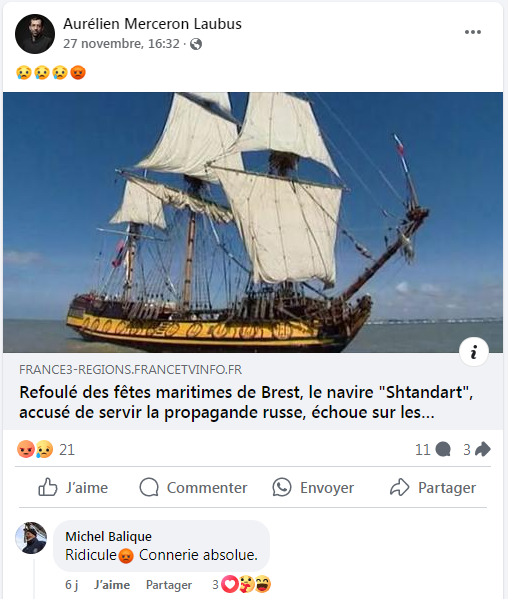
Having stated at a press conference on 23 September 2024 that there was “serious doubt as to the legality of the prefectural decrees” implementing the European sanctions, Michel Balique described the Council of State’s ruling of 18 November 2024 as:
“Ridiculous. Absolute bullshit.”
Comment by Michel Balique on Welcome Shtandart In Europe, 27 November 2024
Documentary exhibit 3
This way of portraying decisions by public authorities was not an isolated occurrence. In this respect, Michel Balique’s statements show similarities with those of Russian national Vladimir Martus, who:
- on 9 July 2024, stated in Ouest-France that the order issued by the Prefect of Finistère was “not legally made” and that the prefect “did not have the right to stop the vessel”;
- on 16 July 2024, as reported by Ouest-France, stated that he believed he had “the right to fight against this unjust decision by Europe”, referring to Council Decision (CFSP) 2024/1744 of 24 June 2024;
- on 18 August 2024, mocked the instructions issued by the Maritime Prefect for the Atlantic, describing them as “even more ridiculous” (than the order issued by the Prefect of Finistère).
Documentary exhibit 4
2. Michel Balique’s statements concerning the sanctions regime
In January 2023, Michel Balique denied that Shtandart was affected by the European sanctions. He continued to maintain this claim publicly until 2026.
“It is neither a Russian military vessel nor a vessel linked to the Russian State, since it belongs to a non-profit association. Nor is it in the hands of an oligarch, so it has the full right to remain in French ports.”
Michel Balique to Libération, 16 January 2023
“I was told that the vessel does not fall within the categories of vessels covered by the European sanctions: it belongs neither to the Russian State nor to a Russian oligarch. It is an association-owned vessel.”
Michel Balique to Ouest-France, 29 March 2024
These statements relied on criteria from earlier sanctions regimes, namely the first four packages of sanctions, which notably targeted vessels owned by the Russian State or linked to sanctioned individuals or entities. They did not correspond to the fifth package, which notably introduced the port-access prohibition applicable since 16 April 2022, almost two years before Michel Balique’s statements to Ouest-France were made. It prohibits access to Union ports by any vessel registered under the flag of Russia and also extends that prohibition, under the conditions laid down in the regulation, to vessels that changed their Russian flag or Russian registration number after 24 February 2022.
As regards the vessel’s purported association status, it should be noted that the Shtandart has nominally belonged to Mariia Martus, Vladimir Martus’s daughter, since spring 2024. It is therefore officially privately owned, rather than association-owned. Previously, it belonged to the Shtandart Project, based in Saint Petersburg, in which Vladimir Martus holds more than 60% of the shares. This entity does not have the characteristics of a French association under the 1901 law, nor even of the Russian legal form that comes closest to it, known as a “foundation” (фонд).
The Shtandart is operated by the commercial company Martus TV GmbH, a legal form equivalent to a French SARL, based in Hamburg. Vladimir Martus is its managing director and chief executive officer, as well as one of its only two shareholders, the other being his wife, Irina Ermakova. It should be noted that, in the “Beneficial owner” declaration written in his own hand, Vladimir Martus describes himself as holding both Ukrainian and Russian citizenship. His German residence permit, however, mentions only Russian citizenship.
“Although replicas of historical vessels are now covered by the restrictions on access to ports, the Shtandart does not appear to be affected by this measure. The prohibition targets vessels involved in commercial activities generating revenue for Russia (defence, security, oil, energy, food security), which is not the case with the Shtandart.”
Michel Balique to France 3, 14 September 2024
“Thanks to the failed intervention of a journalist (also a failure), I was able to give the audience, who appreciated it, a clear reading of the European regulation, highlighting the fact that the Shtandart IS NOT COVERED by the European sanctions… At this stage, there is therefore serious doubt as to the legality of the prefectural orders.”
Michel Balique’s Facebook post concerning his lecture in La Rochelle on 23 September 2024
This September 2024 statement was made even though the wording of Article 3ea of Council Regulation (EU) No 833/2014, Council Decision (CFSP) 2024/1744 of 24 June 2024, the order issued by the Prefect of Finistère on 7 July 2024, and the order of the Rennes Administrative Court of 11 July 2024 had already been issued or published.
On 10 March 2026, Michel Balique sent an email to his contacts in the maritime sector concerning the order issued by the Maritime Prefects. He circulated several pieces of information contradicted by official documents:
- “Replicas of historical vessels were added to the list of prohibited vessels [on 24/06/2024].” — This statement is contradicted by the texts and decisions recalled in Section II. The prohibition regime applicable since 16 April 2022 already covered vessels falling within its scope, and the situation of historical replicas was subsequently explicitly clarified, on 24 June 2024.
- “The No Shtandart in Europe collective and its few supporters therefore prevailed.” — This wording attributes the adoption of the order to the collective’s action. However, the Maritime Prefects’ order does not present the decision as resulting from such a causal attribution: its grounds and recitals set out the legal framework and the elements on which the Prefects based their decision. This is how the matter should be handled in a State governed by the rule of law.
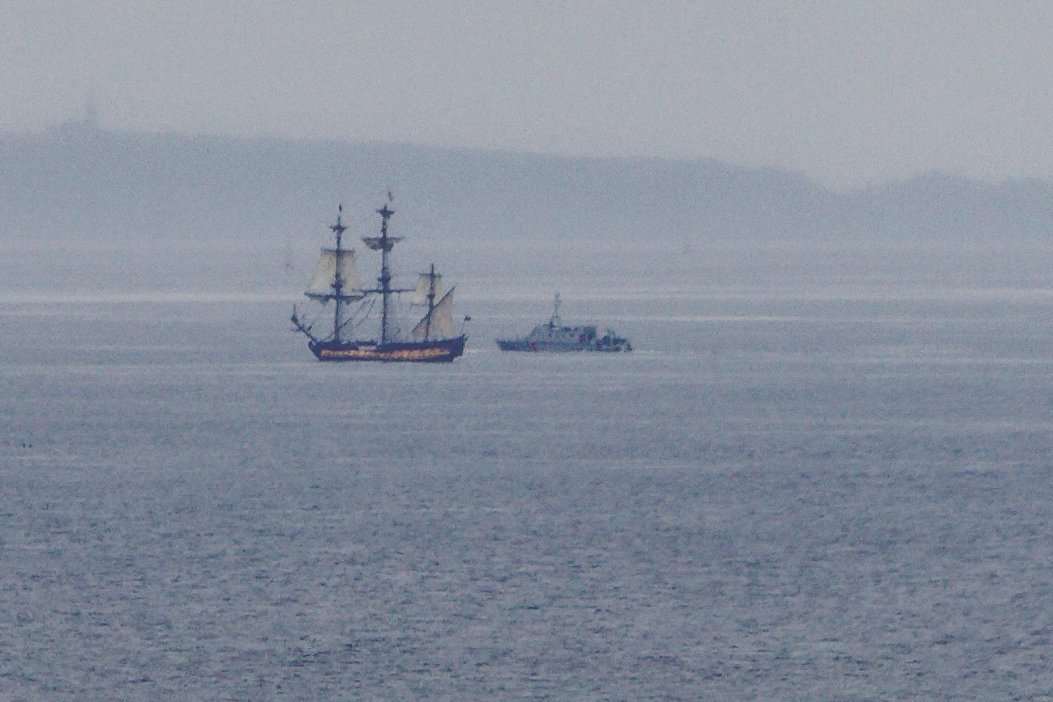
- “In 2024 Vladimir Martus had faithfully followed the instructions of the French authorities.” — This is not accurate. It is sufficient to recall that the Shtandart intended to disregard the prefectural order of 7 July 2024, as reported by France3 on 9 July, and as he stated on social media on 10 July. On 11 July 2024, he was denied access to the Brest Narrows (goulet de Brest) and Brest harbour by a French Navy patrol vessel.
IV. An alternative narrative
The quotations brought together in this section are not intended to invite the reader to take a position for or against the persons targeted by Michel Balique. They are presented in order to document, on the basis of verifiable statements, the argumentative methods employed by the president of Sail Training Association France in connection with the Shtandart case.
1. Discrediting the sources
“I took some time before sending you this message because, given the length of the piece of trash (B. Grua’s letter of 4 December 2024) and the number of lies it contains, a response could not be immediate.”
Letter from Michel Balique to the authorities, the press and B. Grua, 15 December 2024
“And if the frigate were in an irregular situation, it would have been sent back to international waters by the French Navy long ago. Mr Grua’s accusation (European prohibition) is therefore complete nonsense. ”
Letter from Michel Balique to the authorities, the press and B. Grua, 15 December 2024
“Bernard Grua’s pamphlet (letter of 2 January 2025) has no other purpose than to fuel a sterile and hateful controversy of which he is a great specialist.”
Letter from Michel Balique to the authorities, the press and B. Grua, 3 January 2025
Here, the spokesperson for the whistleblower collective is presented as the subject of the debate, whereas the regulatory texts and court decisions constitute the substance of the case.
“But unfortunately, you will not help solve the problem by stirring up hatred …”
Comment by Michel Balique addressed to B. Grua, 17 June 2022
Michel Balique’s repeated use of rhetoric concerning “anti-Russian hatred” or “Russophobia” shifts the debate from legal questions towards an allegation of a discriminatory nature.
In the present case, this narrative again encounters the facts. Bernard Grua’s work and publications on Russia, published by the Russian state media outlet Russia Beyond, demonstrate documented knowledge of the country and its culture, as well as a longstanding interest in Russian society and history:
- “Unknown but fascinating Siberia” (2020);
- “Tunka Valley in Siberia: heir to the Mongols and observer of the celestial bodies” (2019);
- “Botogol: a Frenchman’s lost mine in the Siberian Sayan Mountains” (2018).
The “Russophobia” argument therefore appears as a semantic replication of terminology used officially in Moscow. Indeed, rhetoric concerning “anti-Russian hatred” or “Russophobia” is frequently used in propaganda discourse to discredit criticism directed at Kremlin policy. These concepts were actively promoted from 2014 onwards by the Russian Ministry of Foreign Affairs and Russian propaganda outlets following the annexation of Crimea and the outbreak of the war in Donbas. Even the Russian media outlet RBC had reported on this shift as early as 2017. This talking point therefore warrants examination in light of the facts to which it is applied.
2. Wording comparable to elements of official Russian discourse
Several statements and items of content circulated in the Shtandart’s environment reproduce formulations that portray criticism of the vessel as discrimination against Russians on the basis of their nationality.
The reference made here to these similarities does not purport to infer any coordination with the Russian authorities. It simply identifies the formulations used, the context in which they were disseminated and, where documented, their correspondence with elements found in official Russian discourse.
“…the fear is that a few hotheads for whom everything Russian must be destroyed will physically attack the vessel and its crew.”
Letter from Michel Balique to maritime organisations, 20 March 2022
These remarks were made before the Shtandart arrived in La Rochelle, whilst the Russian army was conducting its offensive against Kyiv and the first allegations of war crimes committed in Ukraine had already been documented. The crimes in Bucha, in particular, would come to light after Russian forces withdrew from the region in early April. Similar wording would subsequently reappear in Michel Balique’s statement.
“So there was no point in writing an entire paragraph about it, developing theories about war crimes …”
Comment by Michel Balique to B. Grua, 17 June 2022
The crimes committed in Bucha, Irpin, Hostomel and Borodyanka are not theories. Documented two and a half months before Michel Balique’s statement, they were the reason for the fifth package of sanctions. This is the package that, among other measures, prohibited the Shtandart from entering Union ports.
“It was not the fact that the Shtandart is a Russian sailing vessel that led to the cancellation of its participation in the maritime festivals (Escale à Sète 2022), but the authorities’ fear that these events might give rise to public-order disturbances and acts of violence perpetrated by crude anti-Russian activists .”
Michel Balique to B. Grua, 17 June 2022
In the same document, Michel Balique nevertheless adds:
“As for the flash mob and the growing mobilisation, a small dozen individuals, including three or four kids, that’s frightening! ”
Michel Balique to B. Grua, 17 June 2022
The video of 4 May 2024 introduces an explicit comparison with the Holocaust.
At 00:06:23.180, the following can be heard:
“…some people are attacking the Shtandart and its captain on the grounds of their nationality, their ethnicity. Doesn’t that remind you of something? Here, perhaps it is not yet sufficiently obvious, because there have not yet been any deaths as a result of this. But in the last century, there were more than 6 million deaths because of this social phenomenon. Don’t you remember? Come on, a little moustached man. There you go, does that bring it back to you? That’s it. The only difference is that yesterday, it was the Jews and the social phenomenon reached its culmination and resulted in the Holocaust. Today, it is the Russians, but the social phenomenon has not yet reached its culmination. They are only slowly waking up…”
→ Link to the full transcript of the video
Vladimir Martus hosted the author of this video. It was shared on 10 May 2024 on the Shtandart’s Facebook page and on the Sail Training Association France Facebook page.
Documentary exhibits 5, 6, 7 and 8
Michel Balique wrote about this:
“Regarding the video shared on Facebook (by Sail Training Association France), I thank Mr Grua because I had not seen it! … In reality, this video is not our doing, but was created by AMV. And I find it absolutely excellent.”
Letter from Michel Balique to the authorities, the press and B. Grua, 15 December 2024
As Vladimir Putin himself puts it:
“Nazism is manifesting itself again in Russophobia or anti-Semitism.”
Agenzia Nova, 5 September 2023
Documentary exhibits 9
The reference to “denazification” also needs to be placed in context. The “denazification” of Ukraine is among the justifications advanced by the Russian authorities to present the 2022 invasion. In this regard, reference may notably be made to the article “What Russia Should Do with Ukraine”, published on 3 April 2022 by RIA Novosti under the name of Timofei Sergeitsev.
France 24: “Seen from Russia”: how Russian propaganda justifies the “denazification” of Ukraine, 24 March 2022
Michel Balique also presents Vladimir Martus as an opponent of the Russian regime. However, the latter has documented relations with RIA Novosti and other Russian state agencies, including after 2022. Through these media outlets, primarily during the summer of 2024, he notably criticised France and European institutions.
On 14 July 2024, Vladimir Martus personally reported the author of this note in an RIA Novosti publication. The publication was subsequently reproduced by several Russian media outlets. At the same time, in France, he stated that he had severed his links with Russia, particularly since the change of flag on 6 June 2024.
3. The argumentum ad personam
“While one can only agree with the second paragraph of his email (B. Grua’s), everything else is nothing but rambling dictated by excessive pride.”
Letter from Michel Balique to the authorities, the press and B. Grua, 3 January 2025
“He (B. Grua) is a megalomaniac .”
Michel Balique’s Facebook comment concerning the Maritime Prefects’ order, 10 March 2026
“He (B. Grua) boasts of achieving his results through violence .”
Michel Balique’s Facebook comment concerning the Maritime Prefects’ order, 10 March 2026
These formulations constitute an argumentum ad personam: they shift the debate towards the person presenting the facts rather than towards the facts and sources cited.
Michel Balique adds:
“All the so-called documents he parades are actually fabrications and articles that he either wrote or dictated.”
Letter from Michel Balique to the authorities, the press and B. Grua, 3 January 2025
As for the alleged “fabrications”, anyone can examine the original sources documenting each statement made by the collective. It should nevertheless be noted that reference must be made to the original writings, rather than to the reformulation of them by Michel Balique or Vladimir Martus.
As for the “articles… dictated…”, Michel Balique is referring in particular to publications by certain journalists from Le Télégramme and Ouest-France (see below), who have shown caution towards his narrative and have actually investigated the Shtandart case. They documented their publications with established facts as well as primary sources.
“And what is most cynical , most contemptible about Bernard Grua’s attitude is that, assuming he succeeds in his aim and makes the Shtandart leave European waters, he and his friends in the collective will rub their hands with pleasure.”
Letter from Michel Balique to the authorities, the press and B. Grua, 3 January 2025
In the documents examined for this note, Michel Balique provides no evidence substantiating these accusations. For nearly four years, he also repeatedly made personal allegations, attributed statements to the whistleblowers that they had not made and, on that basis, threatened them with defamation proceedings.
4. The argument from fear
“…a group of anti-Russian activists continues to pressure port authorities in order to prevent the frigate from coming there (to French ports). Their objective is to force the vessel to return to Russia, where, as you know, it will have major problems with the Russian authorities.”
Letter from Michel Balique to Éric Banel, DGAMPA, 13 July 2022
The statement about “major problems with the Russian authorities” will be examined later. It is first necessary to consider a recurring assertion. Michel Balique repeatedly claimed that the whistleblowers were demanding the return of the Shtandart to Russia, whereas they were simply calling for the application of EU Regulation No 833/2014, which prohibits this vessel from entering Union ports, and were suggesting destinations in countries without port-access sanctions.
He develops this idea further by writing:
“Better still, they will have done a great service to Putin , who since 2009 has never stopped trying to get his hands on the vessel as a kind of trophy.”
Letter from Michel Balique to the authorities, the press and B. Grua, 3 January 2025
This assertion must likewise be confronted with the available evidence:
- The Shtandart dispute in Russia (2007–2009) was not political in nature. It concerned only one department of the Ministry of Transport and related to safety issues. It was resolved in July 2020, as Vladimir Martus announced on social media (Instagram and Facebook), on the Shtandart website and in the press.
- The Shtandart has, at the very least, been regularly used in the service of Russian institutional and diplomatic interests, as demonstrated by its activities since its launch. The clearest example was the diplomatic mission of October 2021, conducted under the patronage of Vladimir Putin and financed by the presidential administration’s grant fund.
- Russian diplomatic services confirmed this again on 18 July 2025, strongly “slamming” (to use the term in the TASS headline) the British port authorities who opposed the Shtandart’s entry into Aberdeen.
- Neither Michel Balique nor Vladimir Martus has provided public evidence establishing that Putin intended to “seize” the vessel.
Michel Balique concludes:
“As long as it remains in European waters, the Russians will not attempt anything. But as soon as it is pushed back into international waters, I would not give it eight days before it is seized and its captain imprisoned for having declared himself against the war in Ukraine and called for Putin’s removal.”
Letter from Michel Balique to the authorities, the press and B. Grua, 3 January 2025
The vessel’s movements before and after this statement provide an opportunity to compare Michel Balique’s 3 January 2025 assertion with the available facts:
- In March and April 2024, the Shtandart made port calls in Tangier, Morocco. In autumn 2025, it again sailed outside the territorial waters of the European Union, notably to Morocco, Tunisia and Turkey.
- The Shtandart is now based in Turkey, where it offers, among other services, activities aimed at a Russian clientele.
These facts do not confirm the scenario announced by Michel Balique.
The elements examined in the two preceding sections may help explain how a narrative distinct from that resulting from the regulatory texts, decisions by the authorities and confirmed facts may have taken hold around the Shtandart case within the association.
With regard to this vessel, Michel Balique was speaking in his capacity as president of Sail Training Association France. The question is therefore no longer solely one of his personal positions: it becomes a question of the association’s internal oversight.
V. Association governance and consequences of the steps taken in support of the Shtandart
1. The framework of responsibility
The purpose of this document is not to presume the personal liability of the directors of the Sail Training Association France.
Indeed, the applicable liability regime depends, in particular, on the nature of the acts performed, the statutory powers of each individual, their knowledge of the facts and, where applicable, their personal involvement in them.
Under French law, criminal liability is personal. Article 121-2 of the French Criminal Code also provides for the criminal liability of legal entities for offences committed, on their behalf, by their organs or representatives, without excluding that of the natural persons who are perpetrators or accomplices.
It is therefore for the competent authorities, where appropriate, to establish whether any acts capable of giving rise to liability have been committed.
2. Questions put to the Board of Directors
Against this background, several questions may legitimately be put to the Board of Directors:
- Were the directors informed of the steps taken by Michel Balique in support of the Shtandart?
- Had these steps been authorised, discussed or approved by the Board?
- Were the directors aware of the regulatory, administrative and judicial elements that progressively contradicted the narrative put forward by their president?
- When the French and European authorities successively confirmed the ban applicable to the vessel, did the Board reconsider the association’s position?
- Were any measures taken to verify the compliance of the association’s activities and partnerships with the applicable restrictive measures?
- What decisions did the Board of Directors take after these elements had been brought to its attention?
In France, the Shtandart case lasted nearly four years, whereas in the other European countries, whether or not members of the European Union, it was resolved within about fifteen days (see Box 1 below).
3. A relationship with the French administration potentially weakened
These questions take on particular significance in light of the steps taken in support of the Shtandart.
Michel Balique’s actions were not limited to media statements. They also involved interactions with the French administration, at a time when the European and French authorities and courts were progressively clarifying and confirming the legal framework applicable to the Shtandart.
Steps that had until then taken the form of private exchanges between the association and members of the state apparatus were made public by Vladimir Martus and Me Thierry Clerc. On reading them, and given the potential embarrassment they may cause their authors, it appears that some of these documents were probably intended to remain confidential.
For the Sail Training Association France, this development raises the question of the sustainability of trust-based relationships with part of the French administrative network in which the association had been active.
4. A maritime association at odds with the three maritime prefects
The consequence is all the more significant because the Sail Training Association France is a maritime association.
On 5 March 2026, the maritime prefects of Cherbourg, Brest and Toulon adopted an exceptional inter-prefectural order laying down the conditions applicable to the Shtandart. These three senior officers of the French Navy combine their duties as maritime prefects, representing the State at sea, with those of military commanders of maritime areas. They cover all metropolitan French territorial waters and coastline.
In other words, the signatories of this order were not acting solely in their capacity as civilian authorities responsible for State action at sea. They are the originators of the order and have the means to enforce it, in terms of surveillance, vessels and personnel deployed at sea.
DGAMPA, the SGMer and the departmental prefectures now have virtually no room for manoeuvre, insofar as the Shtandart’s navigation in French maritime waters is concerned, to adopt an interpretation different from the framework established by the maritime prefects. The latter have significantly narrowed the scope for interpretation. They agreed on a single, strict and comprehensive text that anticipates possible ways in which the Shtandart might seek to circumvent the sanctions. They are responsible for enforcing it. The response from the CECMED Operations Centre (Toulon), on 12 May 2026, provides an illustration of this.
The situation is particularly unusual: for several years, the president of the Sail Training Association France defended continued access for the Shtandart and undertook démarches with the administration, while the French maritime authorities ultimately froze the applicable framework for this vessel.
As discussed earlier, the numerous inaccurate or unsubstantiated statements made by its chairman have seriously undermined the credibility of Sail Training Association France in the eyes of certain national media outlets. The outcome of the Shtandart case therefore cannot be reduced to an image crisis for the association. The strategy pursued by its president has placed the association in a position of divergence with the French authorities responsible for enforcing the legal framework applicable to the Shtandart. This context may have implications for its future activities.
One final question now arises for the Board of Directors. Does the association intend to maintain its commitment in support of the Shtandart, or does it now wish to distance itself from this case and refocus its activities on its statutory purpose?
Conclusion: an issue that is now institutional
The debate over the application of European sanctions to the Shtandart is no longer the main issue in this case. The legislation, decisions by the authorities and judicial decisions recalled here now constitute the documentary framework.
The remaining question is that of the governance of the Sail Training Association France.
Finally, there remains an ethical dimension: is the Mérite maritime medal, awarded to Michel Balique in June 2024, compatible with the positions and actions described in this document? This question calls for clarification and, where appropriate, consideration of any further action that may be warranted.
This note makes available the documents that enable everyone — directors, members of the association, public authorities, maritime partners and journalists — to form their own view of the facts and of the governance issues they raise.
Box 1: International comparison
In the nine European countries, other than France, where the Shtandart has attempted to call since April 2022, the authorities, once alerted, took less than fifteen days to enforce the ban on port access. This concerns both EU countries (Italy, Portugal, Spain, Ireland, Denmark and Belgium) and non-EU countries (the United Kingdom, Norway and Montenegro). These circumstances are detailed in a document covering the period from July 2022 to 31 December 2025. Another document covers the first half of 2026.
In France, the Shtandart case lasted from 16 April 2022 to 5 March 2026, that is, three years, ten months and approximately fifteen days. This duration, which stands in marked contrast to that observed in the other countries, raises, as explained above, the question of the role played by the Sail Training Association France.
The situation came to an end only as a result of the action taken by the three French maritime prefects. The order of 5 March 2026 therefore emanates from authorities who are responsible both for State action at sea and for the military command of the maritime areas concerned.
Box 2: Right of reply
This note distinguishes between administrative and judicial documents, public statements made by the parties involved, and the analyses drawn from them. Wherever possible, quotations are accompanied by their original source and links so that readers can verify them. Persons or organisations who consider themselves to have been implicated may exercise their right of reply.
Any responses they may provide will be published in full and without modification.
Bernard Grua
Spokesperson for the whistleblower collective
No Shtandart in Europe
22 September 2026
Further reading
Dossiers
- Comprehensive dossier on the Shtandart, Michel Balique and the Les Amis des Grands Voiliers – Sail Training Association France
- Complete chronological dossier of articles relating to the Shtandart, Michel Balique and the Les Amis des Grands Voiliers – Sail Training Association France
Main articles relating to the note above
- Michel Balique / No Shtandart in Europe: Michel Balique and the maritime prefects’ order concerning the Shtandart: his “explanations” examined against the law and the facts — 18 August 2026
- Le Télégramme: “An extraordinary order”: why the Shtandart was banned from French waters by the three maritime prefectures — 2 April 2026
- Michel Balique / No Shtandart in Europe: Sail Training Association France: Michel Balique and the maritime prefects’ order concerning the Russian vessel Shtandart — 17 March 2026
- Ouest-France: Three months after drones flew over Île Longue, the Russian vessel Shtandart banned from French waters — 12 March 2026
- Le Télégramme: A Russian travel agency organises a cruise around Brittany aboard the Shtandart… banned from access to European ports — 25 November 2025
- Diploweb: Russia. From soft power to hybrid warfare. A case study of Russian influence in Europe: the Shtandart — 25 November 2025
- Desk-Russie: When the Russian vessel Shtandart and La Rochelle defied European sanctions — 28 September 2025
- Ouest-France: Investigation. The Russian vessel Shtandart brings Putin’s war to the Gulf of Morbihan — 23 May 2025
- No Shtandart in Europe: French authorities and the preferential treatment granted to the Russian vessel Shtandart — 15 May 2025
- Michel Balique: A diatribe by the president of the “Sail Training Association France” — 3 January 2025
- No Shtandart in Europe: Shtandart — the “truths” of the president of “Sail Training Association France” — 2 January 2025
- Michel Balique: Why, according to the president of “Sail Training Association France”, is the Shtandart not covered by European sanctions? — 23 September 2024
- Sail Training Association France: Michel Balique appointed a Knight of the Mérite maritime — 26 June 2024
- No Shtandart in Europe: Sail Training Association France, an influence network serving the Russian frigate Shtandart? — 26 April 2024
- No Shtandart in Europe: Michel Balique, president of the “Sail Training Association France”, takes aim at Ouest-France and falls flat — 24 April 2024
- Michel Balique: Right of reply from the president of “Sail Training Association France” to Ouest-France — 18 April 2024
- No Shtandart in Europe: Can Michel Balique and the “Sail Training Association France” still escape the downfall of the Russian vessel Shtandart? — 10 April 2024
- Ouest-France: Opponent or Putin propagandist: who is the captain of the Shtandart invited to Brittany? — 29 March 2024
- No Shtandart in Europe: Michel Balique and the Russian vessel Shtandart in troubled waters in Libération — 26 January 2023
- Michel Balique: Welcoming the Shtandart (continued) — 16 January 2023
- Michel Balique: The president of “Sail Training Association France” launches another attack against critics of the Russian vessel “Shtandart” — 4 July 2022
- No Shtandart in Europe: Shtandart case: response to Michel Balique, President of the “Amis des Grands Voiliers” association — 28 June 2022
- Michel Balique: The president of the “Sail Training Association France” association comments on “The Russian vessel Shtandart in the port of La Rochelle” — 17 June 2022
- Michel Balique: Welcoming the Shtandart — 20 March 2022
Documentary exhibits — screenshots
The screenshots cited in this note have been compiled in a documentary file.
→ Download the documentary file
These screenshots are made available to enable any reader who wishes to do so to verify the elements referred to in the note.
Documentary Exhibit 1: Michel Balique announces the arrival of the Shtandart and mentions the role of the Les Amis des Grands Voiliers – Sail Training Association France, 4 June 2022

Documentary Exhibit 2: Michel Balique states that he is particularly proud that Les Amis des Grands Voiliers – Sail Training Association France participated in bringing the Shtandart to La Rochelle, 8 June 2022

The video by Patrice Bernier shared in this post is no longer available, but it has been saved and can be viewed via this link: “Michel Balique’s welcome for the Shtandart in La Rochelle”
Documentary Exhibit 3: Michel Balique describes the Conseil d’État judgment as “Ridiculous. Absolute bullshit”, 27 November 2024
Documentary Exhibit 4: Vladimir Martus describes the instructions issued by the maritime prefect of Brest as “even more ridiculous”, 18 August 2024

Documentary Exhibit 5: The creator explains the purpose of his video Au gré des vents, 2 May 2024

Rhetoric:
Battle formation – Ethnic discrimination – Polemic – Firing off barbs – Giving them a proper telling-off – Taking down narrow-minded people and other extremist mindsets
Documentary Exhibit 6: Vladimir Martus meets the creator of the video Au gré des vents, 8 May 2024
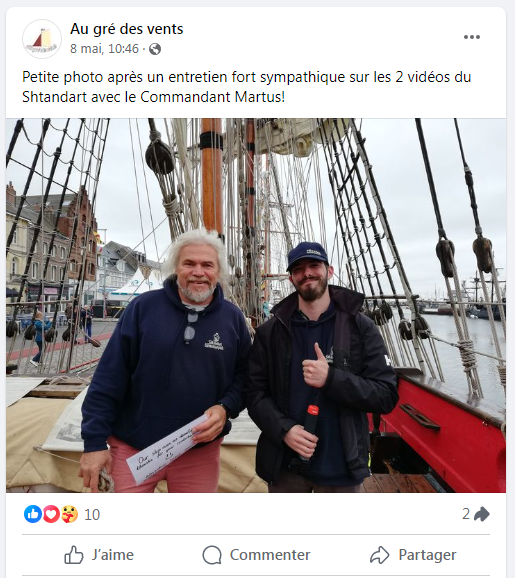
Documentary Exhibit 7: The Shtandart shares the video by Au gré des vents and congratulates its creator, 10 May 2024

Documentary Exhibit 8: The Les Amis des Grands Voiliers – Sail Training Association France association shares the video by Au gré des vents, 10 May 2024

Documentary Exhibit 9: Screenshots from the video Au gré des vents
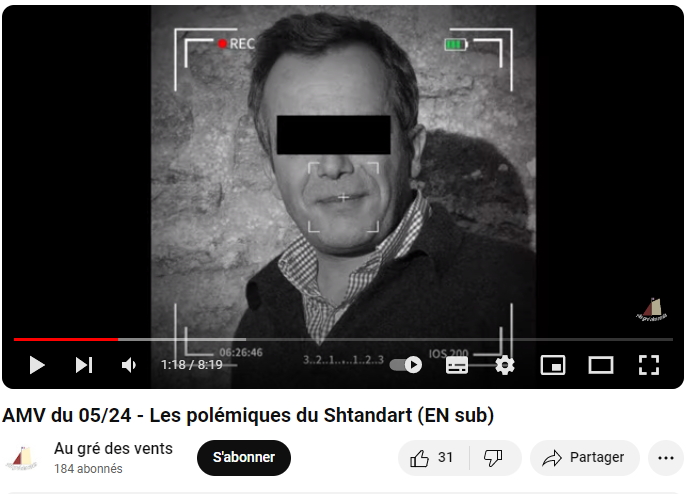

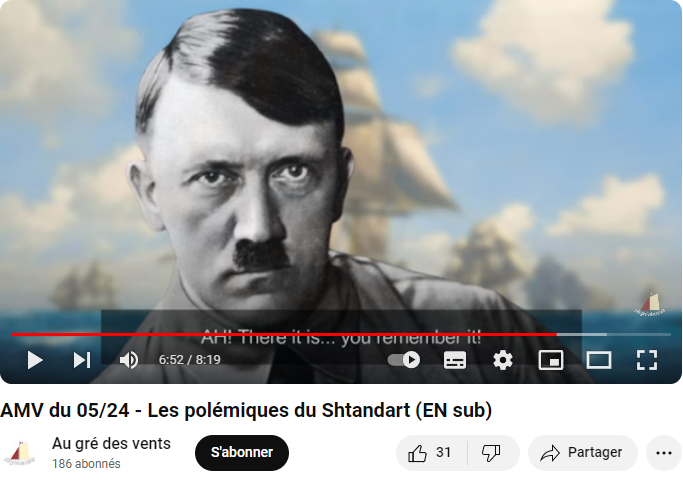
→ Link to the full transcript of the video
Note: The collective remains available to any reader wishing to obtain additional information or documents that may help verify facts or elements mentioned in this note.


Un avis sur « Michel Balique, the Board of Directors of “Les Amis des Grands Voiliers – Sail Training Association France”, the “Shtandart” and the Law »