
By Bernard Grua
15 May 2025
While the Shtandart‘s influence network has repeatedly claimed that the Russian vessel was fully entitled to call at French ports despite the sanctions adopted in the aftermath of the Bucha massacre, the facts show that, over the past three years, it has never received any official authorisation in France. Instead, it benefited solely from confidential exemptions issued by representatives of the executive branch who, in most cases, had no authority over the implementation of EU port sanctions.
According to the documents reproduced below, these officials advanced an interpretation of the Regulation that differs from the wording of Article 3ea and intervened with maritime authorities and prefects in support of the Shtandart’s access to French ports.
- 1. Chronology and documentation of administrative waivers granted to the Shtandart by French authorities
- May 2022 – Did the Shtandart receive an “express authorisation” from President Emmanuel Macron?
- June 2022 – Did Prime Minister Élisabeth Borne grant one or more unofficial exemptions to the Shtandart?
- 15 July 2022 – Confirmed preferential treatment from Éric Banel, Director-General for Maritime Affairs, Fisheries and Aquaculture
- 23 January 2023 – Confirmed waiver from the National Directorate of Customs Intelligence and Investigations (DNRED)
- 13 March 2023 – Confirmed waivers granted by CECLANT Premar Atlantique
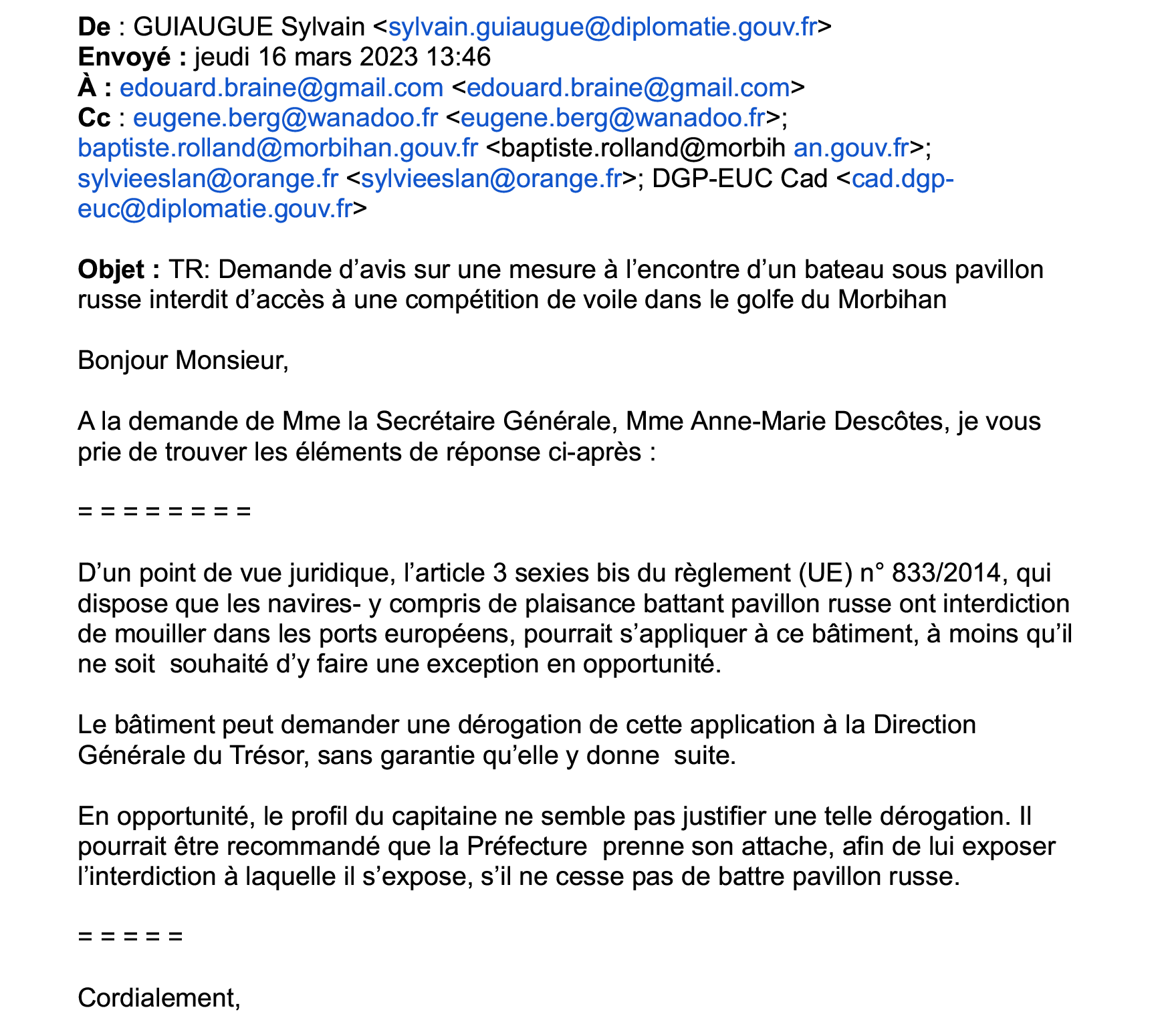
- 16 March 2023 – Position of the Ministry for Europe and Foreign Affairs
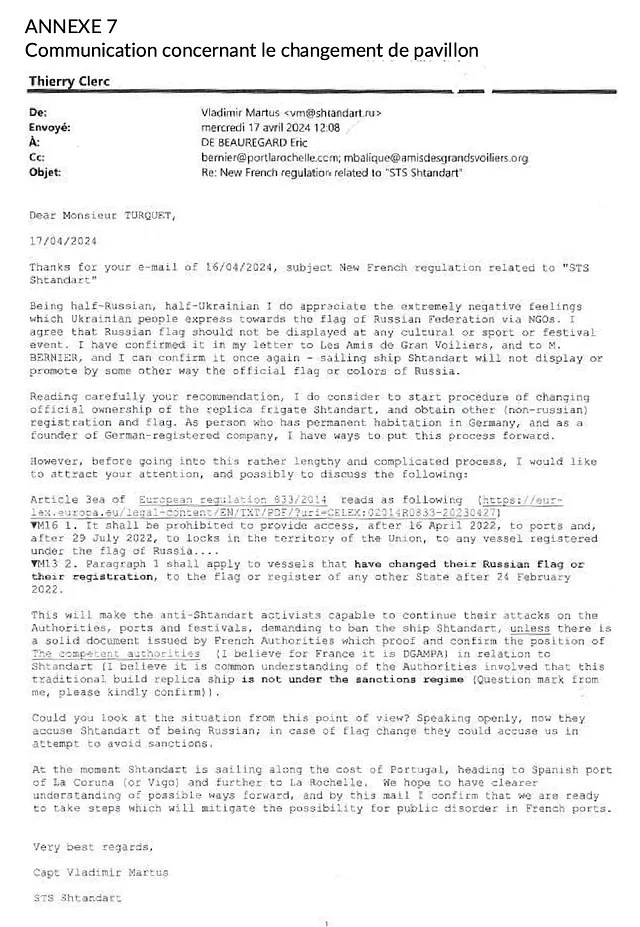
- 16 April 2024 – Request to change the vessel’s flag and confirmation of the administrative position adopted by Éric Turquet de Beauregard, SGMer
- 24 June 2024 – Confirmation by the European Council that the Shtandart falls within the scope of sanctions.
- 25 June 2024 – Maintenance by SGMer of the waivers granted to the Shtandart despite the Council clarification.
- 11 July 2024 – Did Prime Minister Gabriel Attal grant preferential treatment to the Shtandart?
- 2. Media coverage raised concerns about the irregular nature of the “waivers”
1. Chronology and documentation of administrative waivers granted to the Shtandart by French authorities
Informal exemptions were predominantly issued by authorities that were not responsible for enforcing port sanctions.
The document « National competent authorities for the implementation of EU restrictive measures (sanctions) » specifies that the general coordination of sanctions is ensured by the Ministry for Europe and Foreign Affairs (Quai d’Orsay) (page 19). The implementation of port sanctions falls under the responsibility of departmental prefects and the directors of major maritime ports. For requests for information and reporting on authorisations, it is possible to contact the Directorate-General for Maritime Affairs, Fisheries and Aquaculture (DGAMPA).

In other words, neither the National Directorate of Customs Intelligence and Investigations (DNRED), nor CECLANT Premar Atlantique, nor the General Secretariat for the Sea (SGMer) have a mandate to enforce port sanctions, to decide on derogations, and even less so to exclude a Russian vessel from the scope of EU Regulation No. 833/2014.
| First name | Last name | Organisation | Preferential treatment for the Shtandart |
|---|---|---|---|
| X | Anonymous | DNRED | Confirmed involvement |
| Gabriel | Attal | Prime Minister | Not confirmed involvement |
| Michel | Balique | Amis des Grands Voiliers – Sail Training France | Confirmed involvement |
| Éric | Banel | DGAMPA | Confirmed involvement |
| Patrice | Bernier | Port of La Rochelle | Confirmed involvement |
| Elizabeth | Borne | Prime Minister | Not confirmed involvement |
| Thierry | Clerc | Lawyer for the Shtandart | Confirmed involvement |
| Eline | Le Bars | CECLANT Premar Atlantique | Confirmed involvement |
| Christophe | Lenormand | DGAMPA | Confirmed involvement |
| Emmanuel | Macron | President of the French Republic | Not confirmed involvement |
| Vladimir | Martus | Captain and de facto owner of the Shtandart | Confirmed involvement |
| Éric | Turquet de Beauregard | SGMer | Confirmed involvement |
In this case, the General Secretariat for the Sea (SGMer) appears consistently, either implicitly or explicitly. Its possible links with Russian influence networks warrant investigation. It should be recalled that until January 2025, SGMer was headed by Didier Lallement, former Prefect of Police of Paris.
May 2022 – Did the Shtandart receive an “express authorisation” from President Emmanuel Macron?
This is what journalist Javier H. Rodríguez of Faro de Vigo reported on 6 July 2022:
“I am forwarding what I was told by unofficial sources from the Ministry of Transport and by a person in Vigo who has direct contacts with the captain of the Shtandart (Vladimir Martus). He has an exceptional authorisation in Spain based on the express authorisation of Macron in France.”

In any case, we recommended that Javier H. Rodríguez suggest to the Spanish authorities that they verify the “French express authorisation from Macron”. As a result, on 22 July 2022, in application of EU law, the Shtandart was banned from participating in the “Ruta Iacobus Maris” in Vigo and from calling at A Coruña.
June 2022 – Did Prime Minister Élisabeth Borne grant one or more unofficial exemptions to the Shtandart?
Vladimir Martus and his main lobbyist Michel Balique have repeatedly claimed, as shown in the article below, that the Shtandart received authorisation from Prime Minister Élisabeth Borne. However, over three years, they have never been able to provide any proof.
See also: Élisabeth Borne and the Russian Vessel Shtandart: Alleged Involvement in Circumventing EU Port Sanctions (fr)
15 July 2022 – Confirmed preferential treatment from Éric Banel, Director-General for Maritime Affairs, Fisheries and Aquaculture (DGAMPA)
Michel Balique requests an official authorisation for the Shtandart.
On 13 July 2022 at 11:22,
Michel Balique wrote:Dear Mr. Banel,
Please excuse me for contacting you again regarding the Shtandart, but the captain is in real need of an official letter authorizing the vessel to navigate in French territorial waters and to call at French ports.
Indeed, a group of anti-Russian activists continues to put pressure on the port authorities in order to prevent the frigate from calling there. Their objective is to force the vessel to return to Russia where, as you know, he would face serious problems with the Russian authorities, since he has publicly declared his opposition to the war in Ukraine and to Russian government policy in general. There is an international crew on board, including Ukrainian and French sailors.
Thank you in advance for your assistance.
Yours sincerely,
Michel Balique
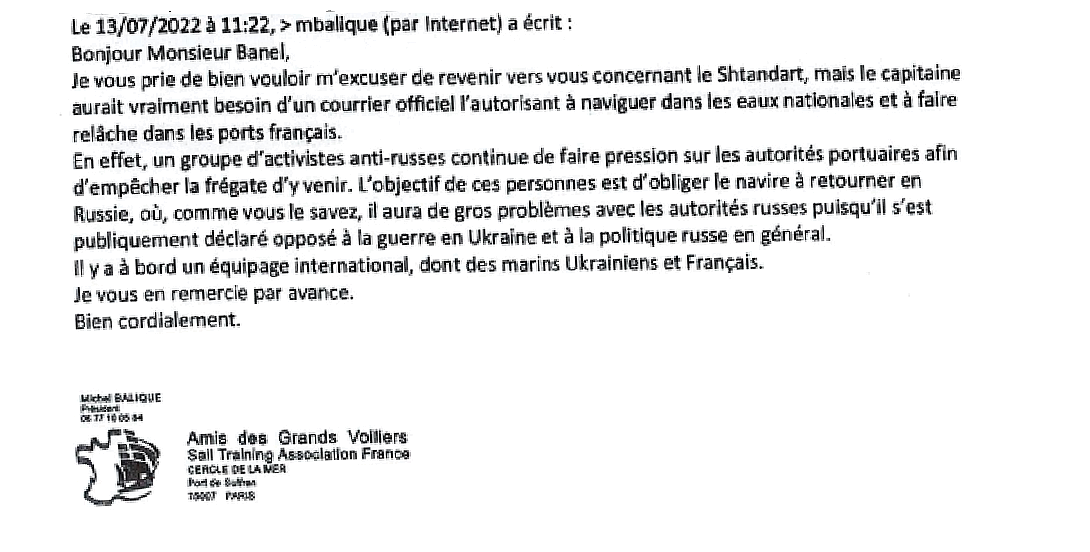
Michel Balique writes: “(authorisation) to navigate in national waters”. It is notable that the vessel’s main lobbyist did not properly read the sanctions text. Russian vessels are not prohibited from entering territorial waters under EU law; they are only prohibited from calling at ports of the Union.
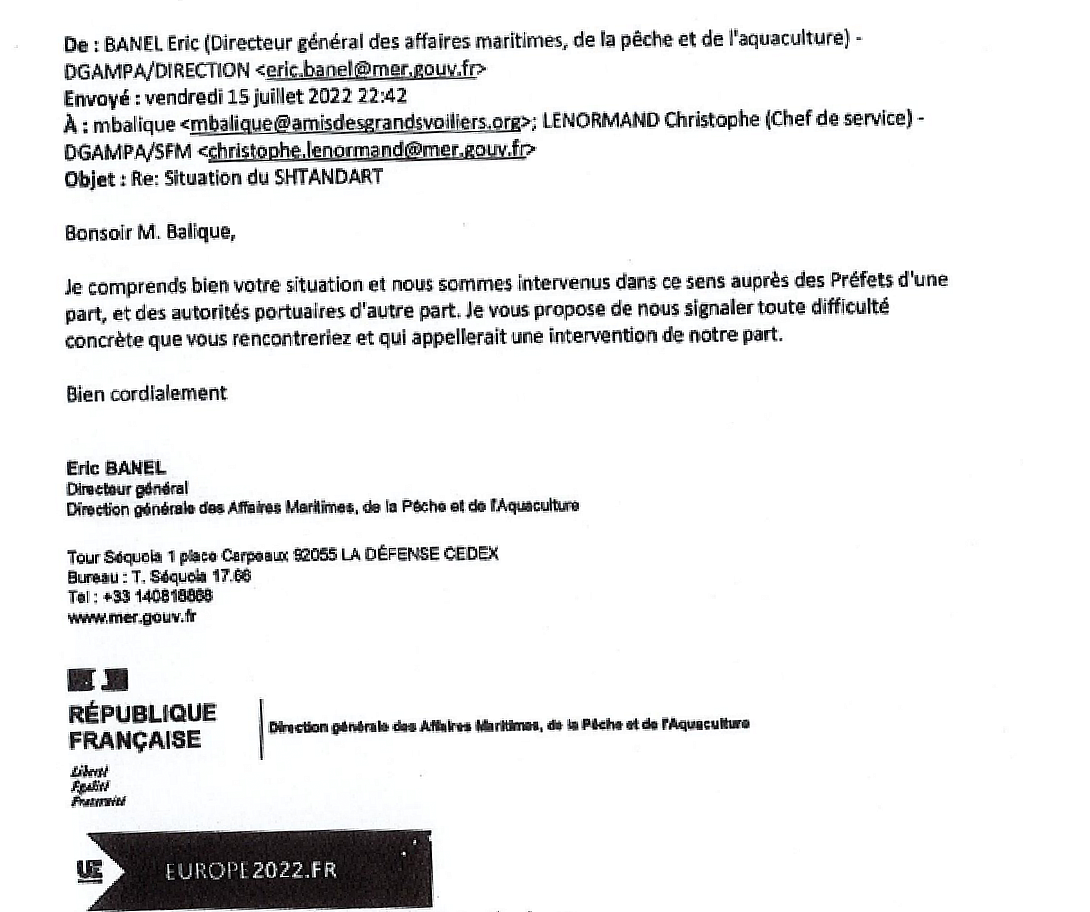
Éric Banel, DGAMPA, does not grant an official authorisation for the Shtandart but confirms the administrative arrangement.
From: BANEL Eric (Director-General for Maritime Affairs, Fisheries and Aquaculture) — DGAMPA eric.banel@mer.gouv.fr
Sent: Friday 15 July 2022 22:42
To: mbalique <mbalique@amisdesgrandsvoiliers.org>; LENORMAND Christophe (Chef de service) -DGAMPA/SFM christophe.lenormand@mer.gouv.fr
Subject: Re: Situation of the SHTANDART
Good evening Mr Balique,
I understand your situation and we have intervened accordingly with the Prefects on the one hand, and with the port authorities on the other. I suggest that you inform us of any concrete difficulties you may encounter that would require our intervention.
Kind regards,
Eric BANEL
Director General
Directorate General for Maritime Affairs, Fisheries and Aquaculture (DGAMPA)
Tour Séquoia
1 place Carpeaux
92055 LA DÉFENSE CEDEX
Office: T. Séquoia 17.66
Tel: +33 140816600
www.mer.gouv.fr
23 January 2023 – Confirmed waiver from the National Directorate of Customs Intelligence and Investigations (DNRED)
Article 3ea of EU Regulation No. 833/2014, as updated on 17/12/2022:
1. It shall be prohibited to provide access, after 16 April 2022, to ports and, after 29 July 2022, to locks in the territory of the Union, to ANY vessel registered under the flag of Russia, with the exception of access to locks for the purpose of leaving the territory of the Union.
…
3. For the purposes of this Article, with the exception of paragraph 1a, a ‘vessel’ means:a) a ship falling within the scope of the relevant international conventions;
https://eur-lex.europa.eu/legal-content/EN/TXT/?uri=CELEX%3A02014R0833-20221217
b) a yacht, of 15 metres in length or more, which does not carry cargo and carrying no more than 12 passengers; or
c) recreational craft or personal watercraft as defined in Directive 2013/53/EU of the European Parliament and of the Council
The DNRED, in an unsigned email, provides a misleading reinterpretation of the sanctions text in order to enable the Shtandart to circumvent EU Regulation No. 833/2014.
The DNRED states: “It (the Shtandart) does not belong to a listed entity.” This is a misleading presentation of Article 3ea of EU Regulation No. 833/2014. The regulation does not target specific categories or construction methods. It also does not establish any list of owners. On the contrary, paragraph 3 of Article 3ea is exhaustive. It clarifies paragraph 1, which applies to ALL vessels flying the Russian flag as of 24/02/2022. The vessels exempted are those falling under the derogations set out in paragraph 5. This is not the case of the Shtandart.
Article 3ea §3(c), notably through Directive 2013/53/EU, even includes recreational craft as small as 2.5 metres in hull length up to 24 metres, as well as personal watercraft, within the definition of vessels under EU law. If the DNRED claims that the Russian private yacht Shtandart is not a vessel, should it instead be considered—despite its 1,120 horsepower engine—a rowing boat, canoe, kayak, gondola, pedal boat, or surfboard under Directive 2013/53/EU?
The DNRED further states that only “SOLAS, MARPOL or the International Load Line Convention” are considered relevant international conventions. This is a gross misrepresentation with regard to the International Maritime Organization (IMO).
It adds “In practice, this refers to vessels of 500 GT and above (from the smallest to the largest) operating commercially in international navigation.” This interpretation does not reflect the wording of the IMO instruments.
The DNRED concludes: “Local maritime authorities, including those of La Rochelle, have classified the vessel as a ‘traditional construction vessel’ outside the scope of the Regulation (EU).” However, the EU Regulation does not refer to construction methods. The email is unsigned.
From: dnred-signalement@douane.finances.gouv.fr
Subject: Re: Request to Host the Shtandart during the Semaine du Golfe
Date: 23 January 2023, 5:19:22 p.m. (UTC+1)
To: Valence LEMAISTRE valencelemaistre@semainedugolfe.com
Cc: dnred-signalement dnred-signalement@douane.finances.gouv.fr; Jean-Pascal DEVIS (Deputy Director, Delegate for the Sea and Coastline) – DDTM 56; Yann Guillou; vm@shtandart.ru; Gérard; Polig Belenfant; Philippe CARRERE; Jeff WAGNER; Nadège PAVEC; Kerhoas Grand Large; Aimé KERGUERISDear Madam,
The Russian vessel SHTANDART is known to our services. To the best of our knowledge, it is not owned by a listed entity.
Since 16 April 2022, we have regularly been asked about its status following the entry into force of the new rules applicable to Russian vessels. Under Article 3ea of the amended Regulation (EU) No 833/2014 concerning restrictive measures in view of Russia’s actions destabilising the situation in Ukraine, « it shall be prohibited, after 16 April 2022, to provide access to ports in the territory of the Union to any vessel registered under the Russian flag. »
A document issued by the Directorate General of the Treasury (DGT) states that these sanctions apply to the following categories of vessels:
- a vessel falling within the scope of the relevant international conventions (the SOLAS Convention, the MARPOL Convention, or the International Convention on Load Lines). In practice, this means commercially operated vessels of 500 gross tons (GT) and above engaged in international navigation;
- a yacht of 15 metres or more in length, carrying neither cargo nor more than twelve passengers;
- or (c) a recreational craft or personal watercraft within the meaning of Directive 2013/53/EU of the European Parliament and of the Council.
The local maritime authorities, including those in La Rochelle, have classified the vessel as a « traditional-built vessel » falling outside the scope of Regulation (EU), since it is considered neither a « recreational craft » nor a « cargo vessel », which de facto excludes it from the categories of vessels covered by the amended Regulation (EU) No 833/2014. This classification has not been challenged by the Directorate General of the Treasury (DGT).
Yours sincerely,
CP Division – International Sanctions
French National Directorate for Customs Intelligence and Investigations (DNRED)
Customs Investigations Directorate
2 Mail Monique Maunoury, TSA 9031
94853 Ivry-sur-Seine, France
signalement-dnred@douane.finances.gouv.fr

13 March 2023 – Confirmed administrative waivers granted by CECLANT Premar Atlantique
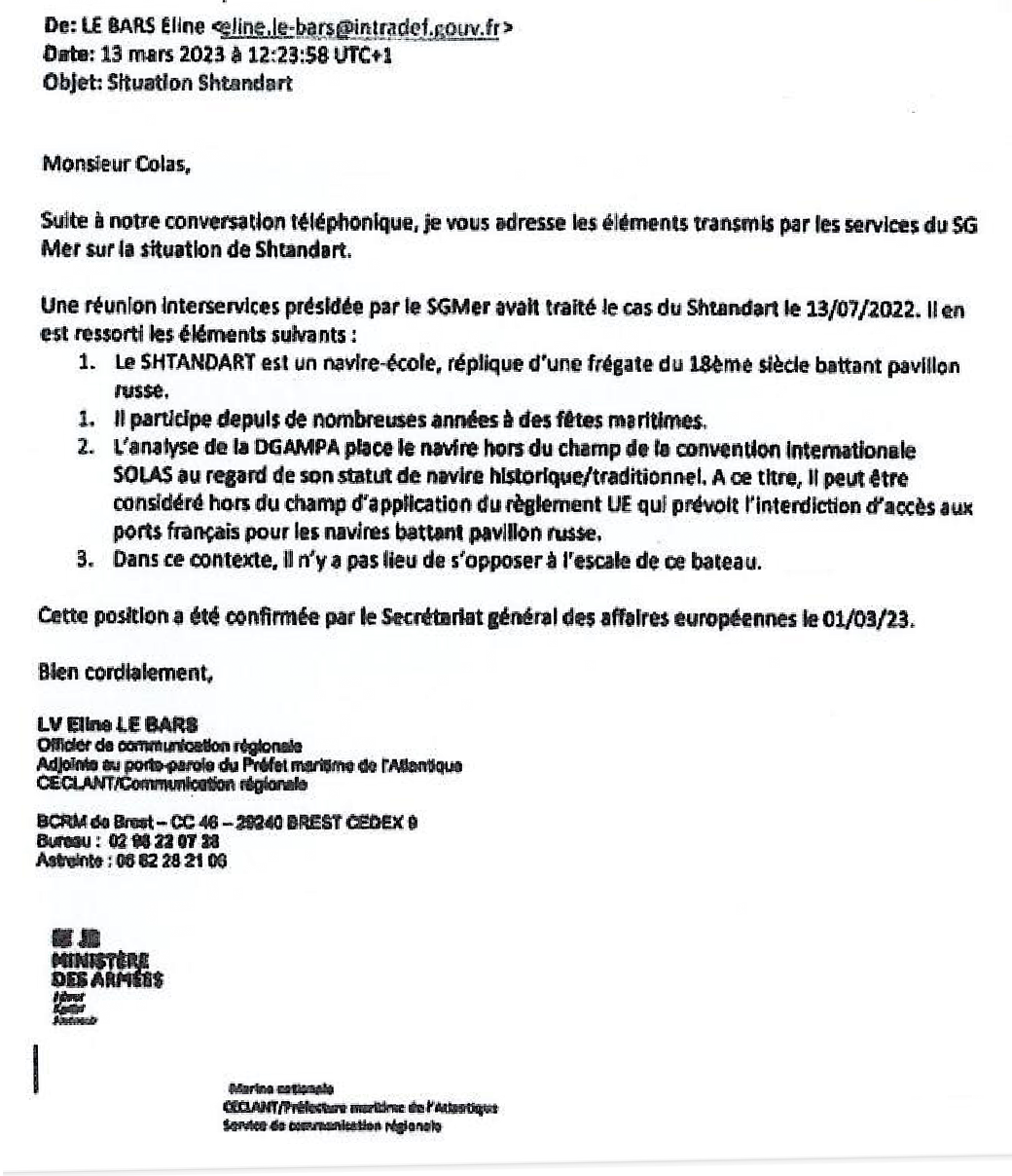
The position expressed by Lieutenant de Vaisseau Le Bars, from the Atlantic Maritime Prefecture (CECLANT Premar Atlantique), is striking in its extent. Since the Shtandart is considered to fall outside the SOLAS Convention—an interpretation that is itself contestable—it is stated that: “it may be considered outside the scope of EU law.” This interpretation reduces the expression « relevant international conventions » to the SOLAS Convention alone, whereas the Regulation uses the plural.
Lieutenant de Vaisseau Le Bars also states: “This position was confirmed by the General Secretariat for European Affairs on 01/03/23.” This is not what is stated in the email from the General Secretariat of the Ministry for Europe and Foreign Affairs dated 16/03/2023, reproduced below (Position of the Ministry for Europe and Foreign Affairs).
From: LE BARS Eline eline.le-bars@intradef.gouv.fr
Date: 13 March 2023 at 12:23:58 UTC+1
Subject: Situation ShtandartMr Colas,
Following our telephone conversation, I am sending you the information provided by the services of SG Mer regarding the situation of the Shtandart.
An interministerial meeting chaired by SGMer addressed the case of the Shtandart on 13/07/2022. The following conclusions were reached:
- The SHTANDART is a training ship, a replica of an 18th-century frigate flying the Russian flag.
- It has been taking part in maritime festivals for many years.
- The analysis by DGAMPA places the vessel outside the scope of the SOLAS Convention, given its status as a historical/traditional ship. As such, it may be considered outside the scope of the EU Regulation, which provides for a ban on access to French ports for vessels flying the Russian flag.
- In this context, there is no reason to oppose the vessel’s port call.
This position was confirmed by the General Secretariat for European Affairs on 01/03/23.
Kind regards,
LV Eline LE BARS
Regional Communications Officer
Deputy to the spokesperson of the Prefect of the Atlantic Maritime Zone
CECLANT/Regional CommunicationBrest Naval Base (BCRM) – CC46
29240 Brest Cedex, FranceOffice: +33 2 98 22 07 28
Duty Officer (24/7): +33 8 82 28 21 00MINISTRY OF THE ARMED FORCES
See also: “Who manipulated the Commander-in-Chief for the Atlantic in favour of sanctions fraud concerning the Russian vessel Shtandart?”, 27/01/2025 (fr) and “Mr Prefect of the Atlantic Maritime Zone, it is urgent to put an end to the irresponsible conduct of your services regarding the Russian vessel Shtandart.” ,04/04/2024 (fr)
16 March 2023 – Position of the Ministry for Europe and Foreign Affairs
The email from Lieutenant de Vaisseau Le Bars of the Atlantic Maritime Prefecture states: “This position (exclusion from sanctions) was confirmed by the General Secretariat for European Affairs on 01/03/23.” However, this is not the position expressed in the email sent by the General Secretariat of the Ministry for Europe and Foreign Affairs on 16 March 2023, which states: “It could be recommended that the Prefecture establish contact in order to explain to it the prohibition to which it is exposing itself…”
From: Sylvain GUIAUGUE
Sent: Thursday, 16 March 2023, 1:46 p.m.
To: edouard.braine@gmail.com
Cc: eugene.berg@wanadoo.fr; baptiste.rolland@morbihan.gouv.fr; sylvieeslan@orange.fr; DGP-EUC Cad cad.dgp-euc@diplomatie.gouv.fr
Subject: FW: Request for an opinion on a measure concerning a Russian-flagged vessel barred from participating in a sailing event in the Gulf of MorbihanDear Sir,
At the request of the Secretary General, Ms Anne-Marie Descôtes, I am pleased to provide you with the following response:
From a legal standpoint, Article 3ea of Council Regulation (EU) No 833/2014, which provides that Russian-flagged vessels, including recreational vessels, are prohibited from calling at European ports, could apply to this vessel, unless it were considered appropriate to make an exception on discretionary grounds.
The vessel may apply to the Directorate General of the Treasury for a derogation from the application of this provision, without any guarantee that such a request would be granted.
From a discretionary standpoint, the captain’s profile does not appear to justify such a derogation. It could therefore be recommended that the Prefecture contact him to inform him of the prohibition to which he is exposed if he continues to sail under the Russian flag.
Yours sincerely,
16 April 2024 – Request to change the vessel’s flag and confirmation of the administrative position adopted by Éric Turquet de Beauregard, SGMer
Paragraph 2 of Article 3ea of EU Regulation No. 833/2014, as amended on 17/02/2024, states:
2. Paragraph 1 shall apply to vessels that have changed their Russian flag or their registration, to the flag or register of any other State after 24 February 2022.
https://eur-lex.europa.eu/legal-content/EN/TXT/?uri=CELEX%3A02014R0833-20221217
Éric Turquet de Beauregard, from SGMer, requests that the Shtandart change its flag in order to continue benefiting from the existing administrative arrangement.
Dear Sir,
Taking into account the increasingly tense context related to the conflict in Ukraine as well as numerous denunciations coming from Ukrainian NGOs, it has been considered that the fact for the “STS Shtandart” of port calling in French harbours may generate public disorder.
This is the reason why French authorities have decided to deny access of “STS Shtandart” to French harbours. Nonetheless, this ban is non applicable in the case of a change of flag.
In order to allow you to take all appropriate measures (ie change of flag), “STS Shtandart” is still authorized to reach La Rochelle on 28 April 2024 as initially scheduled and this ban will only begin once “STS Shtandart” leaves La Rochelle, on 2nd May 2024.
Consequently, “STS Shtandart” will not be able to participate to Fécamp Grand’Escale, from 8 to 12 May 2024, if she still displays the Russian flag at that time and the access to this harbour will be denied, as well as to all other French harbours.
Best regards
Eric TURQUET de BEAUREGARD
Head, Law Enforcement at Sea Desk
French Secretariat General for the SeaSecrétariat géréral de la mer
20, Avenue de Ségur, 75007 PARIS
http://www.sgmer.gouv.fr// @SGMer

Vladimir Martus unsuccessfully requests an official authorisation.
De: Vladimir Martus <vm@shtandart.ru>
Envoyé: mercredi 17 avril 2024 12:08
A: DE BEAUREGARD Eric
Cc: bernier@portlarochelle.com; mbalique@amisdesgrandsvolliers.org
Objet: Re: New French regulation related to “STS Shtandart”
Dear Monsieur TURQUET,
17/04/2024
Thanks for your e-mail of 16/04/2024, subject New French regulation related to “STS Shtandart”.
Being half-Russian, half-Ukrainian I do appraciate the extremely negative feelings which Ukrainian people express towards the flag of Russian Federation via NGOs. I agree that Russian flag should not be displayed at any cultural or sport or festival event. I have confirmed it in my letter to Les Amis de Gran Voiliers, and to M. BERNIER, and I can confirm it once again — sailing ship Shtandart will not display or promote by some other way the official flag or colors of Russia.
Reading carefully your recommendation, I do consider to start procedure of changing official ownership of the replica frigate Shtandart, and obtain other (non-russian) registration and flag. As person who has permanent habitation in Germany, and as a founder of German-registered company, I have ways to put this process forward.
However, before going into this rather lengthy and complicated process, I would like to attract your attention, and possibly to discuss the following:
Article 3ea of European regulation 833/2014 reads as following (https://eur-lex.europa.eu/legal-content/EN/IXT/PDF/?uri=CELEX% 02014R0833–20230427)
M16 1. It shall be prohibited to provide access, after 16 April 2022, to ports and, after 29 July 2022, to locks in the territory of the Union, to any vessel registered under the flag of Russia…..
▼M13 2. Paragraph 1 shall apply to vessels that have changed their Russian flag or their registration, to the flag or register of any other State after 24 February 2022.
This will make the anti-Shtandart activists capable to continue their attacks on the Authorities, ports and festivals, demanding to ban the ship Shtandart, unless there is a solid document issued by French Authorities which proof and confirm the position of The competent authorities I believe for France it is DGAMPA) in relation to Shtandart (I believe it is common understanding of the Authorities involved that this traditional build replica ship is not under the sanctions regime {Question mark from me, please kindly confirm}).
Could you look at the situation from this point of view? Speaking openly, now they accuse Shtandart of being Russian, in case of flag change they could accuse us in attempt to avoid sanctions.
At the moment Shtandart is sailing along the cost of Portugal, heading to Spanish port of La Coruna (or Vigo) and further to La Rochelle. We hope to have clearer understanding of possible ways forward, and by this mail I confirm that we are ready to take steps which will mitigate the possibility for public disorder in French ports.
Very best regards,
Capt Vladimir Martus
STS Shtandart
+49 1516 703 1703 mobile & Telegram
+7 921 9075721 Whatsapp
captain_mart1 Skype
www.shtandart.eu
Éric Turquet de Beauregard, from SGMer, does not issue any official authorisation but states that the Shtandart may, under a flag of convenience, continue to benefit from its exemptions.
Dear Sir,
I can confirm that French authorities will continue to consider” STS Shtandart” as authorized to enter French harbours, unless her flag remains Russian. And DGAMPA will continue to answer to anti-Shtandart activists within the same framework than in the past 2 years.
Thus, I can also confirm that French authorities will take any measures to mitigate any public disorder related to “STS Shtandart” ports of call in France.
Best regards
Eric TURQUET de BEAUREGARD
Head, Law Enforcement at Sea Desk
French Secretariat General for the Sea
Secrétariat général de la mer
20, Avenue de Ségur, 75007 PARIS
http://www.sgmer.gouv.fr//@SGMer

Éric Turquet de Beauregard indicates:
“…the ‘STS Shtandart’ is still authorised to reach La Rochelle on 28 April 2024 as initially planned, and this restriction will only take effect once the ‘STS Shtandart’ has left La Rochelle on 2 May 2024. Consequently, the ‘STS Shtandart’ will not be able to participate in Fécamp Grand’Escale from 8 to 12 May 2024 if she still flies the Russian flag at that date, and access to this port will be denied, as well as to all other French ports.”
However, after 2 May 2024, the vessel nevertheless called at Fécamp, Calais and Honfleur while still flying the Russian flag. This sequence of events appears difficult to reconcile with the assurances contained in Mr Turquet de Beauregard’s email.
24 June 2024 – confirmation by the European Council that the Shtandart falls within the scope of the sanctions.
(7) Article 3ea is amended as follows:
…(b) in paragraph 3, point (a) is replaced by the following:
‘(a) a ship falling within the scope of the relevant international conventions, including replicas of historical ships;’
COUNCIL REGULATION (EU) 2024/1745 of 24 June 2024 amending Regulation (EU) No 833/2014 concerning restrictive measures in view of Russia’s actions destabilising the situation in Ukraine https://eur-lex.europa.eu/legal-content/EN/TXT/HTML/?uri=OJ:L_202401745
…
25 June 2024 – Maintenance by SGMer of the waivers granted to the Shtandart despite the Council clarification.
SGMer, claiming to speak on behalf of the French authorities, persists in this approach and continues to assert that the Shtandart is not covered by port sanctions.
11 July 2024 – Did Prime Minister Gabriel Attal grant preferential treatment to the Shtandart?
On 11 July 2024, Thierry Clerc, lawyer for Vladimir Martus, claimed in court that Prime Minister Gabriel Attal had granted preferential treatment to the Shtandart. No evidence is produced in support of this assertion beyond an email from Éric Turquet de Beauregard, which counsel appeared to treat as expressing the Prime Minister’s position.
“The Prime Minister, the Directorate for Maritime Affairs… all have been saying for two years that it is not subject to European Union regulation.”
11/07/2024, Me Thierry Clerc, Administrative Court of Rennes https://www.meretmarine.com/fr/histoire-navale/la-justice-confirme-l-interdiction-pour-le-voilier-russe-shtandart-d-accoster-a-brest
The Prime Minister, Gabriel Attal, had indeed “contacted” the Shtandart on 16 April 2024, asking it to “change its flag” following a “request from the French government”.
2. Media coverage raised concerns about the irregular nature of the “waivers”
Over the past three years, media coverage of the Shtandart has been extensive. However, relatively few journalists have taken a close look at the key legal text at the heart of the issue: EU Regulation 833/2014, and in particular the article concerning the prohibition on access to EU ports for vessels flying the Russian flag.
Among the published articles, some nonetheless explicitly raised questions about the legal robustness of the administrative decisions that allowed the vessel’s port calls, or about the interpretation adopted by certain French authorities. These questions, although documented, did not result in any broader public discussion of the consistency of sanctions enforcement.
Notably:
- 76Actu (10/01/2023) – Armada 2023. Controversy over the arrival of a Russian ship: “My boat is a political refugee.”
The article presents contrasting positions regarding the vessel’s status and that of its crew. - La Croix (18/03/2023) – In Morbihan, a collective opposes the arrival of a Russian vessel
The newspaper reports on local tensions and debates surrounding the vessel’s presence at maritime events. - Ouest-France (23/08/2023) – “Does the Russian vessel ‘Shtandart’ have the right to enter French ports?”
The article examines differing interpretations between administrative actors and civil society groups. - Hitwest (05/09/2023) – “La Rochelle. Can the Russian ship ‘Shtandart’ be allowed into French ports?”
This radio report questions the compatibility between port decisions and the European regulatory framework. - Ouest-France (03/06/2024) – “The Russian vessel Shtandart in Brest? ‘France is not applying the European rule’”
The article highlights a local controversy regarding the enforcement of EU sanctions in French ports.
Read also – The Shtandart Case: Documentation, Legal Analysis and Investigative Reports (2022–2026)


2 commentaires sur « French Authorities and Administrative Waivers Granted to the Russian Vessel Shtandart »