
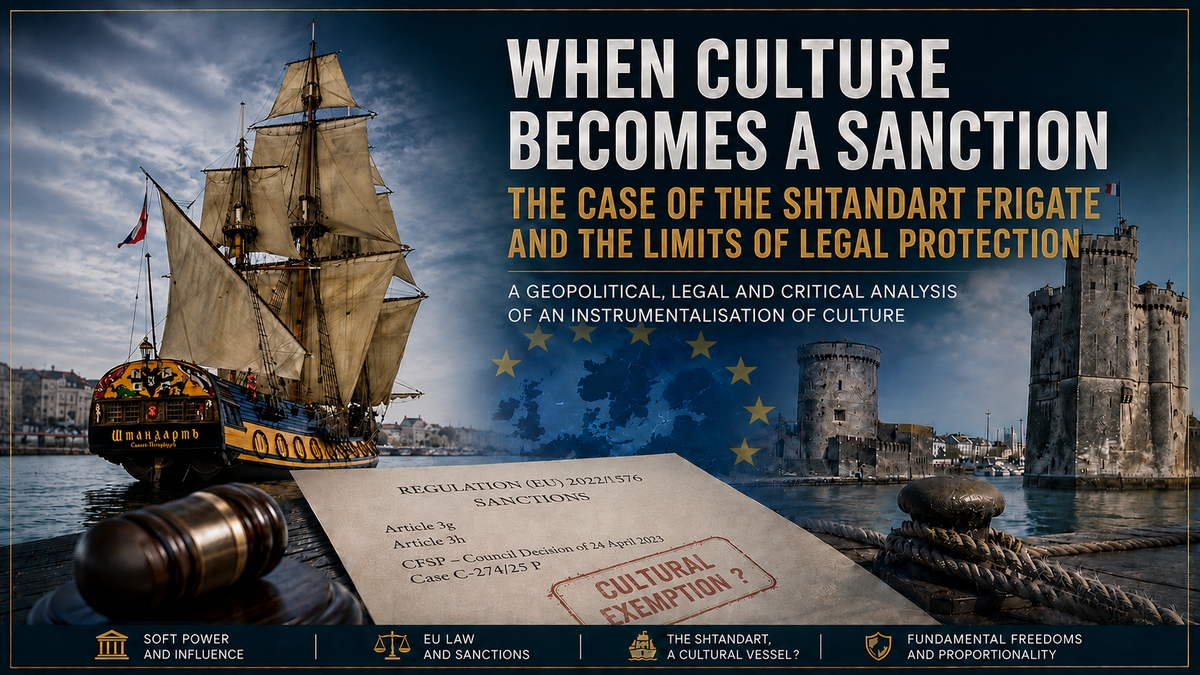
In a statement published on 5 May 2025 on its website, “When culture becomes a sanction… the limits of legal protection”, the Shtandart invokes culture as a principle of neutrality in the face of war and sanctions. This is not an isolated case but an intervention that may be analysed as an illustration of Russian influence mechanisms.
Portrayed as a maritime and educational replica, the vessel has become the subject of controversies with very concrete consequences.
Most of the arguments it develops have already been discussed in three publications, making it possible to assess the use of cultural narratives for political purposes. This triptych, predating the Shtandart’s text, constitutes the analytical and documentary corpus through which this position can be examined, without restating here all previously established developments.
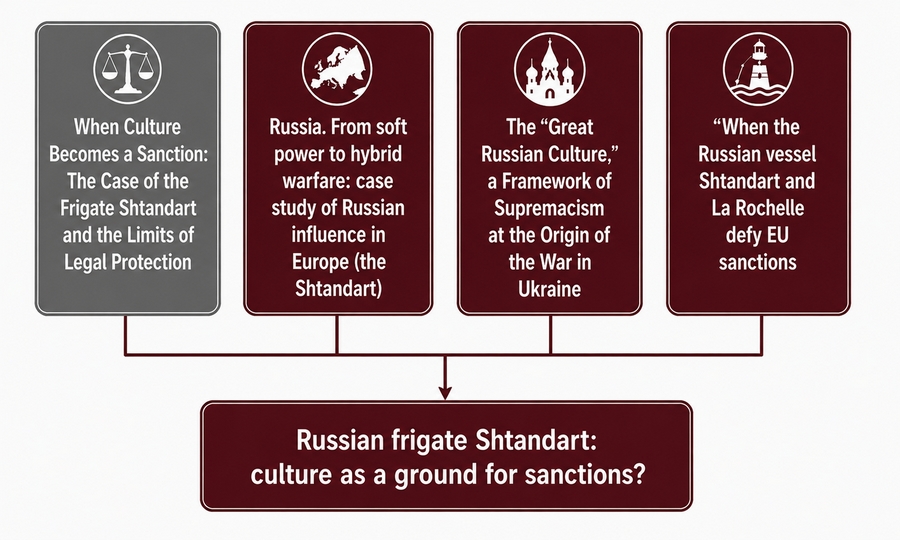
The Shtandart article is not limited to its own defence: it proposes a redefinition of the relationship between culture, politics, and sanctions that calls for discussion.
[0] Anna Gamzikova, “When Culture Becomes a Sanction: The Case of the Frigate Shtandart and the Limits of Legal Protection”, shtandart.eu, 5 May 2025
I. The implicit thesis of the Shtandart text
The substance of the Shtandart text (MMSI 518999255) only becomes apparent after careful reading, even though its title already signals its general meaning.
The replica of Peter the Great’s frigate is presented as a historical and educational object which, by virtue of its nature, should be preserved and kept apart from political conflicts as well as from the sanctions regime. It is also recalled that “the protection of cultural heritage, especially in times of conflict, is a widely recognised principle.”
The Shtandart argues another reason for exclusion from EU restrictive measures: “It is not a military vessel, it does not perform any state function, and it carries no political mandate.”
The restrictions targeting the vessel would therefore not be the normal result of the application of EU regulations, but the product of a distorted interpretation under the effect of activist and reputational pressure.
The document refers to a “broader flexibilisation of law”. It suggests that some administrative authorities may have preferred to ban the vessel not because of applicable legal criteria, but out of fear of political and media risk linked to the war in Ukraine and the campaigns conducted against Shtandart.
The vessel would thus have been targeted precisely because of its historical vocation. The title, “When culture becomes a sanction…”, is thereby confirmed.
In summary, the Shtandart would be a heritage sailing ship specifically targeted, portrayed as a victim of a weakening of the rule of law in times of conflict. Other interpretations of this text, which is relatively unclear and lacking substantial factual documentation, may nevertheless legitimately be formulated.
However, examining the reasons underlying restrictive measures against this vessel cannot be limited to their presentation by the party concerned. It requires a broader interrogation of the relationship between culture and politics as analysed in works on soft power.
II. The myth of cultural neutrality
The core of the argument consists in marketing the Shtandart as a purely historical and educational project strictly separated from contemporary political dimensions. But this type of claim has already been challenged in the literature on Russian soft power. Edward Said notes that:
“Culture is never innocent; it is always involved in relations of power.”
This dichotomy has also been criticised in the Diploweb publication on hybrid influence dynamics related to this vessel [1].
The issue is not limited to the nature of Peter the Great’s frigate replica; it also concerns the imperial imaginaries it conveys, the symbolic representations it shapes, and its effects in the public space. This articulation between cultural project and political dimension appears in certain statements by Vladimir Martus. Interviewed in July 2018 by Natalya Aryaeva, the captain and owner of the Shtandart himself stated:
“We are supported by the Committee on Youth Policy of the Government of Saint Petersburg. Participation in such a project is an excellent way to educate young people in patriotism. Real patriotism… The Shtandart is a living history — a bridge between the glorious past of the era of Peter I and the present… We sail and will always sail under the Russian flag. I try to realise on board the ideal I was taught in communism… I would very much like to preserve this spirit on the Shtandart, taking the best of the Soviet Union.”
With the war in Ukraine, the Shtandart therefore cannot be reduced to a neutral vector of transmission.
While the links between culture and politics are widely acknowledged, some authors and studies go further, considering Russian culture itself as a structuring factor of the conflict in Ukraine.
[1] Bernard Grua, “Russia. From soft power to hybrid warfare: case study of Russian influence in Europe (the Shtandart),” Diploweb, 25 November 2025.
III. Russian culture as a matrix of power politics
In times of conflict, culture is often interpreted through the lens of soft power and hybrid warfare. But for some, it must be understood more structurally, as a matrix of external projection.
This idea has been expressed particularly explicitly by Timothy Snyder:
“The invocation of Russian history and culture is used to justify military aggression and expansionism, giving war a moral veneer.”
The conclusions of the study devoted to “Great Russian Culture” [2] lead to similar findings. The purpose of that article was not to deny the existence or richness of Russian culture, but to show that certain historical and cultural references can be exploited as tools of geopolitical legitimisation.
This approach remains relatively invisible in French debate. Yet it cannot be ignored without risking overlooking a major dimension of the Shtandart case, as perceived in neighbouring countries of Russia.
Certain aspects of the Russian cultural narrative have for centuries contributed to a vision of civilisational superiority, which feeds into the ongoing conflict.
Invoking it as proof of neutrality is no longer sustainable. In several Eastern European countries, it is even understood as contrary to the objective pursued by the Shtandart’s communication.
The main question is not whether this vessel is a cultural asset — which it undeniably is — but to recognise that it remains a strategic object embedded in a geopolitical confrontation and a struggle over representations.
If the cultural dimension of the Shtandart appears more complex than presented in public debate, its treatment nevertheless falls within a clearly defined European normative framework based on clearly defined criteria.
[2] Bernard Grua, “The “Great Russian Culture,” a Framework of Supremacism at the Origin of the War in Ukraine” , bernardgrua.net, 26 October 2025.
IV. EU sanctions: neither an isolated case nor an administrative misunderstanding
The vessel argues that the restrictions targeting it result from a misunderstanding of its cultural vocation, or even from a juridical-administrative drift.
This explanation does not withstand examination of the decisions concerning it. These fall under the EU sanctions programme adopted in response to the full-scale invasion of Ukraine. This regime is defined in Article 3ea of Regulation (EU) No 833/2014. It has been confirmed on several occasions, notably by the order of the Court of Justice of the European Union of 22 August 2025.
Here, the cultural qualification of the Shtandart, as well as the claimed apolitical nature of the vessel, constitutes neither an exemption nor a basis for applying these measures. Such parameters simply do not enter into the equation, contrary to what is argued.
The determining criterion lies elsewhere. EU texts are based on objective indicators linked to flag and registration. This practice is consistent across the Union and applies to all vessels concerned, without derogation based on any symbolic or traditional status. The Shtandart belongs to a group of more than 4,000 vessels flying the Russian flag on 24 February 2022, without distinction of ownership or use. These vessels have been banned from EU ports since 16 April 2022.
Their identification by port authorities relies on European tracking and information systems, in particular those of the European Maritime Safety Agency (EMSA).
While the regulatory treatment of the Shtandart in Europe is broadly coherent, one particular case reveals a more “flexible” implementation, favourable to the vessel, in which the cultural argument has been mobilised for justificatory purposes.
V. From Shtandart’s discourse to administrative leniency
The claims examined above have not remained theoretical. They have translated into concrete practice in a French Atlantic port.
A Desk Russie article focuses on La Rochelle [3], where the Shtandart was based for more than three years. It highlights, at the very least, accommodating arrangements and interpretative “flexibility” in the application of the rules. Such a situation, however, is an exception compared to practice in other EU ports.
This atypical situation in La Rochelle ended with the inter-prefectoral order of 5 March 2026 adopted by the French maritime prefects (Channel–North Sea, Atlantic, Mediterranean). This order renders the arguments advanced by the Shtandart moot.
Beyond controversies over administrative and legal practices, the Shtandart’s position is distinguished by its structure and by questions surrounding its purpose.
[3] Bernard Grua, “When the Russian vessel Shtandart and La Rochelle defy EU sanctions”, Desk-Russie, 28 September 2025.
VI. A well-known Russian rhetoric
Part of the narrative reproduces elements of language classically associated with Russian soft power. The remainder reflects the construction of an alternative reality, which consists in presenting administrative and legal decisions taken against the Shtandart as primarily resulting from activist influences, rather than from the application of an EU sanctions regime based on objective criteria. The applicable regulatory framework is, however, clearly established and confirmed by consistent case law.
The purpose of the Shtandart’s argumentation raises questions.
It appears difficult to mobilise in a legal appeal against the administration or the courts, given the unsubstantiated accusations it makes against them. There is no indication that it is capable of challenging the inter-prefectoral order of 5 March 2026.
Its sometimes obscure formulation and disembodied content are not suited to regional or national media, nor to social networks where the Shtandart’s supporters usually express themselves.
Russian media, attentive to the campaign led by the Shtandart against sanctions, may therefore constitute one of its outlets. These developments would thus contribute to fuelling contestation of national or European institutions, as has already been observed in previous years.
Bernard Grua
No Shtandart In Europe
Email: noshtandartineurope@gmail.com
Website: https://bit.ly/No-Shtandart
Facebook: groups/noshtandartineurope
WhatsApp
Further Reading
Triptych constituting the analytical reference corpus (recommended reading for understanding the argument):
- Bernard Grua, “Russia: From Soft Power to Hybrid Warfare – A Case Study of Russian Influence in Europe (the Shtandart)”, Diploweb, 25 November 2025.
- Bernard Grua, “The “Great Russian Culture,” a Framework of Supremacism at the Origin of the War in Ukraine”, bernardgrua.net, 26 October 2025.
- Bernard Grua, “When the Russian Vessel Shtandart and La Rochelle Challenge EU Sanctions”, Desk Russie, 28 September 2025.
Other references cited (in order of appearance):
- Natalya Aryaeva, “Captain Vladimir Martus and His Dream Come True – the Frigate Shtandart” (FR), Zhizn’ mechty, 27 July 2018.
- EUR-Lex, “Article 3ea of Council Regulation (EU) No 833/2014”, 8 April 2022.
- Court of Justice of the European Union (CJEU), “ECLI:EU:T:2025:807, Case T-446/24, Martus TV GmbH, Mariia Martus and Vladimir Martus v Council of the European Union”, 22 August 2025.
- European Maritime Safety Agency (EMSA), “Russian-flagged vessel database”, June 2024.
- French Maritime Prefectures, “Inter-prefectoral order regulating navigation of the TS Shtandart in French territorial waters and internal waters”, 5 March 2026.
- No Shtandart in Europe, “TS Shtandart: EU regulations, administrative texts and case law” (FR).
- No Shtandart in Europe, “Dossier – The Shtandart and Russian media”, 2024/2025.
Additional contextual sources (reverse chronological order):
- Anna Gamzikova, “Open letter to the three French maritime prefects: contestation of the ban” (FR), shtandart.eu, 2 April 2026.
- No Shtandart in Europe, “Report – The Russian vessel ‘Shtandart’: exclusions and port restrictions in Europe in 2025”, bernardgrua.net, 13 January 2026.
- Shtandart, “The Shtandart case: defending maritime heritage against misinterpretations and harassment” (FR), shtandart.eu, 20 September 2025.
- TASS, “Russia’s Consulate General slams banning frigate Shtandart from entering Scottish harbour”, tass.com, 18 July 2025.
- Vladimir Martus, “Open letter to the French maritime authorities: request for clarification regarding the status of the training ship Shtandart” (FR), shtandart.eu, 15 May 2025.
- Bernard Grua, “Understanding the Russo-Ukrainian cultural front” (FR), 7 June 2022
- Bernard Grua, “Everything separates Ukrainian culture from ‘Russian culture’”, 31 March 2022
Summary
Shtandart argues that it was targeted by sanctions not despite its cultural dimension, but precisely because of it. The vessel claims that the port bans directed against it result from a “flexible” interpretation of the law in the context of the war in Ukraine and the campaigns conducted by its opponents. This argument must be analysed in light of Russia’s political uses of culture and the applicable European legal framework.
Original text from Shtandart
When Culture Becomes a Sanction: The Case of the Frigate Shtandart and the Limits of Legal Protection
Author : Anna Gamzikova
Date : 5 mai 2025
The story of the frigate Shtandart is not merely a private dispute around a single vessel. It is a revealing case study of how, in times of geopolitical crisis, the very logic of law shifts — and how cultural projects can suddenly become exposed to risk.
A closer look at this case leads to three uncomfortable but important conclusions: culture is not shielded from politics; symbols can outweigh substance; and the law is far more flexible than we tend to believe.
A Cultural Object That Ceased to Be “Just Culture”
Formally, the Shtandart is a historical replica — an educational and cultural initiative. It is not a military vessel, does not perform state functions, and carries no political mandate.
Yet within the framework of EU sanctions policy, this proved irrelevant.
The key shift occurred in the criteria of assessment: the question changed from “What is this object?” to “What is it associated with?”
Its connection to Russia — through flag, origin, and symbolic meaning — automatically moved the vessel into a risk category. Within this logic, its cultural status no longer provided protection.
When Symbol Overrides Substance
One of the most striking aspects of this case is the substitution of substance with symbolism.
In substance: educational activity, historical reconstruction, international collaboration.
In symbolism: the Russian flag, historical association with Russia, the context of an ongoing conflict.
Under political tension, the symbolic dimension became decisive — not necessarily through explicit legal wording, but through broader interpretation: a symbol may be treated as a potential instrument of influence.
This fundamentally changes the underlying logic of how such cases are assessed. Where culture was once considered “outside politics,” it can now be interpreted as an extension of it.
The Role of Pressure: How Campaigning Integrated into the System
Public campaigning played an important role — but not as simple external pressure. More precisely, it operated by leveraging the existing legal framework.
Individuals and campaigners opposing the vessel did not need to prove that it directly violated the law. Instead, the strategy was to demonstrate that, under current sanctions, it could be interpreted as a risk.
From there, a familiar bureaucratic mechanism took over: every official decision is evaluated through the lens of risk; allowing the vessel may trigger controversy; prohibiting it carries minimal consequences.
This creates a structural asymmetry: permission requires justification; prohibition does not.
As a result, the system naturally gravitates toward restriction.
The Failure of Cultural Logic in a Non-Cultural Environment
One reason the defense of the Shtandart proved ineffective lies in the mismatch of arguments.
Appeals to culture, education, and apolitical intent work in stable environments. Under sanctions, they are outweighed by harder categories: risk, security, and policy.
This creates a fundamental disconnect: one side speaks the language of values, the other speaks the language of risk management.
In such conditions, the latter prevails.
The Expanding Nature of Law as the New Normal
The most important takeaway is not about a single vessel, but about the nature of law in times of conflict.
Law does not disappear — but it changes its properties: it becomes more flexible, allows broader interpretations, and shifts from proof to prevention.
This means that the boundaries of legal application can move faster than stakeholders can adapt.
Implications
The Shtandart case illustrates a broader pattern: cultural status alone does not shield a project from political frameworks, and even indirect or symbolic associations may become decisive in administrative decision-making. In practice, risk avoidance often takes precedence, limiting the space in which cultural initiatives can operate — particularly in sanctions contexts linked to geopolitical conflict.
Conclusion
The case of the Shtandart is an example of how cultural initiatives can be caught in and constrained by sanctions regimes shaped by geopolitical conflict. It highlights a central point: the protection of cultural heritage, particularly in times of conflict, is a widely recognised principle, but in practice it can come into tension with broader political and security considerations.


Un avis sur « Russian frigate Shtandart: culture as a ground for sanctions? »