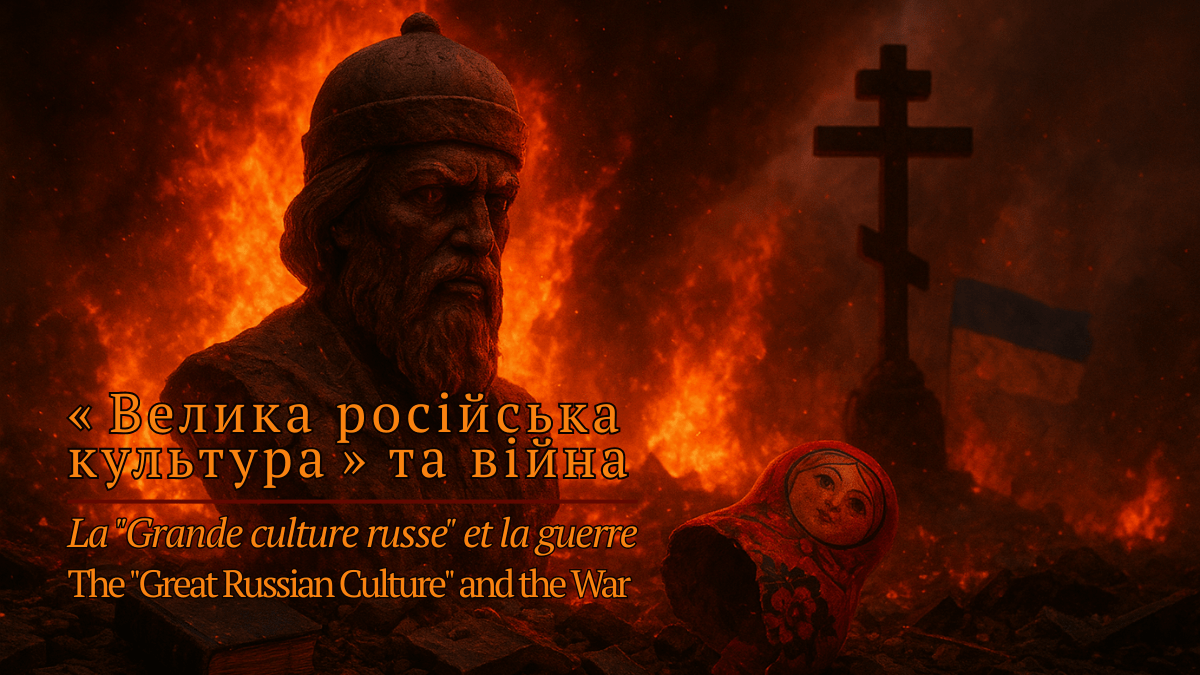
Since February 2022, many have sought to dissociate the war waged by Russia from what is called the “Great Russian Culture.” This distinction, flattering to Western consciences, allows one to continue admiring Tolstoy, Tchaikovsky, or Tarkovsky without discomfort. Yet, if one examines the very structure of what this expression encompasses, it must be recognized that the concept of “Great Russian Culture” intrinsically carries an unjustifiable civilizational hierarchy. It has powerfully contributed to making the war of aggression against Ukraine appear conceivable and acceptable.
This is not about attributing moral responsibility to a culture in the anthropological sense, but about analyzing a political narrative—the one of “Great Russian Culture”—as it has been historically constructed, mobilized, and instrumentalized.
- “Great Russian Culture” and French Russophilia
- A Culture Conceived from the Center
- The “Great” as an Instrument of Domination
- A Cultural Hegemony Shared by Opponents
- From Aesthetics to War
- For a Decolonial Re-reading
- Conclusion
- Notes
- Read also
“Great Russian Culture” and French Russophilia
The expression “Great Russian Culture” took root abroad, especially in France, less because of the reality of its artistic production than through a clever political and symbolic construction. Since the 19th century, Russia has cultivated this myth to assert its international prestige, highlighting a few isolated figures as emblems of a supposed national genius. This narrative found fertile ground in the romantic fascination for the so-called “Slavic soul” and, later, in Soviet sympathy for a culture perceived as heroic and popular. Thus, the “Great Russian Culture” stems from a strategy of influence and not from actual artistic superiority.
Françoise Thom1: “Neo-Eurasianism and the myth of a ‘Russian civilization’ feed on ideological Slavophilism, heir to imperial doctrines, more than they translate a cultural reality.”
The myth established itself all the more easily in France because its citizens are ignorant of Russian reality, and the opacity surrounding this country is fertile ground for projecting cultural, familial, social, and political fantasies.
Anna Colin Lebedev2: “There is no need for Kremlin propagandists for the Russian gaze to permeate, long before Vladimir Putin arrived on the political scene, our perception of this region of the world.”
This fascination is neither the result of individual naivety nor moral fault, but of a long process of cultural and political mediation that favored the projection of a Russian imaginary largely disconnected from historical and social realities.
As Schmitt and others note, French admiration for “Russian culture” is often based on erroneous premises: “Pushkin does not justify allying with Putin”3 (Schmitt). The literary historian recalls that in the 19th century, “the French people… were ignorant of the Tsarist empire and its customs”4, which suggests that this idealized “Russia” was for a long time merely a product of the French imagination.
Anna Colin Lebedev²: “Out of affection for Russia beyond its government, attachment to its artists and intellectuals, fascination with its turbulent history and extraordinary destinies, we adopted Moscow’s perspective, without realizing the distortions this entailed.”
A Culture Conceived from the Center
Russia was built as an empire long before conceiving itself as a nation. Its political system, art, and spirituality were formed around one idea: Moscow as the center of the Slavic and Orthodox world, heir to Byzantium and custodian of the “universal truth”.
Richard Pipes5: “The vision of Russia as the moral and spiritual center of the Slavic universe served to legitimize its expansion and domination over its neighbors.”
Within this framework, other peoples—Ukrainians, Belarusians, Tatars, peoples of the Caucasus or Siberia—were not denied, but subordinated: they participated in a common culture whose heart, language, and legitimacy remained Russian. It was not only political domination: it was an internalized cultural hierarchy.
Anna Colin Lebedev²: “The Russian gaze is that of a center on its periphery; that of a dominant power over those it has long dominated. It is a narrative that grants itself the right to define great culture and peripheral cultures, the language of civilization and subordinate languages, major events and local histories, great men and great traitors.”
Like any imperial culture, Russian culture was built in a relationship of hierarchy and centrality; what distinguishes it today is the claimed persistence of this pattern, not deconstructed and still operative in contemporary political discourse.
Oleg Kharkhordin6: “Russian culture has been regularly mobilized to legitimize conquest and expansion, presenting imperial policy as a civilizing duty.”
The “Great” as an Instrument of Domination
Speaking of Great Russian Culture (великая русская культура) is not a simple laudatory formula: it is a device of symbolic power.
Svetlana Alexievitch7: “I realized that the war inhabited us; that it was our culture. People talk about the great culture of Russia, but the main element of this ‘Great Russian Culture’ is war.”
“Great” compared to what? Compared to “small,” “local,” or “peripheral” cultures, whose very existence seems to have to be measured by what was considered Russian culture. This greatness, celebrated in St. Petersburg as in Paris, has always implied the capacity to speak for others, to represent the universal from the imperial center. Under Tsarism, this hierarchy justified Russification; under the USSR, it took the form of an “internationalism” in which Russian remained the language of the supposed civilization; today it is reformulated in the “Russian world” (russki mir), an ideological instrument of the Kremlin.
Vladimir Putin8: “The key and unifying role in the historical consciousness of the multinational Russian people belongs to the Russian language, that is to say, to the Great Russian Culture.”
The critique of the adjective “great” targets neither the works nor their aesthetic quality, but the symbolic use of this greatness as a principle of hierarchy and erasure of so-called peripheral cultures.
Anna Colin Lebedev²: “How can one see today, for example, in the Russian language anything other than a weapon of war, when Russification is a central policy of occupying Ukrainian territories?”
A Cultural Hegemony Shared by Opponents
The most troubling aspect is that this imperial matrix transcends political divides.
Françoise Thom¹: “Even opponents of the Kremlin often situate themselves within a political culture that does not question the idea of the Russian empire.”
Alexei Navalny, a hero of resistance to Putin, embodied a struggle for justice and freedom—but within the mental borders of the empire. His assumed nationalism, his refusal to recognize Ukrainian sovereignty over Crimea, or his disdain for migrants from the Caucasus, were noticeable. It shows how deeply the sense of Russian superiority remains structural, even among “democratic” opponents. In Russia, contesting power does not necessarily mean contesting the idea of empire.
Recognition of the individual courage of opponents to the regime does not prevent observing that many of them remain inscribed in a political imaginary inherited from the empire, rarely interrogated as such.
From Aesthetics to War
The cult of “great culture” today serves as a moral cover for imperial violence. The bombings of Kharkiv or Odessa are “justified” in the name of “defending the Russian world,” of the “Orthodox civilization,” of the “language of Tolstoy.” It is therefore not an accidental diversion: it is the logical consequence of a cultural imaginary in which the phantasmagorical Russian universality denies the plurality of the world.
This is not about positing a direct causality between culture and violence, but about showing how a hierarchical cultural imaginary can make war conceivable, justifiable, and morally acceptable.
Thus, the war in Ukraine is not a deviation of Russian culture. It is the product of its central myth: that of an alleged natural greatness, a pseudo civilizing vocation, and the unfounded claim of moral superiority over other nations labeled, with contempt, as “small peoples.”
Timothy Snyder9: “The invocation of Russian history and culture serves to justify military aggression and expansionism, giving the war a moral veneer.”
For a Decolonial Re-reading
Recognizing this does not mean rejecting Tolstoy or Tchaikovsky, but ceasing to idolize them as emblems of an unblemished universalism. It is time to read Russian culture as an imperial culture among others, with its beauties, its shadows, its lack of humanism, its cruelty, and its violence. And finally, to listen to Russian, Ukrainian, Caucasian, Siberian, or Tatar voices who strive to decolonize the Russian imaginary, often at the cost of exile, silence, torture, or assassination.
Serhii Plokhy10: “Ukrainian history and the peripheral voices of the empire show how Russian culture was constructed as an imperial project, and how these decolonial voices are often silenced or ignored.”
This rereading does not reject or marginalize Russian culture but broadens the perspective to restore the place of voices long marginalized or silenced by the imperial center.
Anna Colin Lebedev²: “It is surprising that we still hear candidly about the ‘Great Russian Culture’ to lament its erasure in Ukraine, while one would no longer dare to evoke the ‘Great French Culture’ and criticize its low presence in the schoolbooks of France’s former colonies.”
Conclusion
Russian supremacism was not born in barracks, but in libraries, cathedrals, and academies. The war in Ukraine is first and foremost a war of “culture”, waged by the uncultured and by a power that relies on centuries of symbolic hierarchy. As long as Russia has not deconstructed its own myth of “Great Culture,” it can neither become democratic nor live in peace with its neighbors—or with itself.
Deconstructing the myth of “Great Russian Culture” does not mean condemning a cultural heritage, but recognizing that no lasting democratization can occur without questioning the symbolic hierarchies that have long served to legitimize domination and violence.
Notes
- Françoise Thom, Comprendre le poutinisme, Paris, Fayard, 2019. ↩︎
- Anna Colin Lebedev, Le filtre russe, Le Grand Continent, 29 August 2022 ↩︎
- Olivier Schmitt, Pourquoi Poutine est notre allié ? 2017 ↩︎
- Murielle Lucie Clément, L’Image des Russes et de la Russie dans le roman français de 1900 à nos jours, 2010 ↩︎
- Richard Pipes, Russia Under the Bolshevik Regime, New York, Vintage Books, 1994 ↩︎
- Oleg Kharkhordin, The Collective and the Individual in Russia: A Study of Practices, Berkeley, University of California Press, 1999. ↩︎
- Svetlana Alexievitch : We are confronted with Russian fascism, Voxeurop, 2023 ↩︎
- President of the Russian Federation : Decree approving the fundamental principles of state cultural policy, 25/01/2023 ↩︎
- Timothy Snyder, The Road to Unfreedom: Russia, Europe, America, New York, Tim Duggan Books, 2018 ↩︎
- Serhii Plokhy, The Gates of Europe: A History of Ukraine, New York, Basic Books, 2015 ↩︎
Read also
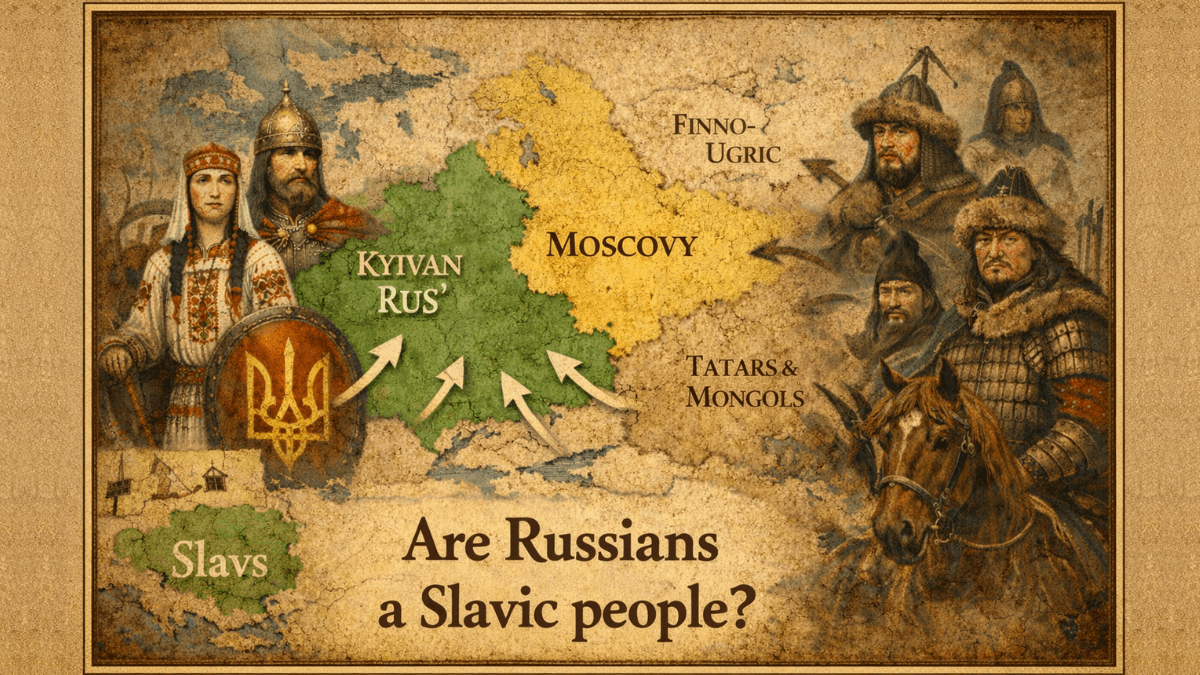
Are Russians a Slavic People?
Ethnicity, nobility and religion: understanding why Russia cannot claim the status of a Slavic people.
Keep reading
Comprendre le front culturel russo-ukrainien
Promouvoir la culture russe aujourd’hui revient à soutenir le « ruscisme », une archaïque idéologie expensionniste et colonialiste panrusse mise à jour de pratiques génocidaires ayant de nombreux points communs avec le nazisme. S’en faire l’avocat, consiste à, de facto, en approuver les modalités techniques que sont les destructions organisées de la culture et du patrimoine de…
Keep reading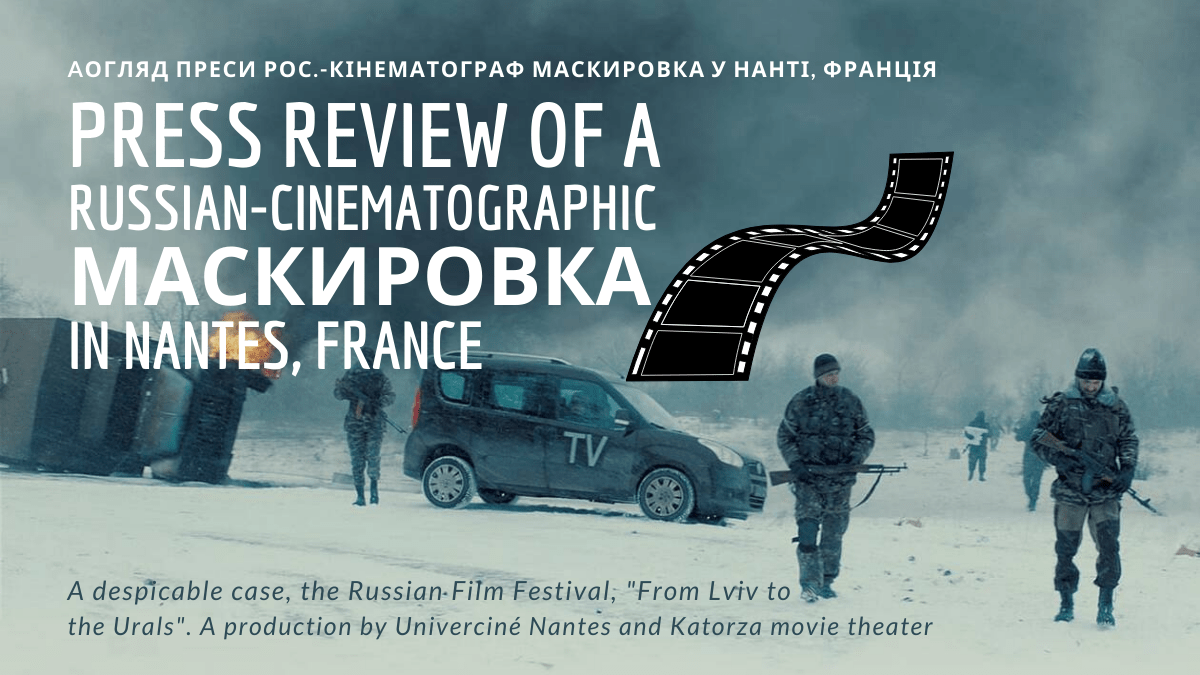
Press review of a Russian-cinematographic маскировка (maskirovka) in Nantes
The case of the film festival named « From Lviv to the Urals » evidenced how difficult it is to counter the pro-Russian lobby, if not a pro-Putin one, in Nantes, France. However, for our nationals, it only impacted a small local circle of cinephiles and agents of influence. On the other side, it revealed a Nantes…
Keep reading
Tout oppose la culture ukrainienne et la « culture russe »
Afin de sortir d’un schéma mortifère pluri-centenaire, porté à son paroxysme depuis le 24 février 2022, la culture ukrainienne ne peut pas et ne doit pas coexister avec la culture russe, dans un même espace et lors d’un même événement. C’est une prophylaxie élémentaire.
Keep reading
 Bernard Grua - No Shtandart In Europe
2 commentaires sur « The “Great Russian Culture,” a Framework of Supremacism at the Origin of the War in Ukraine »