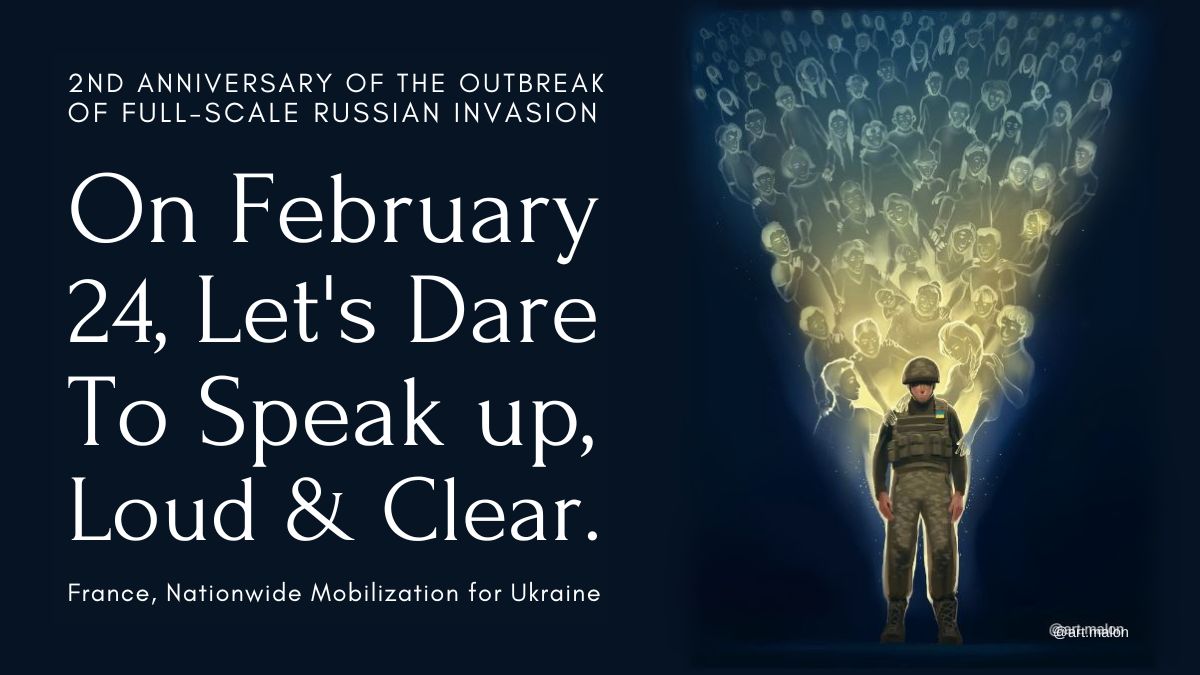
Cover visual by Mariia Loniuk, @art.malon
February 24, 2024 refers to the sinister second anniversary of the Russian Federation’s full-scale invasion of Ukraine, the climax of a war of aggression launched ten years ago. To mark the occasion, French associations, those which actually support Ukraine, have decided to launch a day of national mobilization. Here are a few ideas on how to communicate the event. Unless explicitly quoted, these remarks are the sole responsibility of the author.
- How can we ensure that our communication reflects the diversity of the organizations involved?
- Who should we address?
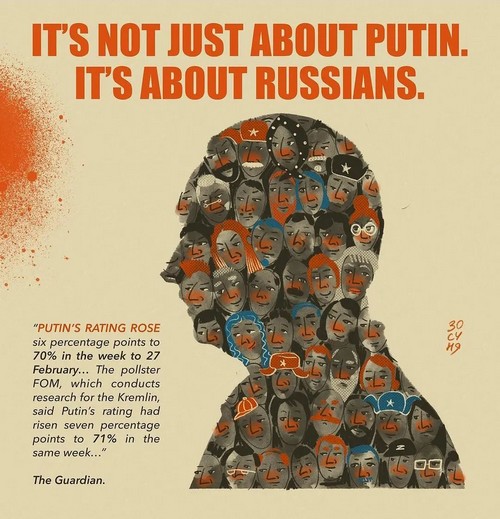
- Should we talk about putin or about russians and russia?
- How to deal with russian anti-putin opposition?
- How can we talk about peace?
- How could we make our message audible and relevant?
- Join the Nationwide Mobilization.
How can we ensure that our communication reflects the diversity of the organizations involved?
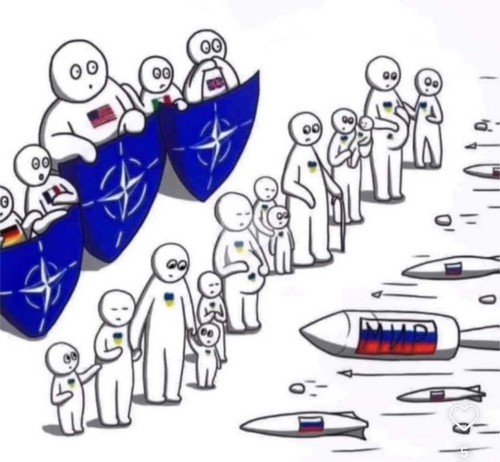
It is crucial to have a unified discourse that attempts to take up everyone’s concerns. But this is an exercise fraught with obstacles, as it can result in a cumbersome and redundant compilation that doesn’t follow a logical path while being, in no way, a demonstration or a call to action. The reader risks getting lost in a profusion of repetitive words, ideas and even expressions. What’s more, as in any pudding made from a pastry chef’s unsold stock, there will be elements that have no place in it. The old adage, « he who embraces too much, embraces poorly », could unfortunately prove relevant.
The art of synthesis will therefore require editorial efforts and, probably, mutual concessions. Only then will it be possible to consider the potential publication of an opinion article in a national or regional media outlet.
Who should we address?
Communication can’t just be aimed at educated and honest readers. It has the potential to be exploited by the ignorant or by individuals acting in bad faith, even in the mainstream media. Not everyone is President Zelensky addressing Heads of State. We need to speak up loud and clear to be heard by all. It’s not an easy task, as we’ve been observing for the past year and a half. In a related field, No Standart For Europe is constantly trying to inform the regional press and correct the approximations and even fake news published by Ouest-France, Le Télégramme, Presse-Océan, La Manche Libre, Nord-Littoral, Sud-Ouest, France 3, France Bleu, La Voix du Nord, Actu Fr… It is also possible to find untruths, if not false testimony, in Le Monde, Libération, BFMTV and AFP.
We need to speak up loud and clear to be heard by all.
But let’s go back to the regional press. As it can be seen from dozens of examples, journalists writing about French demonstrations or events about Ukraine are usually in charge of local news stories, frequently trivial ones. From then on, these contributors, devoid of any knowledge of the subject they are covering, apply a very simplistic, even marvellous, consensual doxa.
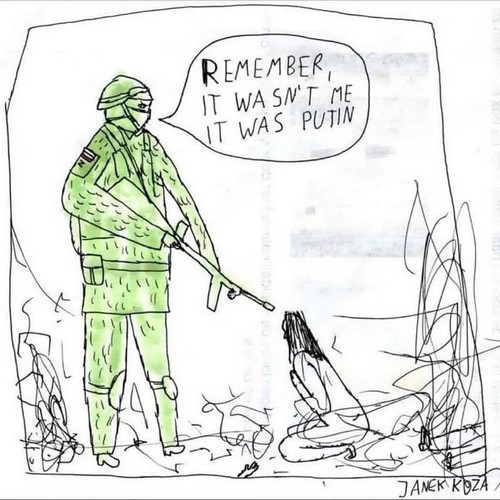
Every effort is made to adhere to it. To put it plainly: « There are no problems between russians and Ukrainians, who are so close in so many ways. Everything that’s happening in Ukraine is putin’s fault, and putin’s fault alone. The russians in France support the Ukrainians »… when those same russians aren’t falsely declaring themselves Ukrainian.
In an event that supports Ukraine, the point of view of a single russian is granted as much space, for many media, as that of thirty or fifty Ukrainians. The « good russian », even if alone, gives credit to the editorial marshmallow. Our production will inescapably be hijacked by selected, decontextualized quotations. We’ll inevitably have headlines like « Strong mobilization for peace ». Pen-pushers, without even reading the details of our statement, will probably outbid their colleagues’ headlines: « Strong mobilization to negotiate with Putin ». By being concise and avoiding incidental considerations, we must ensure that we drastically limit possible falsifications. Because we can’t count on obtaining any right of reply.

Should we talk about putin or about russians and russia?
We need to have a message that causes no confusion. In the three questions below, our statement should answer only the first one. The others are irrelevant.
- Is it a demonstration against the russian war and for the victory of Ukraine?
- Is this a demonstration against the russian regime?
- Is this a demonstration to support russians who declare themselves anti-putin (even if this is a lie, or even if they continue to share a condescending, i.e. colonialist, vision of Ukraine)?
Incidentally, as far as « russian opponents » are concerned, it’s worth pointing out some serious ambiguities. Let’s take two examples like Vladimir Martus and Lev Ponomarev, whose primary aim is to promote a presentable image of Russia. In the case of the former, we can’t rule out the possibility that he is acting in agreement with Moscow’s special services, while passing himself off as an opponent to the French press, which systematically refuses to share our sourced elements contradicting his narrative. As for the latter, a Peace Nobel Prize, we recall his contemptuous and patronizing admonition as a russian big brother, which he addressed to Marianna Perebenesiuk on the set of TV5 channel.
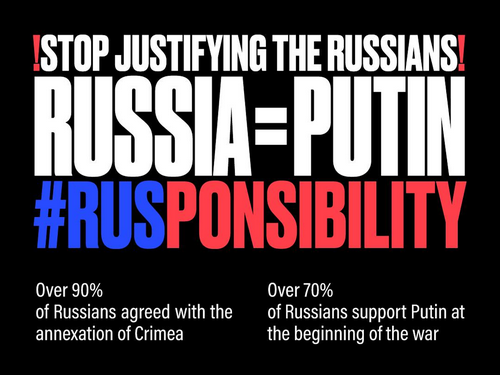
Putin did not make russia. Russia made putin. Read « Why Russians are to Blame for Putin » by Iryna Podolyak, former Ukrainian Deputy Minister of Culture.
As Anna Colin Lebedev says, « russian culture is the mother of war ». This is indeed a Russian war of annihilation waged on Ukrainian territory against the Ukrainian people, nation, culture and heritage. Let’s not delude ourselves. Today, the enemy of the European continent, of which Ukraine is the geographically largest country, is russia, and not just putin.
The enemy of the European continent is russia, and not just putin.
The russian aggressor.
Ukraine today, European Union tomorrow

How to deal with russian anti-putin opposition?
Let’s ask ourselves a few questions.
- Can the russian opposition topple putin?
- Can the russian opposition stop the war?
- Is the russian opposition numerically significant in France?
- Does it make sense to disperse our forces by supporting the russian opposition?
- Can our mobilization have any impact on russian governance?
My answer is five times « no ». We’ve had 20 years to demonstrate against putin. Now it’s too late. And it would only create confusion. After the Rouen event against the violation of the 5th round of sanctions, Olesya Telizenko published a piece in the Ukrainian media: « We demonstrated against the russians ». She didn’t bother with circumlocutions. And she was right. As Alexandra Goujon recommends, let’s listen to the Ukrainians.
Let’s not waver, or we’ll lose our voice. If we are forced to choose between the Ukrainians and the russian « opponents », then we must drop the latter. The Ukrainian cause has no business giving artificial visibility to fringe organizations or being instrumentalized by the convulsions of a « Russkii Mir » prey to its own demons and its quest for whitewashing.
How can we talk about peace?
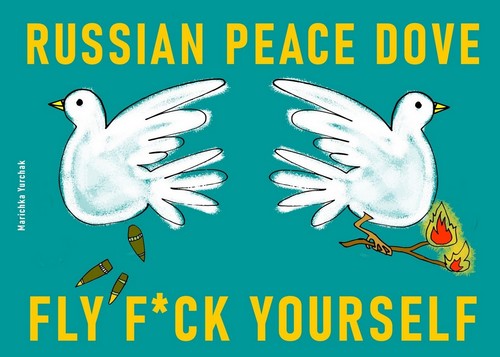
Everyone wants peace, including the pro-russians and pro-putin. These latter wish to consolidate the gains of the invasion so that they can quietly prepare the next aggression against Ukraine and other countries. Abusing the term « peace », for the sake of grabbing a larger support, runs the risk of endorsing all the « solutions » advocated by russia and its useful idiots to achieve this: disarmament of Ukraine, capitulation of Ukraine, territorial concessions, deportation, ethnic cleansing, imprisonment, torture, russification, forced adoptions and so on.
A case in point is our bitter experience in Nantes of a « Coordination pour la Paix » (Peace Coordination), a mishmash of parties and unions, whose organizer, a retired politician and former Trotskyite leader in the CGT (communist union), poses as the local leader of the Ukrainian cause and claims to speak on behalf of Ukrainians. At the same time, he works hand-in-hand with russian or pro-russian networks. In the « name of peace », he has not hesitated to resort to blackmail, slander and lobbying practices against Loire-Atlantique’s leading Franco-Ukrainian association.
First and only, to demand arms for Ukraine, in order to defeat the Russian army and to ensure Ukrainian military victory.
In my opinion, our slogan should be simple. First and only, to demand arms for Ukraine, in order to defeat the Russian army and to ensure Ukrainian military victory. Then, just if we are asked why, we will reply that this is how peace was restored in 1918 and 1945.
Everything in its own time. Clémenceau, Churchill or de Gaulle invoked victory, not peace. Today, in Europe, that’s where we are.
The men who made peace in Europe possible spoke only of military victories.

Lithography. Paris, Musée Carnavalet.


The men who made war in Europe possible spoke only of peace.
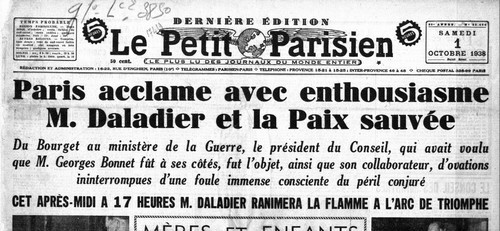
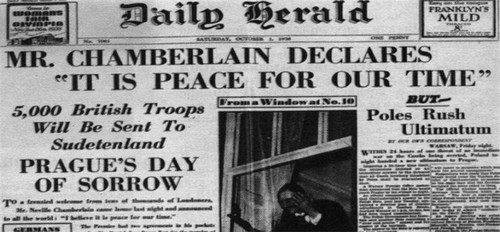
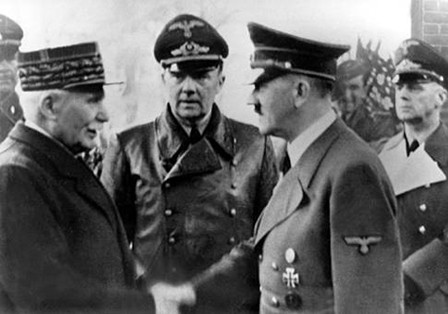
How could we make our message audible and relevant?
Our communication could be built around three topics:
- a report on the humanitarian catastrophe in Ukraine and the risk of russian military operations spreading to the rest of Europe,
- a call to wake up and mobilize,
- an appeal to French and European leaders.
Our message must have a single objective: to win the victory of the Ukrainian army and to push the aggressor back to its internationally recognized borders.
If our mobilization is a success, then our address to the leaders will have a better chance of being heard.
Join the Nationwide Mobilization.


 Bernard Grua - No Shtandart In Europe
Un avis sur « On February 24, let’s dare to speak up, loud and clear. »