
To: the Coast Guard, Harbour Masters & Port Authorities of eastern Irish coasts.
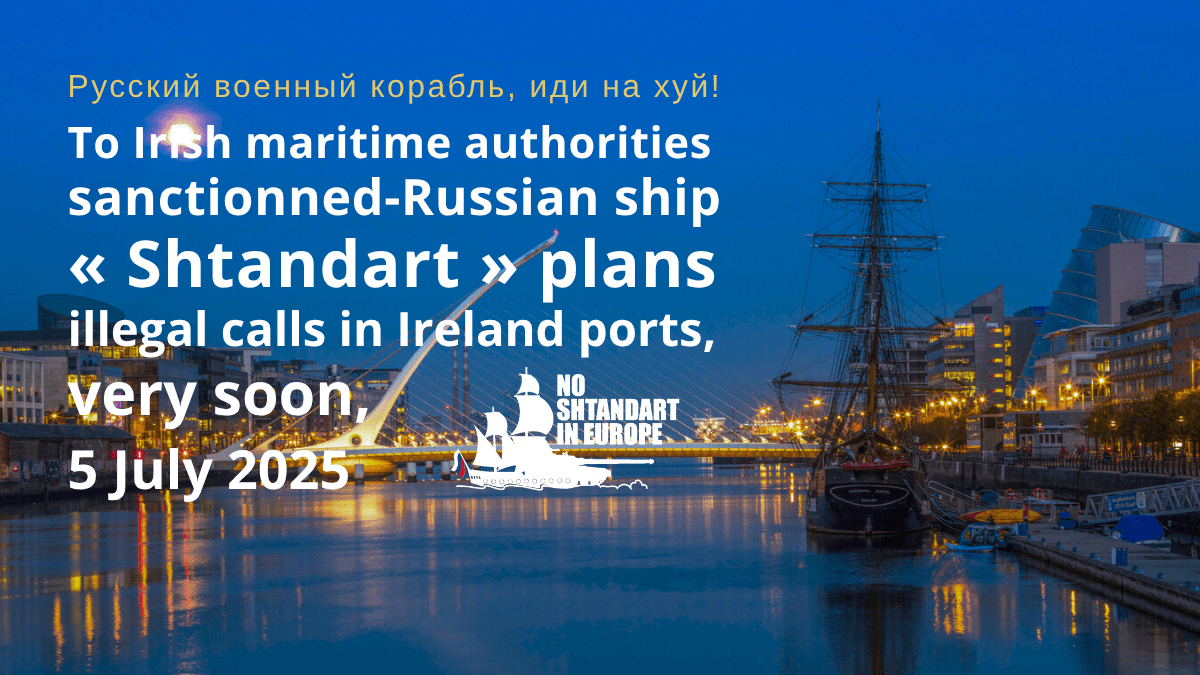
Re: Urgent ! Sanctionned-Russian ship « Shtandart » plans illegal calls in Ireland ports, very soon (possibly from today on)
5 July 2025
Dear Madam, Dear Sir,
This summer, the Russian propaganda ship Shtandart (MMSI: 518999255) is offering illegal cruises to various destinations. During its voyage to Aberdeen (2–20 July 2025), it is expected to dock in Dublin. However, it may also call at other Irish ports. We alert the Irish authorities so that they can prevent this fraud relating to European sanctions in their ports and territorial waters.
For up-to-date information – https://shtandart.eu/channel-islands-aberdeen-11-07-20-07-2025/ & https://shtandart.eu/services/sail-with-us/
- The Shtandart (MMSI: 518999255), a Russian dark ship
- A violation of the sanctions imposed following the Russian massacre in Bucha.
- Vladimir Martus, a false opponent and a promoter of Russian interests
- Unannounced dockings
- ‘Humanitarian’ blackmail to force access to prohibited ports.
- How is it possible to put an end to this thuggish behavior?
1. The Shtandart (MMSI: 518999255), a Russian dark ship
In an attempt to evade European sanctions, the Russian vessel Shtandart was registered under the convenience flag of the Cook Islands on 24 June 2024, and ownership of the vessel was transferred from the Saint Petersburg-based company Shtandart Project to Mariia Martus, who obtained Finnish citizenship after studying in Helsinki. Mariia Martus is the daughter of Vladimir Martus, the Russian skipper and de facto owner of the Shtandart.
See: provisional certificate of registration for Shtandart in the Cook Islands
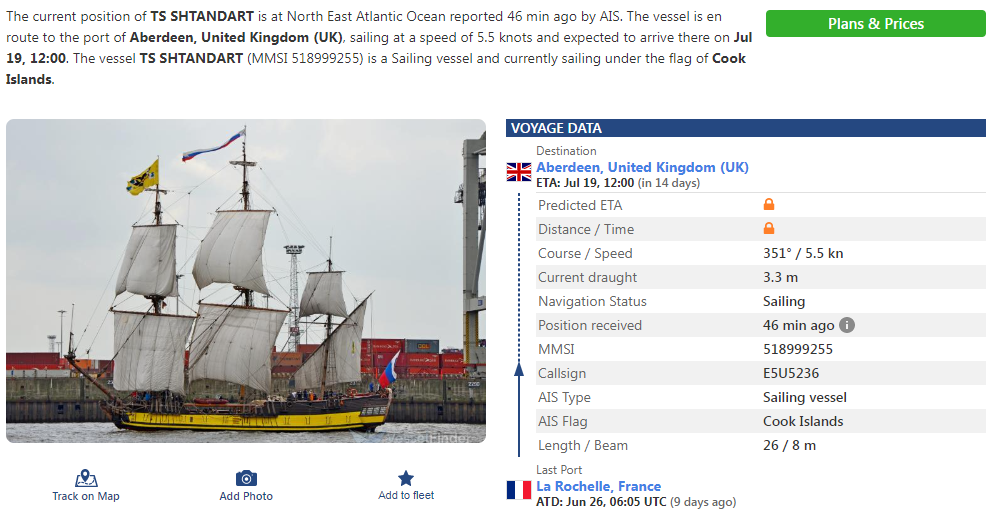
See also on Marine Traffic
Update: 6 July 2025, 18:00 UTC. Like other ships from the Russian shadow fleet, the Shtandart disconnected its AIS (Automatic Identification System) a few hours ago.
2. A violation of the sanctions imposed following the Russian massacre in Bucha.
The Shtandart‘s summer 2025 tour violates Article 3ea of Council Regulation (EU) No 833/2014, introduced in response to the fifth round of sanctions imposed following the Bucha massacre.
1. After 16 April 2022, it shall be prohibited to provide access to ports and, after 29 July 2022, to locks in the territory of the Union to ANY vessel registered under the flag of Russia. Such vessels shall not be permitted to access ports or locks, except for the purpose of leaving the territory of the Union…
European Council – Regulation (EU) No 833/2014, Article 3ea §1
According to European regulations, changing a ship’s country of registration does not exempt it from port sanctions.
2. Paragraph 1 (port prohibition) shall apply to vessels that have changed their Russian flag or their registration, to the flag or register of any other State after 24 February 2022.
European Council – Regulation (EU) No 833/2014, Article 3ea §2
Please note that on 24 June 2024, the 27 Member States of the European Council confirmed that the Shtandart falls within the scope of EU port sanctions.
In paragraph 3, point (a) is replaced by the following:
European Council – Decision (CFSP) 2024/1744 of 24 June 2024
‘(a) a ship falling within the scope of the relevant international conventions, including replicas of historical ships’.
These provisions were confirmed, in 2024, by the decision of the Rennes Administrative Court, a letter from the European Commission to the ‘No Shtandart in Europe’ collective, and a decree from the French Council of State. Nevertheless, the fraud involving the Russian vessel Shtandart continued in 2025.
The Russian ship’s captain and hidden owner, Vladimir Martus, believes that he can disembark unannounced at the destinations he has chosen, in violation of the sanctions resulting from Russia’s large-scale invasion of Ukraine. This is because he is falsely presenting himself as an “opponent of the Russian regime”, and he is confident that he can resort to “ humanitarian” blackmail.
3. Vladimir Martus, a false opponent and a promoter of Russian interests
Martus has falsely claimed to be an ‘opponent’ of the Russian regime since March 2022. Since June 2024, he has claimed not to have had any contact with Russia. In reality, however, he is closely associated with the Russian regime and its propaganda outlets. The following is the documented and sourced result of the collective ‘No Shtandart for Europe’ research:
- « Shtandart, » 2009: Vladimir Martus’s refusal to comply with safety regulations was falsely presented as political opposition to Putin’s regime.
- In October 2021, Vladimir Martus and the « Shtandart » undertook a diplomatic mission with Putin’s sponsorship and financing.
- From 2007 to 2022, a Russian bibliography of Martus shows his status as a non-opponent and as a Russian public figure.
- DOSSIER. The Shtandart, propaganda organs and Russian media. (Summer 2024: Vladimir Martus gave interviews to Russian propaganda outlets: RIA Novosti, TASS, RBC, Izvestia, etc. He was presented as a national hero for fighting against the French authorities, sanctions, and European institutions in hundreds of Russian press articles).
The Ouest-France Bretagne editorial team’s in-depth work must also be examined.
- INVESTIGATION: The Russian ship « Shtandart » brings Putin’s war to the Gulf of Morbihan, 23/05/2025.
- Who is the captain of the Shtandart, Putin’s opponent or propagandist, invited to Brittany? 29/03/2024
Additionally, it is worth reading the following:
- Komsomolskaya Pravda, 06/08/2024 – Russian sailing ship “Standart” will make a third attempt to violate European sanctions (Ru).
- Komsomolskaya Pravda, 15/08/2024 – “We do not agree”: the captain of the sailing ship “Standart” sues the European Union over sanctions (Ru)
In RUSSIA, the “Kombat-tour” agency is particularly promoting the illegal commercial activity of Shtandart on the coasts of Western Europe: Открыт набор в Комбат-тур!
Moreover, if Shtandart is short on cash as Vladimir Martus claims, one question arises: Who is funding the flurry of legal action initiated by ‘Martus TV GmbH’ and Vladimir Martus against the French authorities, sanctions, and European institutions?
4. Unannounced dockings
We are alerting to the fact that, if the Shtandart is banned from entering a particular port, it will attempt to enter another neighbouring port without prior notice. This is a practice that it has generalized since 2022 on the Iberian Peninsula. Here below are some recent examples:
- On 4 May 2025, the Shtandart tried to make an unannounced stopover in the port of Le Havre. Alerted by us, the Prefect of Seine-Maritime refused access.
- Later, the Jersey government also refused the Shtandart access to its port.
- Instead of the Channel Islands, the Russian ship then planned to start its summer tour in Saint-Malo on 2 July 2025. Informed by the “No Shtandart in Europe” collective, the prefect of the Ille-et-Vilaine département recalled the European port ban.
- As a consequence, the Shtandart tried to enter the port of Saint-Cast-le-Guildo without announcing itself. The Prefect of Côtes-d’Armor refused entry.
- On 4 July 2024 at 16:41 (UTC), we informed the Harbour Master of St Mary’s, in the Isles of Scilly, that the Shtandart was probably attempting an unannounced port call. The Harbour Master of St Mary’s contacted his counterpart in Falmouth. At 17:21 (UTC), the Russian vessel changed course. It is now possibly heading for Ireland.

Due to this now-classic modus operandi, the Spanish maritime authorities expressly notified the Shtandart on July 24, 2024, that the ban applies to all ports in Spain.
Outono, 24/07/2024 – Spain vetoed the Russian frigate Shtandart, which intended to reach Vigo, in all its ports.
Failure to comply with these and other instructions resulted in the Russian vessel being expelled from and completely banned from Spanish territorial waters on 27 July 2024.
El Mundo, 27/07/2024 — Expulsan de aguas españolas a un velero ruso que fondeó en Galicia sin permiso.
Despite being banned from Spanish territorial waters, Vladimir Martus is advertising cruises to and from Portugalete, Spain, from 26 to 28 September 2025. How is this possible? The crook is confident in his ‘humanitarian’ blackmail strategy.
5. ‘Humanitarian’ blackmail to force access to prohibited ports.
Vladimir Martus deliberately chooses to sail the Shtandart to places he is not permitted to visit. There, he gains access to forbidden ports by playing his favourite ‘humanitarian’ blackmail game.
Vladimir Martus abuses paragraph 4 of Article 3ea of Regulation (EU) No 833/2014, stating that access to ports should be granted for safety or emergency reasons. He claims that the crew does not have sufficient food or water to complete the long journey to their next (prohibited) port of call.
4. Paragraphs 1 and 1a (port prohibition) shall not apply in the case of a vessel in need of assistance seeking a place of refuge, of an emergency port call for reasons of maritime safety, or for saving life at sea.
European Council – Regulation (EU) No 833/2014, Article 3ea §4
Surprisingly, the skipper of the delinquent ship has never been prosecuted for deliberately endangering the lives of others, especially underage customers. Nor has he ever been forbidden to take on passengers who are not adults, including nationals of the country he is visiting. He uses them as hostages in his deceptions. that should be explored in order to punish the perversity of his methods.
6. How is it possible to put an end to this thuggish behavior?
To stop these abuses of the law and repeated infringements, we respectfully suggest that Irish authorities follow Spain’s example. The Shtandart should be banned from their territorial waters. Before its final expulsion, the Russian vessel could be permitted to replenish its supplies with enough water, food, and fuel to reach a country without port sanctions. If the Shtandart does not wish to return to Russia, it can set sail for Tangier, where it has docked twice since 2024 and is scheduled to dock again on October 10, 2025.
Subsequently, if the Shtandart continues to access prohibited waters and ports, Vladimir Martus should be arrested and expelled to Russia. The ship should then be sent to Russia or the next sanction-free port under the supervision of the second captain or a professional crew at the expense of the “owner”, Mariia Martus, and the charterer, “Martus TV GmbH”. Vladimir Martus’s German residency permit should be revoked.
All the other information needed is in the following document that we have prepared for our friends from abroad. Nevertheless, please do not hesitate to ask us any questions you may have.
Yours faithfully,
Bernard Grua
No Shtandart In Europe
Email: noshtandartineurope@gmail.com
Website: https://bit.ly/No-Shtandart
Facebook: groups/noshtandartineurope
WhatsApp








 Bernard Grua - No Shtandart In Europe
Intéressante réponse de l’AI ¨Perplexity à la question de savoir quelles stratégies sont utilisées par le Shtandart pour violer la loi :
Quelles stratégies le Shtandart utilise-t-il pour contourner les interdictions portuaires
Le Shtandart utilise plusieurs stratégies pour contourner les interdictions portuaires imposées par l’Union européenne :
Arrivées à l’improviste (stratégie du fait accompli)Le navire se présente sans prévenir dans des ports européens, espérant profiter de la surprise pour obtenir une autorisation temporaire ou pour forcer la main aux autorités locales. Cette méthode a été utilisée à plusieurs reprises en Espagne (Bilbao 2022, Almerimar 2024, Valencia 2024, Baiona 2024) et en France (tentative au Havre en mai 2025).
Chantage humanitaireLe capitaine Vladimir Martus invoque régulièrement des besoins urgents en eau, nourriture ou sécurité pour l’équipage et les passagers (notamment en présence de mineurs), s’appuyant sur la clause humanitaire du règlement européen. Ce “chantage humanitaire” vise à obtenir une dérogation exceptionnelle pour accoster, comme cela a été fait à Vigo en 2022 et dans d’autres ports par la suite.
Changement de pavillonLe Shtandart a tenté de changer de pavillon (Îles Cook) pour échapper à l’application des sanctions. Cependant, les textes européens précisent que les sanctions s’appliquent aussi aux navires ayant changé de pavillon après le 24 février 2022, ce qui rend cette stratégie juridiquement inefficace, mais elle est néanmoins invoquée dans les recours administratifs et médiatiques.
Lobbying et manipulation médiatiqueLe capitaine organise des événements à bord pour les journalistes, leur offrant un traitement privilégié et orientant le récit médiatique en faveur du navire. Cette stratégie vise à influencer l’opinion publique et à exercer une pression sur les autorités locales et les organisateurs d’événements maritimes.
Exploitation des failles administratives et tolérances localesEn France, le Shtandart a profité d’une application laxiste ou ambiguë des sanctions par certaines préfectures, qui ont parfois autorisé son accès aux ports malgré l’interdiction européenne, souvent sous la pression d’organisateurs de festivals ou d’associations locales.
Recours juridiques et contestationsLe capitaine et ses soutiens engagent des procédures devant les tribunaux pour contester les interdictions, invoquant des arguments techniques ou administratifs (changement de pavillon, statut de navire historique, etc.), même si ces recours sont généralement rejetés.
En combinant ces stratégies — improvisation, recours humanitaire, lobbying, exploitation des failles réglementaires et procédures judiciaires — le Shtandart parvient encore, ponctuellement, à accoster dans certains ports européens malgré l’interdiction officielle.
J’aimeJ’aime
Le Shtandart utilise plusieurs stratégies pour contourner les interdictions portuaires imposées par l’Union européenne :
Le navire se présente sans prévenir dans des ports européens, espérant profiter de la surprise pour obtenir une autorisation temporaire ou pour forcer la main aux autorités locales. Cette méthode a été utilisée à plusieurs reprises en Espagne (Bilbao 2022, Almerimar 2024, Valencia 2024, Baiona 2024) et en France (tentative au Havre en mai 2025)13.
Le Shtandart a tenté de changer de pavillon (Îles Cook) pour échapper à l’application des sanctions. Cependant, les textes européens précisent que les sanctions s’appliquent aussi aux navires ayant changé de pavillon après le 24 février 2022, ce qui rend cette stratégie juridiquement inefficace, mais elle est néanmoins invoquée dans les recours administratifs et médiatiques3.
Le capitaine organise des événements à bord pour les journalistes, leur offrant un traitement privilégié et orientant le récit médiatique en faveur du navire. Cette stratégie vise à influencer l’opinion publique et à exercer une pression sur les autorités locales et les organisateurs d’événements maritimes1.
En France, le Shtandart a profité d’une application laxiste ou ambiguë des sanctions par certaines préfectures, qui ont parfois autorisé son accès aux ports malgré l’interdiction européenne, souvent sous la pression d’organisateurs de festivals ou d’associations locales15.
Le capitaine et ses soutiens engagent des procédures devant les tribunaux pour contester les interdictions, invoquant des arguments techniques ou administratifs (changement de pavillon, statut de navire historique, etc.), même si ces recours sont généralement rejetés3.
En combinant ces stratégies — improvisation, recours humanitaire, lobbying, exploitation des failles réglementaires et procédures judiciaires — le Shtandart parvient encore, ponctuellement, à accoster dans certains ports européens malgré l’interdiction officielle
J’aimeJ’aime