Under the pressure of a pro-russian lobby, the French governmental agency in charge of controlling the respect of sanctions pretends russian vessel « Shtandart » can bypass EU regulation because it would not be a ship falling within the scope of the relevant international conventions. The question was asked to the International Maritime Organization (IMO).
Natasha Brown NBrown@imo.org
28 mars 2023 17:05
Dear Bernard,
Some of the treaties you mention in the list https://www.imo.org/en/About/Conventions/Pages/ListOfConventions.aspx only apply to certain types of ships – for example, CLC applies to oil tankers.
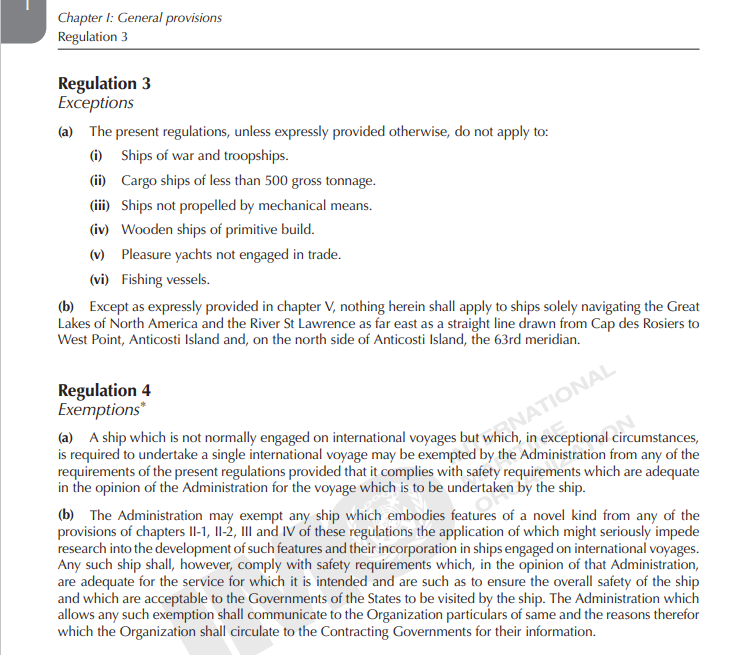
With regards to SOLAS, there are exceptions and exemptions:
SOLAS Chapter I
General Provisions:
Exceptions and Exemptions
See attached
A passenger ship is one carrying 12 or more passengers

Best regards,
Natasha Brown
Natasha Brown
Head
Public Information Services
Legal Affairs and External Relations Division
e: NBrown@imo.org
t: +44 (0)20 7587 3274 w: http://www.imo.org
Gangcan Rao <GRao@imo.org>
28 mars 2023 15:46
Dear Sir or Madam,
Many thanks for your enquiry about Russian ship “Shtandart”.
IMO was established to provide a forum for governments to adopt global standards on maritime matters. However, it is prerogative right and obligation of Member States to implement them, including application and interpretation as appropriate. If necessary, Member States may raise any issues to relevant committees or sub-committee of IMO as per the well-established procedure of IMO. In this context, as the IMO Secretariat, we are not entitled to interpret regulations or make any arbitration to the issue raised in your email.
If necessary, you may approach directly to the flag Administration for further information or clarification/interpretation.
My best regards,
Gangcan Rao Head, Instruments Implementation Support
Department for Member State Audit and Implementation Support
e: GRao@imo.org | t: +44 (0)20 7463 4235
To: International Maritime Organization
4, Albert Embankment
London
SE1 7SR
United Kingdom
+44 (0)20 7735 7611
info@imo.org
From: Bernard Grua
#NoShtandartInEurope committee
Re: Is the Russian ship « Shtandart » falling within the scope of IMO relevant international conventions?
Sainte-Luce sur Loire, March 25, 2023
Dear Madam, dear Sir,
Since April 2022, the Russian ship « Shtandart », visits numerous European ports and maritime festivals, handling, there, a commercial activity.
https://www.marinetraffic.com/en/ais/details/ships/shipid:350830/mmsi:273452840/imo:0/vessel:SHTANDART#VesselInfo
https://en.wikipedia.org/wiki/Shtandart_(frigate,_1999)
However, Council Regulation (EU) N° 833/2014 in its article 3ea states:
1. It shall be prohibited to provide access, after 16 April 2022, to ports and, after 29 July 2022, to locks in the territory of the Union, to any vessel registered under the flag of Russia, with the exception of access to locks for the purpose of leaving the territory of the Union
https://eur-lex.europa.eu/legal-content/EN/TXT/HTML/?uri=CELEX:02014R0833-20221007
…
3. For the purposes of this Article, with the exception of paragraph 1a, a ‘vessel’ means:
(a) a ship falling within the scope of the relevant international conventions;
(b) a yacht, of 15 metres in length or more, which does not carry cargo and carrying no more than 12 passengers; or
(c) recreational craft or personal watercraft as defined in Directive 2013/53/EU of the European Parliament and of the Council ( 9 )
…
Although « Shtandart » frequently carries tens of passengers, there is a controversy about whether this vessel is concerned or not by SOLAS Convention.
Taking SOLAS apart, could you please confirm our conclusion about the fact that « Shtandart » is « falling within the scope of the (other) relevant international conventions » ?
https://www.imo.org/en/about/Conventions/Pages/ListOfConventions.aspx
Many thanks in advance for your answer.
Sincerely yours,
Bernard Grua, #NoShtandartInEurope spokesperson
( 9 ) Directive 2013/53/EU of the European Parliament and of the Council of 20 November 2013 on recreational craft and personal watercraft and repealing Directive 94/25/EC (OJ L 354, 28.12.2013, p. 90)
Exhibit: list of IMO Conventions
https://www.imo.org/en/about/Conventions/Pages/ListOfConventions.aspx
Key IMO Conventions
- International Convention for the Safety of Life at Sea (SOLAS, 1974, as amended.
- International Convention for the Prevention of Pollution from Ships, 1973, as modified by the Protocol of 1978 relating thereto and by the Protocol of 1997 (MARPOL)
- International Convention on Standards of Training, Certification and Watchkeeping for Seafarers ( STCW) as amended, including the 1995 and 2010 Manila Amendments
Other conventions relating to maritime safety and security and ship/port interface
- Convention on the International Regulations for Preventing Collisions at Sea (COLREG), 1972
- Convention on Facilitation of International Maritime Traffic (FAL), 1965
- International Convention on Load Lines(LL), 1966
- International Convention on Maritime Search and Rescue(SAR), 1979
- Convention for the Suppression of Unlawful Acts Against the Safety of Maritime Navigation(SUA), 1988, and Protocol for the Suppression of Unlawful Acts Against the Safety of Fixed Platforms located on the Continental Shelf (and the 2005 Protocols)
- International Convention for Safe Containers (CSC), 1972
- Convention on the International Maritime Satellite Organization (IMSO C), 1976
- The Torremolinos International Convention for the Safety of Fishing Vessels (SFV), 1977, superseded by the The 1993 Torremolinos Protocol; Cape Town Agreement of 2012 on the Implementation of the Provisions of the 1993 Protocol relating to the Torremolinos International Convention for the Safety of Fishing Vessels
- International Convention on Standards of Training, Certification and Watchkeeping for Fishing Vessel Personnel (STCW-F), 1995
- Special Trade Passenger Ships Agreement (STP), 1971 and Protocol on Space Requirements for Special Trade Passenger Ships, 1973
Other conventions relating to prevention of marine pollution
- International Convention Relating to Intervention on the High Seas in Cases of Oil Pollution Casualties (INTERVENTION), 1969
- Convention on the Prevention of Marine Pollution by Dumping of Wastes and Other Matter(LC), 1972 (and the 1996 London Protocol)
- International Convention on Oil Pollution Preparedness, Response and Co-operation(OPRC), 1990
- Protocol on Preparedness, Response and Co-operation to pollution Incidents by Hazardous and Noxious Substances, 2000 (OPRC-HNS Protocol)
- International Convention on the Control of Harmful Anti-fouling Systems on Ships (AFS), 2001
- International Convention for the Control and Management of Ships’ Ballast Water and Sediments, 2004
- The Hong Kong International Convention for the Safe and Environmentally Sound Recycling of Ships, 2009
Conventions covering liability and compensation
- International Convention on Civil Liability for Oil Pollution Damage(CLC), 1969
- 1992 Protocol to the International Convention on the Establishment of an International Fund for Compensation for Oil Pollution Damage (FUND 1992)
- Convention relating to Civil Liability in the Field of Maritime Carriage of Nuclear Material (NUCLEAR), 1971
- Athens Convention relating to the Carriage of Passengers and their Luggage by Sea (PAL), 1974
- Convention on Limitation of Liability for Maritime Claims(LLMC), 1976
- International Convention on Liability and Compensation for Damage in Connection with the Carriage of Hazardous and Noxious Substances by Sea (HNS), 1996 (and its 2010 Protocol)
- International Convention on Civil Liability for Bunker Oil Pollution Damage, 2001
- Nairobi International Convention on the Removal of Wrecks, 2007
Other subjects
- International Convention on Tonnage Measurement of Ships (TONNAGE), 1969
- International Convention on Salvage (SALVAGE), 1989

 Bernard Grua - No Shtandart In Europe