
This article offers a geopolitical analysis of the Shtandart, a replica of Peter the Great’s first frigate, used as a vector of Russian interference in Europe. Officially presented as a cultural and educational project, the ship is in reality part of a composite strategy. It combines soft power, sharp power, and hybrid warfare. Through the mobilisation of maritime heritage, sanctions evasion, and the symbolic manipulation of history, the Shtandart illustrates how Russia transforms civilisational instruments into geopolitical levers of domination.
The study highlights the increasing permeability between culture, law, and power in contemporary information warfare. It underlines the need for European vigilance in the face of hybrid influence strategies exploiting heritage.
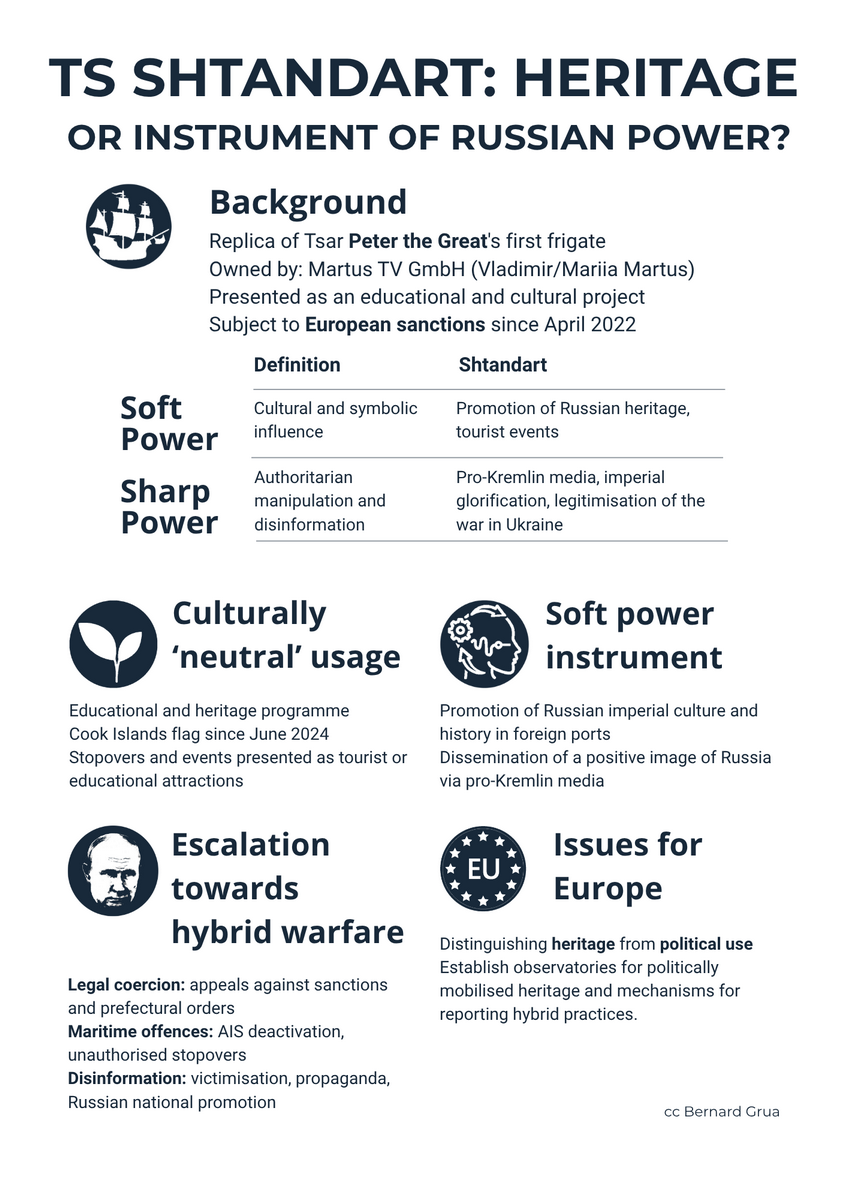
Original French version on Le Diploweb: “Russie. Du soft power à la guerre hybride. Etude de cas d’une influence russe en Europe : le Shtandart”. For clarity and transparency, this English document includes notes and graphs.
1. A Cultural Project Behind a Neutral Facade
The concept of soft power, introduced by Joseph Nye (2004, Soft Power: The Means to Success in World Politics)1, refers to the ability of a political actor to influence another without coercion, notably through cultural or ideological means.
1.1. An Educational Programme with Heritage Value
Some observers argue that the vessel, identified by MMSI (Maritime Mobile Service Identity) number 5189992552, should not be regarded as a tool of Russian strategic influence. For them, it is primarily a historical replica of an 18th-century frigate, intended for educational and commemorative purposes. As noted in Le Chasse-Marée (12 April 2004, Shtandart: The Russian Frigate That Travels Back in Time…)3, its main aim is to showcase Russia’s maritime past rather than to promote the regime or its political projection.
1.2. Private Ownership Without Political Messaging
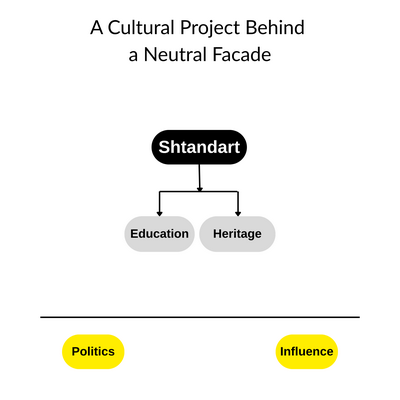
The ship is owned by Martus TV GmbH4 via Mariia Martus5, the captain’s daughter, who conveniently acquired Finnish nationality. The Shtandart is therefore introduced as a strictly private asset and not as an official state instrument. Its port calls and events are presented as festive, educational, or tourist initiatives, without any explicit political message. It is also stated that the three-masted vessel has had no link with Russia since 6 June 2024, when it adopted the Cook Islands flag of convenience. In several ports, it is seen merely as a maritime curiosity, exerting minimal influence on public opinion or decision-makers.
A particularly notable case is that of La Rochelle6, where the Shtandart has been based since June 2022. The local prefecture, municipality, and marina encourage its frequent visits. These authorities consider that port calls for safeguarding human life, as stipulated in paragraph 4 of Article 3ea of EU Regulation No. 833/20147, apply to “technical stops”. On this basis, the Peter the Great frigate recently participated in the Nautical Week from 18 to 26 June 20258.
On 13 December 2024, by awarding the port director the National Security Medal and making him a Knight of the National Order of Merit, the prefect highlighted a form of “inverse soft power.” He argued that the presence of large sailing vessels, including the three-masted Saint Petersburg frigate, should be credited to the recipient. It is said to contribute to the international prominence of the maritime city.
Even if some defend the notion of a strictly private enterprise, it is important to recall that influence diplomacy relies precisely on the permeability between public and private actors. This grey zone fosters the emergence of a diffuse sphere of penetration, where culture becomes a narrative instrument of foreign policy.
2. An Instrument of Russian Soft Power
2.1. Russia’s Cultural Showcase
Laetitia Jacq-Galdeano (Ouest-France Bretagne) is one of only two journalists in France to have conducted thorough, independent reporting on the European regulation violator. After exploring numerous Russian sources, she revealed a previously unknown aspect of the dossier: the role of the captain-owner, Vladimir Martus. On 29 March 20249, she exposed his propagandist activity while he was presenting himself as an opponent of the Moscow regime and as a “victim of Vladimir Putin on the same footing as Ukrainians.”
The owner’s connections with circles of power enable the vessel’s indirect use as a tool of Russian soft power. The Shtandart’s media coverage by pro-Kremlin outlets contributes to projecting a positive image of Russia to local populations and the media. An example is the film shot on board by RT in 201410. Its participation in international events is also notable, such as the 2021 mission to the Aegean islands celebrating the 250th anniversary of the naval victory at Chesme over the Ottoman Empire. Undertaken under Vladimir Putin’s auspices, the expedition was funded by the Presidential Administration’s grant fund11. Russian diplomatic services praised the strategic projection of the Neva gunboat replica in Greece through their plenipotentiary ambassador in Athens, Andrei Maslov12.
Recently, however, perceptions of the Shtandart have shifted away from the narrative promoted by its supporters. In September 2025, Portuguese media13 suspected it of being a “Russian spy,” and Danish media14 already echoed this in August 2025. In Poland (August 2025)15, it was considered a “propaganda and espionage tool” circumventing restrictive measures. Even in France, long reluctant to challenge its narrative, several media outlets have come to describe it as an “ambassador of Russian propaganda” (June 2025)16.
While the baroque and gilded replica captivates the imagination through its symbolism, this visibility also serves to disseminate a skewed historical narrative that legitimises Russia’s will to power abroad.
2.2. Promotion of an Imperialist Culture
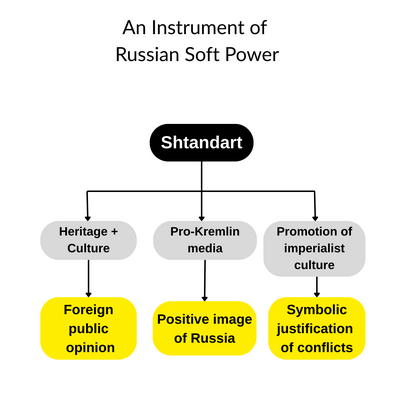
The replica of Tsar Peter the Great’s frigate functions as a symbolic projection vehicle. According to Lysenko (Imperial Nature of Russian Culture through the Prism of War, 2023)17, historical narratives glorifying Russia and its imperial myths serve to justify expansion. Myths of a glorious past and unfounded claims over other countries structure Russia’s vision of power. Recall that on 9 June 2022, Vladimir Putin “explained” the launch of the full-scale invasion of Ukraine by invoking Peter the Great’s legacy18.
Moreover, Russian “strategic culture” portrays Ukraine as an obstacle to its global power ambitions (2024, Russian Strategic Culture and the War in Ukraine)19, reinforcing the idea that the use of force is a legitimate continuity. On 3 April 2022, Ria Novosti published Timofei Sergueitsev’s article, “What Russia Should Do With Ukraine”20, advocating the eradication of Ukrainian culture, language, nationhood, and the elimination of its political and intellectual elites. It is worth to mention that Ria Novosti widely publishes articles on the Shtandart and interviews with its captain-owner21.
By projecting this image through its heritage and symbolism, the frigate contributes to the dissemination of an imperial ideology: “the appropriation of cultural and historical heritage functions as a subtle form of domination” (Complex Patterns of Colonialism: Russian Cultural Imperialism as Domination Through Sameness, 2025)22. Comments by Mikhail Piotrovsky, director of the Hermitage Museum, on 22 June 2022 in RG.ru are explicit:
Our latest exhibitions abroad constitute a true cultural offensive. A sort of ‘special operation’, if you like. Many dislike it. But we move forward. And we must not let anyone hinder our progress… it is a cultural offensive. An exhibition of Shchukin and Morozov in Paris is as if the Russian flag were flying over the Bois de Boulogne…23
This rhetoric of a “cultural offensive” illustrates the Kremlin’s desire to impose its narrative power, reshaping European collective memory around a Russian interpretation of history.
While Vladimir Martus’s private yacht initially served soft power purposes, its use now extends far beyond symbolic projection. Legal and maritime practices deployed by the captain and his team reveal a shift towards more direct forms of coercion. In doing so, it shows that the vessel exceeds classic influence diplomacy to become a geopolitical actor engaged in a strategic hybridisation of culture, law, illegal manoeuvres, communication, and disinformation.
3. From Soft Power to Hybrid Warfare
In the contemporary Russian context, some authors have developed the concept of sharp power. They highlight how cultural or media instruments can be manipulated to exert authoritarian pressure (Christopher Walker and Jessica Ludwig – Sharp Power: Rising Authoritarian Influence, 2017)24. The ship, its captain-owner, and his advisors clearly implement a campaign of coercion against their various targets.
3.1. Legal Strategies and Judicial Harassment
The systematic recourse to French and European courts (Administrative Court of Rennes25, French Council of State26, Court of Justice of the European Union27) to contest prefectural decisions and sanctions reflects a deliberate use of law intended to circumvent legal constraints. Although all the above actions have failed, these procedures slow down the application of prohibitions and obscure their clarity. They “justify” the promotion of a misleading reinterpretation of EU regulations, the use of which is not limited to official supporters of the Shtandart. Such behaviour also involves senior officials at the heart of the French state apparatus28. They create fractures in public opinion, even antagonisms. They serve to fuel rejection of EU institutions in Russia, but also in other countries, especially in France. Vladimir Martus skilfully exploits a victim narrative to denounce the “injustice”29 he allegedly suffers. His statements resonate widely in maritime circles, among sea enthusiasts, in the media, and with the general public.
Another form of pressure is judicial harassment. The No Shtandart in Europe collective recalls European provisions and demands strict enforcement of the rule of law. Its spokesperson has faced two formal notices, a police report, a complaint, and defamatory denunciations to the authorities. These measures constitute SLAPP suits and judicial intimidation targeting whistleblowers30.
Beyond legal pressure, the violator also employs maritime and informational tactics, illustrating a shift towards a direct coercive campaign. This transition from the symbolic to the operational confirms that communication, law, and navigation are integrated into a genuine low-intensity information warfare.
3.2. Maritime Practices and Disinformation
The deliberate disconnection from its Automatic Identification System (AIS), by the Shtandart, aims to conceal its position and destination. Some unannounced or unauthorised port calls confirm this practice. It reflects a clear intention to evade authorities’ surveillance, to navigate outside maritime safety rules, and to test the enforcement of port sanctions.
Such infractions or attempted infractions were observed during the summer of 2025 in Ireland31, Scotland32, Denmark33, and Portugal34. In the latter country, part of the crew was arrested. The incident led to a ban on entering Portuguese territorial waters, mirroring the Spanish ban instituted on 27 July 202435. Nevertheless, Vladimir Martus made an incursion into Galician territorial waters in September 2025 before the press alerted the authorities36.
Combined with a Russian management company based in a Hamburg mailbox and a nominee owner resident in Helsinki, the Shtandart’s practices resemble those of the Russian shadow fleet37.
Hundreds of articles in Russia celebrate the national hero resisting restrictive measures, further reinforcing his political role38. On 6 August 2024, Komsomolskaïa Pravda headlined: “The Russian sailboat Shtandart will attempt for the third time to violate European sanctions.”39
Finally, disinformation regarding its links to Moscow reveals a political approach intended to defend Kremlin interests and manipulate both public opinion and local authorities. The Russian Consulate General emphasised this sharply in a TASS communiqué on 18 July 2025. It aggressively protested the prohibition of the ambassadorial yacht from docking in Aberdeen during the major international Tall Ships Races event.40
These behaviours combine attraction and coercion. They outline the contours of a maritime hybrid warfare. Laetitia Jacq-Galdeano shared this analysis in Ouest-France as early as May 2025.
The Russian vessel Shtandart, supported by Moscow’s press, multiplies provocations and contributes to Putin’s hybrid war to destabilise France. Yet it is banned from ‘all European ports’ by the European Union…41
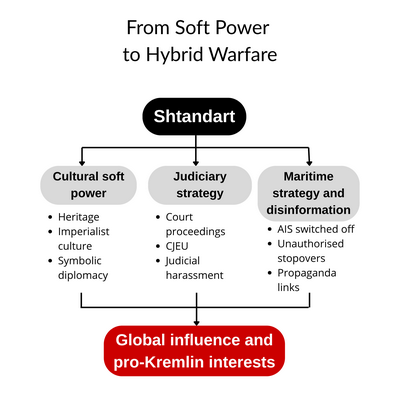
It represents a liminal case: a heritage object mobilised for foreign policy purposes. It exists along the continuum between soft power and sharp power, i.e., the combination of cultural and legal instruments serving ideological penetration. It demonstrates the importance of empirical observation to distinguish heritage valorisation from political use.
Ultimately, the Shtandart appears to substantiate the text published by Ukrainian political scientist Mykola Riabchuk on 6 May 2024.
Why culture ceases to be ‘soft power’ during wartime?42
Conclusion
The case we observe here constitutes a laboratory of post-2022 strategic levers. Behind its civilisational facade, the vessel deploys legal, symbolic, and media manoeuvres that serve power objectives, progressively erasing the boundary between heritage valorisation and geopolitical action.
Beyond the specific campaign of the Shtandart, this study highlights a major challenge for Europe: its capacity to identify and regulate often underestimated or ignored geopolitical uses. In a context of disinformation and hybrid warfare, culture becomes a fully-fledged field of strategic confrontation.
The European response should involve establishing tools for cultural and diplomatic vigilance: observatories of instrumentalised heritage, charters for hosting foreign projects, and mechanisms for reporting hybrid initiatives. Protecting the continent’s narrative and heritage autonomy is now a crucial condition of its cognitive sovereignty — that is, Europe’s ability to safeguard the autonomy of its story and collective memory. These tools will also strengthen geopolitical resilience, understood as the ability to resist, adapt, and recover in the face of external pressure, manipulation, and influence campaigns.
Bernard Grua, 25 november 2025
- Witness of the Revolution of Dignity in Ukraine
- Co-founder and former spokesperson of the international movement No Mistrals for Putin
- Volunteer at the Franco-Ukrainian Association Tryzub, Nantes
- Founder and spokesperson of the pan-European collective No Shtandart in Europe
No Shtandart In Europe
Email: noshtandartineurope@gmail.com
Website: https://bit.ly/No-Shtandart
Facebook: groups/noshtandartineurope
WhatsApp
Keywords: cognitive sovereignty, cultural diplomacy, disinformation, European sanctions, geopolitical resilience, geopolitics, heritage, hybrid warfare, narrative power, propaganda, Russia, sharp power, Shtandart, soft power, sphere of influence, strategic hybridisation, Vladimir Martus
Read also about Shtandart and Russian influence



Notes
- Joseph Nye, 04/05/2004 – Soft Power: The Means to Success in World Politics – Joseph S. Nye, Jr.
↩︎ - Vesselfinder – TS SHTANDART Sailing vessel, MMSI 518999255 ↩︎
- Le Chasse-Marée, 02/07/2004 – Shtandart : la frégate russe à remonter le temps… ↩︎
- Vladimir Martus, 06/06/2024 – Declaration of the managing owner of “TS Shtandart” ↩︎
- Cook Islands, 06/06/2024 – TS SHTANDART ship registry ↩︎
- Desk-Russie, 28/09/2025 – Quand le navire russe Shtandart et La Rochelle défient les sanctions européennes ↩︎
- European Council : Regulation (EU) No 833/2014 of 31 July 2014 concerning restrictive measures in view of Russia’s actions destabilising the situation in Ukraine ↩︎
- Shtandart docking at the ‘bassin des chalutiers’ in La Rochelle (18–26/06/2025) without grounds under Article 3ea §4, Russian imperial flag flying at the top of the main mast ↩︎
- Ouest-France, Laetitia Jacq-Galdeano, 29/03/2024 — Opposant ou propagandiste de Poutine, qui est le capitaine du Shtandart invité en Bretagne ? ↩︎
- RT doc, 2014 – Восемнадцать человек на сундук мертвеца ↩︎
- Russian Geographical Society, 01/11/2021 – The butterfly effect: why the appearance of the Russian sailing frigate excited greece ↩︎
- Afinskiy Kur’yer, Andrey Maslov, 18/02/2022 – для антироссийской пропаганды почва в Греции не благоприятна ↩︎
- Cascais24Horas, 22/09/2025 – VELEIRO suspeito de ser espião russo tentou aproximação a Cascais ↩︎
- TV Midtvest, 13/08/2025 – Pirater eller spioner: Nu går politiet ind i sag om mystisk russisk skib ↩︎
- VP Info, 08/08/2025 – Propaganda i szpiegostwo. Tak rosyjska fregata omija sankcje ↩︎
- Le Télégramme, 06/06/2025 – « Un ambassadeur de la propagande russe » : la venue de ce navire à Saint-Malo fait polémique. ↩︎
- ResearchGate, Oleksandr Lysenko, September 2023 – Imperial Nature of the Russian Culture through the Prism of War ↩︎
- The Guardian, 10/06/2022 – Putin, compares himself to Peter the Great in quest to take back Russian lands ↩︎
- FPRI, Denys Yurchenko, 02/07/2024 – Russian Strategic Culture and the War in Ukraine ↩︎
- Ria Novosti, 03/04/2022 – Что Россия должна сделать с Украиной ↩︎
- Ria Novosti, dossier 2003/2024 : articles about Shtandart ↩︎
- Ukraine World, Daria Synhaievska, 11/06/2025 – Сomplex Patterns of Colonialism: Russian Cultural Imperialism as Domination Through Sameness ↩︎
- RG ru, Mikhail Piotrovsky, 22/06/2022 – Почему необходимо быть со своей страной, когда она совершает исторический поворот и выбор. Отвечает Михаил Пиотровский ↩︎
- National Endowment for Democracy, Christopher Walker and Jessica Ludwig, 05/12/2017 – Sharp Power: Rising Authoritarian Influence ↩︎
- Tribunal administratif de Rennes, 11/07/2024 – Ordonnance rejetant la requête en suspension du “Shtandart” contre l’arrêté préfectoral du Finistère ↩︎
- French Council of State, 18/11/2024 – Ruling rejecting Shtandart’s appeal against the order of the Rennes administrative court ↩︎
- Court of Justice of the European Union, 22/08/2025 – Order in Case T-446/24 ↩︎
- No Shtandart In Europe, 15/05/2025 – Les autorités françaises et les passe-droits du navire russe « Shtandart » ↩︎
- Ouest-France, 17/07/2024 – « Une décision injuste de l’Europe ! » À Brest, le capitaine du navire russe banni à l’offensive ↩︎
- No Shtandart In Europe, 05/08/2025 – “Shtandart”: the judicial harassment strategy orchestrated by Thierry Clerc and the Russian Vladimir Martus ↩︎
- The Journal, 09/07/2025 – Controversial ‘Russian’ replica sailing ship leaves Irish waters (but not before garda visit) ↩︎
- The Scotsman, 17/07/2025 – Ship banned from Tall Ships Race due to Russian sanctions turned away at Orkney ↩︎
- tvSyd, 07/08/2025 – Formodet russisk spionskib lå flere dage i dansk havn: Kaptajn Vladimir hemmeligholdt besøget ↩︎
- Autoridad Marítima Nacional (AMN), 24/09/2025 – Marítima Nacional monitoriza veleiro TS SHTANDART ao longo da costa portuguesa ↩︎
- El Mundo, 27/07/2024 — Expulsan de aguas españolas a un velero ruso que fondeó en Galicia sin permiso. ↩︎
- Faro de Vigo, 20/09/205 – La fragata rusa «Shtandart», vetada por Bruselas, irrumpe en aguas gallegas ↩︎
- No Shtandart In Europe, 25/08/2025 – Why is the sanctioned ship ‘Shtandart’ part of the Russian shadow fleet? ↩︎
- Dossier, 2024/2025 – The Shtandart and Russian media ↩︎
- Komsomolskaïa Pravda, 06/08/2024 – Российский парусник «Штандарт» сделает третью попытку нарушить европейские санкции. ↩︎
- Tass, 18/07/2025 – Russia’s Consulate General slams banning frigate Shtandart from entering Scottish harbor ↩︎
- Ouest-France, Laetitia Jacq-Galdeano, 23/05/2025 — Investigation. The Russian ship “Shtandart” brings Putin’s war to the Gulf of Morbihan ↩︎
- Nova Polshcha, Mykola Ryabchuk, 06/05/2024 – Що ми скасовуємо, або Чому культура під час війни перестає бути «м’якою силою» ↩︎

 Bernard Grua - No Shtandart In Europe