 Texte en français
Continuities, Discontinuities, and Ideological Constructions in the Formation of Historical Russia
👉 You can download this article as a PDF file.
Abstract
The Russian Federation frequently presents itself as the heir of the Eastern Slavs and as a central pole of the « Slavic world. » This article examines the validity of this claim from a comparative ethno-historical perspective, distinct from linguistic analysis. It demonstrates that the demographic, social, and elite formation of Muscovy and later Russia largely relied on Finno-Ugric and Turkic-Tatar substrata, and that linguistic Slavicization primarily resulted from the adoption of Orthodox Christianity and its institutions. Comparison with other Slavic peoples highlights the absence of majority Slavic ethno-historical continuity in Russia and suggests that Russia’s claim to represent the « Slavic world » is an ideological construction of imperial origin.
- I. Problematic and Conceptual Framework
- II. State of Research and Historiographical Positioning
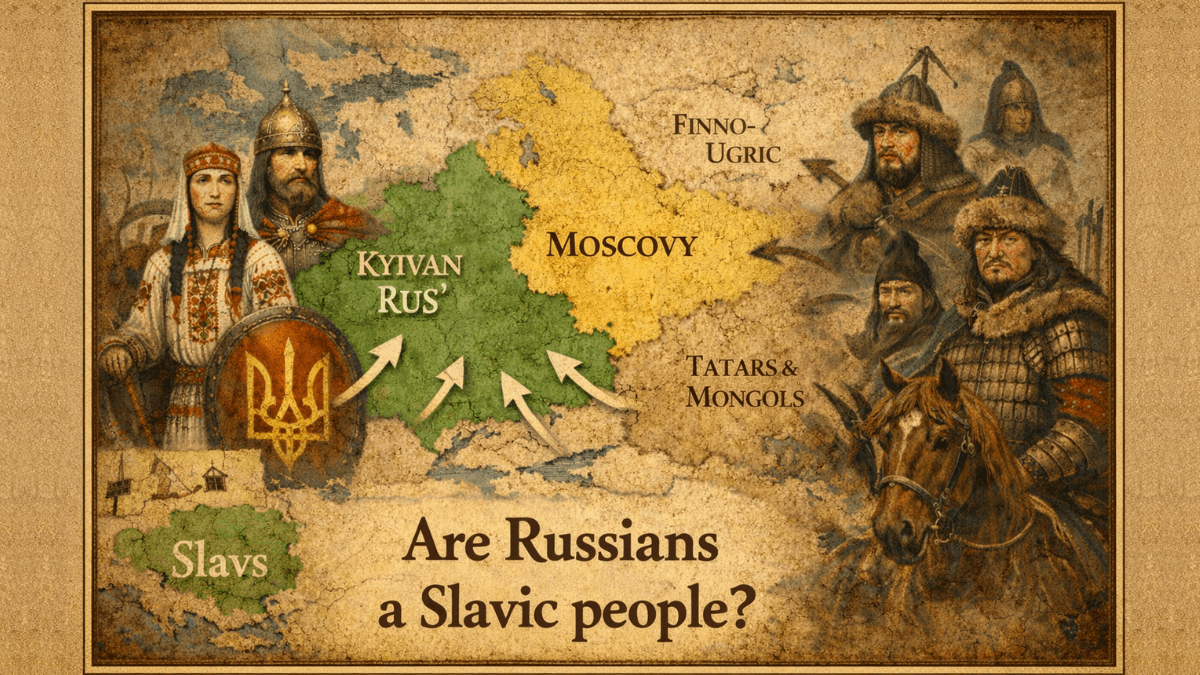
- III. Discontinuity Between Kievan Rus’ and Muscovy
- IV. Finno-Ugric Substratum in the Formation of Russia
- V. Turkic-Tatar Legacy and the Formation of the Russian Elite
- VI. Linguistic Slavicization and the Role of Religion
- VII. Comparative Approach with Other Slavic Peoples
- VIII. Discussion: Ideological Construction and Political Uses
- IX. Conclusion
- Notes
- Exhibit : Responses to Anticipated Objections
- Objection 1: “Russians speak a Slavic language; therefore, they are a Slavic people.”
- Objection 2: “Muscovy is the direct heir of Kievan Rus’.”
- Objection 3: “Finno-Ugric populations were fully assimilated.”
- Objection 4: “Tatars played only a marginal role.”
- Objection 5: “All peoples are mixed; Russia is no exception.”
- Objection 6: “This analysis is ideological and anti-Russian.”
- Objection 7: “Russians self-identify as Slavs.”
- Conclusion
I. Problematic and Conceptual Framework
Determining whether Russians constitute a Slavic people cannot be resolved solely through language or contemporary self-identification1. It requires distinguishing several analytical levels: language, religious culture, political institutions, and ethno-historical continuity2.
In Russian national narratives—imperial, Soviet, and post-Soviet—these dimensions are often conflated, resulting in a naturalization of Russian Slavic identity. In comparative historiography, belonging to a « Slavic people » is based on historical and demographic continuity, not merely linguistic usage3.
This study therefore adopts a comparative and restrictive definition of Slavic belonging, grounded in ethno-historical continuity between medieval Slavic populations and modern peoples claiming this heritage.
II. State of Research and Historiographical Positioning
Classical Russian historiography long emphasized a direct continuity between Kievan Rus’ and Muscovy, and later Imperial Russia4. This interpretation was institutionalized during the Empire and systematized under the Soviet regime, where it acquired explicit ideological functions.
By contrast, several historians have highlighted a profound discontinuity between Kievan Rus’ and Muscovy, both institutionally and demographically5. Works by Kliuchevsky, Vernadsky, Pipes, and Kappeler emphasize the central role of Finno-Ugric populations, the political legacy of the Golden Horde, and late Slavicization through the Orthodox Church6.
This article follows this latter historiographical tradition while systematically comparing Muscovy to other Slavic peoples.
III. Discontinuity Between Kievan Rus’ and Muscovy
Kievan Rus’ (9th–13th centuries) was a political and cultural entity centered on Eastern Slavs in the Dnieper and Pripyat basins7. Plokhy’s research shows that Ukrainians, and to a lesser extent Belarusians, exhibit direct historical and territorial continuity with this medieval formation8.
Musovy, by contrast, emerged in a geographically distinct area—the forested northeast—largely populated by Finno-Ugric groups. Vernadsky emphasizes that Muscovy was not a mere eastern survival of Kievan Rus’, but a new political formation arising from a different human space9.
IV. Finno-Ugric Substratum in the Formation of Russia
Northeastern Russia developed on territories predominantly inhabited by Meryans, Muromians, Veps, Mordvins, and Komis10. These populations were gradually assimilated culturally and administratively, but their initial demographic weight is well attested archaeologically and through toponymy11.
Kliuchevsky described this process as internal colonization, highlighting Muscovy’s expansive and assimilative character12. This dynamic contrasts sharply with Western and Southern Slavic peoples, whose demographic continuity is more homogeneous.
V. Turkic-Tatar Legacy and the Formation of the Russian Elite
The dominance of the Golden Horde (13th–15th centuries) deeply influenced Muscovy. Pipes demonstrates that the Muscovite state adopted numerous administrative and fiscal mechanisms derived from the Tatar system13.
Regarding the elite, Kappeler estimates that roughly one-third of the Russian nobility was of Tatar origin14. These lineages were integrated, baptized, and Russified, but their non-Slavic origin is documented. This evidence invalidates the idea of a fundamentally Slavic elite through genealogical continuity.
VI. Linguistic Slavicization and the Role of Religion
The Russian language is undeniably part of the Eastern Slavic linguistic group. However, linguistic reality alone does not constitute evidence of Slavic ethno-historical continuity. Pipes notes that the Orthodox Church, through the use of Church Slavonic, played a decisive role in unifying linguistically heterogeneous populations15.
Slavicization thus appears as a cultural and religious process, comparable to Latinization in non-Latin populations in Western Europe, without implying ethnic continuity.
VII. Comparative Approach with Other Slavic Peoples
a) Ethno-historical continuity
| People | Medieval Slavic Continuity | Non-Slavic Substrata | References |
|---|---|---|---|
| Ukrainians | High | Low | Plokhy |
| Belarusians | Medium-High | Moderate | Plokhy |
| Poles | High | Low | Barford |
| Slovaks | High | Low | Barford |
| Russians (Muscovy) | Low | High | Kliuchevsky, Vernadsky, Kappeler |
b) Composition of the Russian nobility
| Origin of the lineages | Proportional estimate | Reference |
|---|---|---|
| Tatar | ~33 % | Kappeler, 2001 |
| Assimilated Slavs | ~50 % | Pipes, 1974 |
| Others (Finno-Ugric, Mongolian, various) | ~17 % | Vernadsky, 1948 |
This comparison demonstrates that Russia is atypical among Slavic peoples, both in its low Slavic demographic continuity and the importance of non-Slavic substrata.
VIII. Discussion: Ideological Construction and Political Uses
Russia’s claim to represent the « Slavic world » appears, in light of this analysis, as an ideological construction forged in an imperial context. It relies on the appropriation of the name Rus’, the liturgical language, and religious prestige rather than direct historical continuity.
The analogy with Romania is instructive: speaking a Romance language does not authorize Romanians to claim political inheritance from the Roman people. Similarly, linguistic Slavicness does not justify historical claims to represent the Eastern Slavs.
IX. Conclusion
Comparative ethno-historical analysis leads to the following conclusions:
- Russians are not a Slavic people in the comparative sense applied to Ukrainians, Poles, or Slovaks.
- The demographic and elite formation of Russia relied heavily on Finno-Ugric and Turkic-Tatar substrata.
- Linguistic Slavicization results primarily from the actions of the Orthodox Church and the state.
- Russia’s claim to represent the « Slavic world » is an ideological construction of imperial origin.
These findings are analytical, not evaluative, emphasizing the importance of distinguishing language, culture, and ethno-historical continuity when analyzing collective identities.
Notes
- S. Plokhy, The Origins of the Slavic Nations, Cambridge University Press, 2006, pp. 6-9. ↩︎
- A. Kappeler, The Russian Empire: A Multiethnic History, Longman, 2001, pp. 3-7. ↩︎
- P. M. Barford, The Early Slavs, Cornell University Press, 2001, pp. 3-15. ↩︎
- G. Vernadsky, Kievan Russia, Yale University Press, 1948, pp. 1-12. ↩︎
- Ibid., pp. 67-74. ↩︎
- V. O. Kliuchevsky, Курс русской истории, leçon I, Moscou, 1908. ↩︎
- S. Plokhy, op. cit., pp. 35-42. ↩︎
- Ibid. ↩︎
- G. Vernadsky, op. cit., pp. 67-74. ↩︎
- P. M. Barford, op. cit., pp. 12-15. ↩︎
- A. Kappeler, op. cit., pp. 15-18. ↩︎
- V. O. Kliuchevsky, op. cit. ↩︎
- R. Pipes, Russia under the Old Regime, Penguin Books, 1974, pp. 45-52. ↩︎
- A. Kappeler, op. cit., pp. 68-70. ↩︎
- R. Pipes, op. cit., pp. 49-52. ↩︎
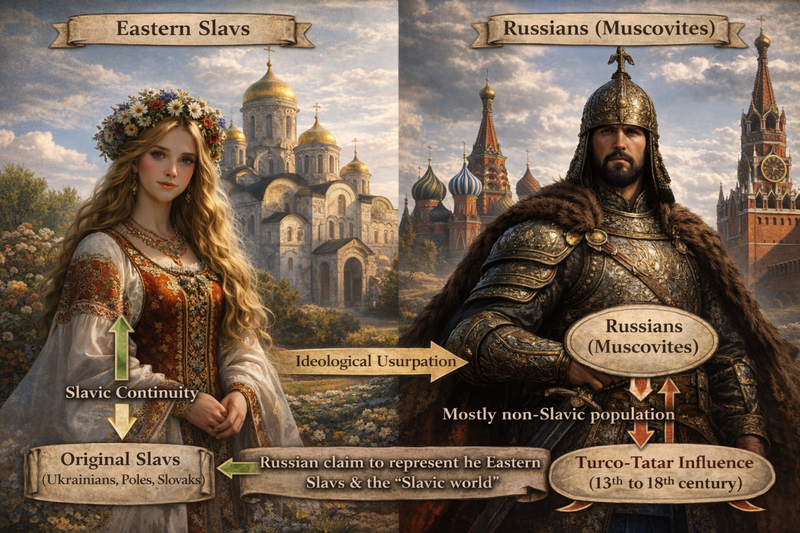
Exhibit : Responses to Anticipated Objections
Objection 1: “Russians speak a Slavic language; therefore, they are a Slavic people.”
- Response: Linguistic adoption is not equivalent to ethno-historical continuity. Church Slavonic and administrative practices drove Slavicization without implying majority Slavic ancestry.
Objection 2: “Muscovy is the direct heir of Kievan Rus’.”
- Response: While Muscovy appropriated the symbols and name of Rus’, its population, geography, and political structures differ significantly; Ukrainians (and to a lesser extent Belarusians) show stronger continuity.
Objection 3: “Finno-Ugric populations were fully assimilated.”
- Response: Assimilation does not erase historical demographics. Substrata shaped social and political structures, remaining relevant in ethno-historical analysis.
Objection 4: “Tatars played only a marginal role.”
- Response: The Golden Horde influenced administration and elite formation; ~33% of the nobility had Tatar origins (Pipes, Kappeler).
Objection 5: “All peoples are mixed; Russia is no exception.”
- Response: Comparative data show that Russia’s non-Slavic substrata are proportionally higher, making it atypical among Slavs.
Objection 6: “This analysis is ideological and anti-Russian.”
- Response: The article applies comparative criteria consistently, without value judgments; accusations of bias reflect rhetorical strategy, not scholarship.
Objection 7: “Russians self-identify as Slavs.”
- Response: Contemporary self-identification does not establish historical continuity; identities are constructed and often retrospective.
Conclusion:
None of these objections undermines the main finding: Russia does not exhibit the same Slavic ethno-historical continuity as other Eastern Slavs, and its claim to represent the Slavic world is an ideological construction.

 Bernard Grua - No Shtandart In Europe
Un avis sur « Are Russians a Slavic People? »